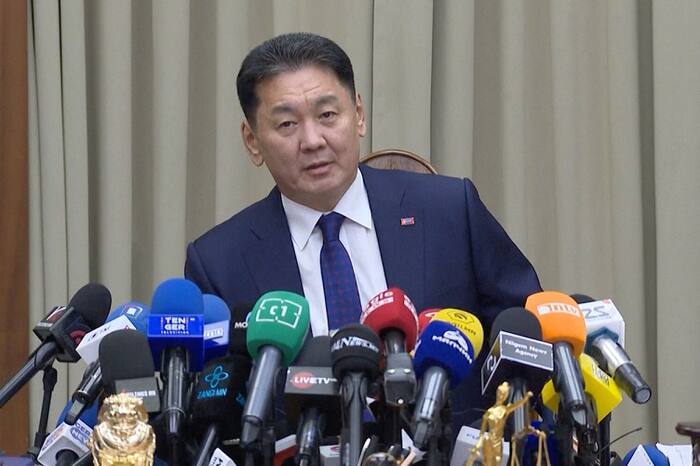
When Mongolia’s president announces an intention to step down amid escalating corruption accusations, the immediate headlines treat it like a straightforward moral reckoning. The reality in Ulaanbaatar is far more calculated. A president facing graft allegations in a resource-dependent democracy rarely exits solely out of sudden contrition; such a departure is almost always the final move in a high-stakes survival strategy designed to preempt parliamentary impeachment, preserve political immunity, or protect entrenched patronage networks before an incoming administration audits the state-owned mining ledger.
To understand why a sitting head of state would relinquish the highest office in the land, you have to stop looking at the podium and start looking at the ledger. Mongolia sits atop trillions of dollars in untapped copper, gold, and coking coal. For three decades following the country's peaceful transition away from Soviet-backed socialism in 1990, the central tension of Mongolian politics has not been ideological. It has been distributional. Who controls the off-take agreements? Who sits on the boards of the state-owned enterprises? And when public anger over inflation and graft boils over into the sub-zero streets of Sukhbaatar Square, who gets thrown overboard to save the ship? In similar developments, take a look at: The Quiet Assembly Lines of Novosibirsk and the Heavy Math of Modern War.
The Anatomy of a Step-Down in Ulaanbaatar
A resignation under pressure is never just an exit. It is a legal and political firewall.
Under Mongolia’s constitutional framework—which underwent significant revisions in 2019 to curb presidential overreach and strengthen the prime minister—the presidency remains a potent bully pulpit with veto power, judicial appointment influence, and command over the National Security Council. However, once a president loses the backing of the ruling party or faces unified opposition in the State Great Khural, the country's unicameral parliament, the office transforms from a shield into a target. USA Today has also covered this critical subject in extensive detail.
When corruption accusations reach critical mass, whether tied to illicit coal exports, questionable sovereign wealth fund allocations, or opaque licensing deals, a sitting president faces two starkly different paths. Fighting an impeachment battle drags every financial disclosure, family business tie, and offshore transaction into the public record through parliamentary hearings. Stepping down voluntarily, by contrast, allows a leader to negotiate the terms of their departure behind closed doors.
In comparative political analysis across emerging resource economies, negotiated exits frequently include unspoken guarantees. Prosecutors suddenly find their caseloads backed up. Investigations into mid-level deputies take precedence over inquiries into the former principal. By stepping down before a formal removal vote, the executive avoids the permanent constitutional disqualifications that come with impeachment and retains the status—and often the legal protections—afforded to former heads of state.
Why Resource Wealth Breeds Chronic Executive Instability
Mongolia’s political volatility is a textbook case of the resource curse, though local analysts despise the phrase because it makes human greed sound like an act of nature. There is nothing mystical about why executives fall in Ulaanbaatar. It comes down to price cycles and chokepoints.
Consider how capital flows through the Mongolian economy. The country is landlocked between two massive neighbors, Russia and China. Roughly ninety percent of Mongolia’s exports go south to China, predominantly raw minerals trucked or railed across border crossings like Gashuunsukhait. Because the infrastructure bottleneck is so narrow, control over export quotas, rail permits, and state-owned mining subsidiaries—most notably Erdenes Tavan Tolgoi, which manages one of the world’s largest untapped coking coal deposits—generates instantaneous, massive rents.
When global commodity prices surge, state revenues swell. Instead of diversifying the economy away from raw extraction, successive administrations have historically used windfalls to fund populist cash handouts ahead of election cycles while awarding lucrative infrastructure and transport contracts to politically connected conglomerates.
Then the cycle turns. Commodity prices dip, or border logistics stall. Foreign exchange reserves tighten, the local currency—the tugrik—depreciates, and imported goods become painfully expensive for ordinary herders and apartment dwellers in Ulaanbaatar. Suddenly, the public tolerance for elite enrichment evaporates.
The Street Protest Mechanism
Outside observers often misread the winter protests in Mongolia as spontaneous uprisings. While the public fury is entirely genuine—driven by brutal air pollution, stagnant wages, and visible inequality—the timing of major anti-corruption demonstrations frequently aligns with elite factional warfare.
In recent years, massive protests over missing coal revenues and inflated state procurement deals have repeatedly forced cabinet reshuffles and high-level resignations. When tens of thousands of citizens brave temperatures plunging to minus thirty degrees Celsius to demand accountability, rival political factions within the parliament seize the momentum. They weaponize the street anger to demand the head of the incumbent executive, positioning themselves as reformers while quietly consolidating control over the very ministries and state enterprises at the center of the scandal.
The Structural Flaws Behind the Headlines
Replacing a single president does not fix a broken procurement system. If you want to know whether this resignation represents genuine institutional reform or merely a changing of the guard, watch three specific structural pressure points over the next six months.
- Beneficial Ownership Transparency: For years, shell companies registered in jurisdictions from Hong Kong to the British Virgin Islands have obscured who actually profits from Mongolian mining subcontracts and off-take deals. Without strict enforcement requiring the public disclosure of ultimate beneficial owners for every firm doing business with the state, new faces simply take over old accounts.
- Judicial Independence: In Mongolia, the appointment and dismissal of judges and top anti-corruption prosecutors have historically been tangled up with executive and parliamentary politics. The Independent Authority Against Corruption (IAAC) possesses significant investigative mandate, yet critics have long pointed out that its high-profile prosecutions disproportionately target out-of-favor politicians while leaving sitting power brokers untouched.
- State-Owned Enterprise Governance: Until state-owned mining and energy companies operate with genuinely independent boards, international auditing standards, and transparent commodity auctions rather than closed-door off-take contracts, the presidency and prime ministership will remain prize vehicles for rent extraction.
What Happens to Foreign Investment During a Presidential Exit
Global mining executives and sovereign bondholders watch Ulaanbaatar with a mixture of fascination and fatigue. Whenever a president steps down under a cloud of corruption allegations, the immediate market reaction is a spike in perceived political risk.
International investors remember the bruising, multi-year disputes over the Oyu Tolgoi copper and gold project, where shifting political winds in Ulaanbaatar repeatedly stalled underground development and triggered fierce renegotiations over tax terms and debt structures. Political instability at the top slows down permitting, freezes ministerial sign-offs, and makes international lenders demand higher risk premiums.
Yet experienced emerging-market analysts draw a sharp distinction between chaotic regime collapse and constitutional turnover. Mongolia remains a functioning multiparty democracy—an anomaly in a region dominated by entrenched autocracies. The fact that public pressure and parliamentary pushback can force a sitting president to step down proves that democratic guardrails still carry weight, even when the underlying corruption is severe. For long-term investors, a messy, transparent reckoning is far preferable to the brittle silence of an authoritarian state where graft is simply buried until the entire system fractures.
The Geopolitical Tightrope No President Can Escape
Any leader occupying the State Palace in Ulaanbaatar operates inside a geopolitical vise that magnifies domestic vulnerabilities. Squeezed between Beijing and Moscow, Mongolia relies on what it calls its Third Neighbor Policy—cultivating diplomatic, security, and economic ties with the United States, Japan, South Korea, and the European Union to balance its two giant neighbors.
When a domestic corruption crisis engulfs the presidency, foreign policy leverage weakens immediately. A weakened executive negotiating transit tariffs with Russia or long-term coal supply agreements with China holds a terrible hand. Domestic opponents frequently weaponize geopolitics during corruption scandals, accusing rivals of selling out national sovereignty to foreign mining interests or neighboring powers in exchange for personal enrichment.
Take a hypothetical example of how this plays out in practice. Imagine a senior executive approves a long-term infrastructure rail link routed to favor a specific cross-border buyer without open competitive bidding. When leaked documents reveal that logistics firms tied to the executive's associates hold exclusive freight forwarding rights on that line, the scandal instantly morphs from a standard embezzlement story into an accusation of treasonous sellout. At that point, no amount of public relations spin can save the presidency. The nationalist backlash forces even loyal party members to distance themselves to survive the next parliamentary election.
The Verdict on Accountability
Western commentators love a clean narrative arc where bad actors get caught, resign in disgrace, and usher in an era of pristine governance. Decades of covering political transitions across Central and East Asia teach a very different lesson.
A presidential resignation over corruption accusations is a symptom of systemic friction, not a cure. It signals that the informal rules governing how political elites divide resource rents have temporarily broken down—either because someone grew too greedy, or because economic conditions deteriorated to the point where the public refused to look the other way.
True accountability in Ulaanbaatar will not be measured by the speech a departing president gives on television, nor by the promises of the politician waiting to take the oath of office. It will be measured in the unglamorous, line-by-line forensic audits of state mining contracts that follow—and whether the prosecutors who open those files are allowed to finish reading them.


