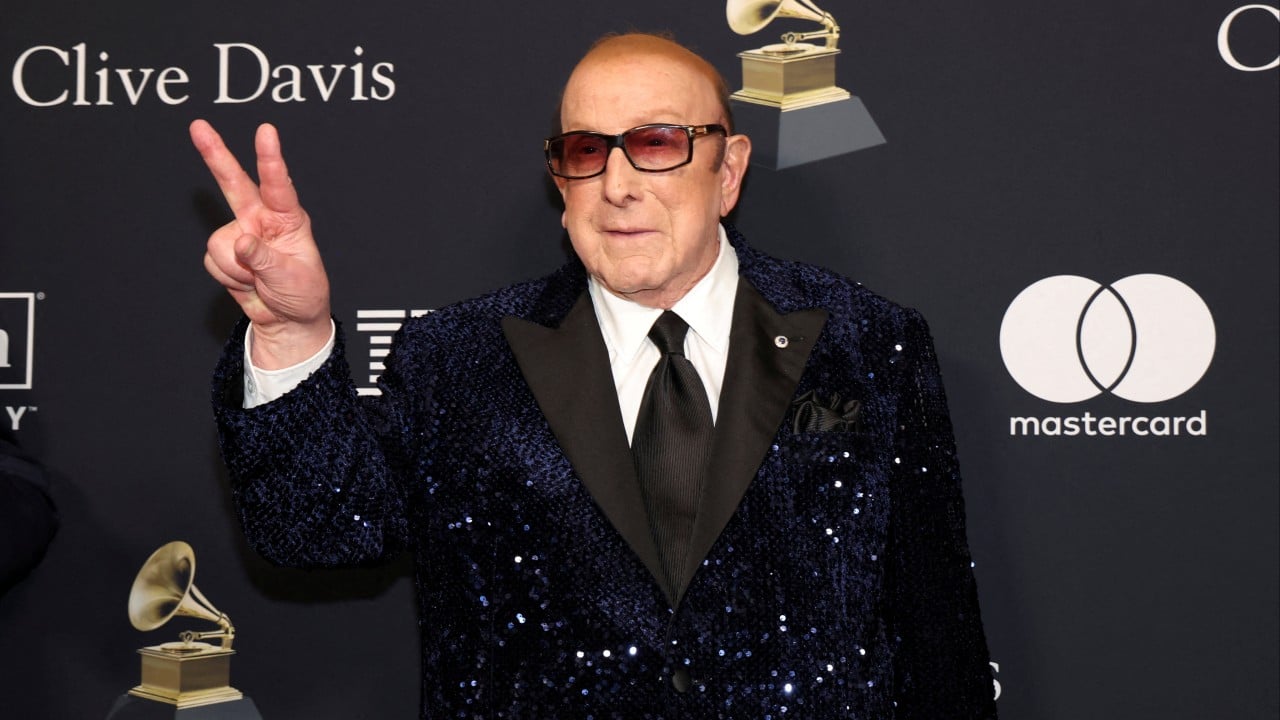
Clive Davis, the definitive architect of modern American corporate music, has died at his home in Manhattan at the age of 94. His passing on June 22, 2026, marks the final expiration of the traditional star-making apparatus that dominated global culture for half a century. While standard industry tributes paint a portrait of a pure ear with an uncanny knack for picking hits, the actual machinery Davis built was far more calculated, aggressive, and unsentimental than the nostalgic eulogies suggest. He did not merely discover talent; he manufactured a commercial template that bound artistic identity to corporate balance sheets.
The standard industry obituary focuses on the glitz. They talk about the pre-Grammy parties, the discovery of Whitney Houston, and the resurrection of Carlos Santana. But focusing exclusively on the discoveries misses the institutional mechanics that made Davis the most formidable executive of his time. He was, first and foremost, a Harvard-trained lawyer who entered the business through the legal department of Columbia Records. He looked at art through the cold lens of contracts, distribution, and top-down management. For another look, see: this related article.
The Invention of the Corporate Starmaker
Before Davis took over Columbia Records in 1967, the music business operated largely on localized intuition and independent hustle. Record men were often fast-talking promoters or eccentric studio engineers. Davis changed that by formalizing the corporate executive as the ultimate arbiter of taste. He recognized that rock, pop, and R&B were no longer counterculture movements or niche genres. They were multi-billion-dollar commodities.
His early tenure at Columbia established the blueprint. When he witnessed Janis Joplin perform at the Monterey Pop Festival, he saw more than raw emotion. He saw an explosive, untamed market opportunity. He moved quickly to sign her, using the financial weight of Columbia to outbid smaller, independent labels. This set off an era of aggressive consolidation. The independent operations that used to nurture regional talent were systematically starved or bought out. Similar analysis on the subject has been shared by Rolling Stone.
Davis brought a rigorous corporate discipline to a chaotic creative field. He instituted strict oversight over track selection, single choices, and artist imaging. If a songwriter wanted to release a self-penned album, they had to prove it could sell a million copies. If not, Davis would hand them a track written by professional hit-makers like Diane Warren. This approach guaranteed commercial returns, but it fundamentally altered the power dynamic between artists and corporations.
The Architecture of Creative Control
The signature achievement of the Davis methodology was Arista Records, the label he founded in 1974 after his abrupt and scandalous ousting from Columbia. Arista was not designed to be an artistic collective. It was engineered as a hit machine.
The ultimate manifestation of this vision was Whitney Houston. Discovered by Davis in a New York nightclub when she was a teenager, Houston possessed a once-in-a-generation vocal instrument. Under the traditional model, an artist with that raw capability might have explored experimental jazz, gospel, or traditional R&B. Davis had other plans. He curated every second of her early career, matching her with slick, cross-format pop production designed to appeal to the widest possible demographic.
It worked spectacularly. Houston became one of the best-selling artists in history, but the cost of that success was an uncompromising level of executive control. Davis held the final say on everything from her wardrobe to her tracklist. This arrangement created global icons, but it also established a grueling environment where commercial viability was the sole metric of human worth. The tragic trajectory of Houston’s later life cannot be uncoupled from the relentless demands of the corporate machinery that shaped her.
The Myth of the Golden Ear
For decades, the industry propagated the myth that Davis possessed a supernatural ability to hear a hit. He cultivated this image himself, frequently appearing on television and writing memoirs that positioned him as a solitary musical visionary. The reality is far more clinical.
Davis relied on a massive infrastructure of data, radio programmers, and industry gatekeepers. His genius lay not in an innate musical sense, but in his deep understanding of distribution channels and mainstream psychology. He knew that if you paired an exceptionally talented vocalist with an undeniable hook, and then used corporate leverage to force that song onto every major radio station in North America, the public would buy it. It was a self-fulfilling prophecy masquerading as artistic discovery.
Consider his engineering of Carlos Santana’s late-career comeback with the album Supernatural in 1999. Santana had spent years releasing experimental, instrumental-heavy music that alienated top-40 radio. Davis stepped in and forced a calculated formula. He paired the veteran guitarist with contemporary pop stars like Rob Thomas and Lauryn Hill. The album went fifteen-times platinum and swept the Grammys. It was a massive financial triumph, but it was also a triumph of marketing over organic artistic evolution. The music was designed by a committee to meet a specific retail demand.
The Systematic Exploitation of Black Music
One of the most complex chapters of Davis’s career is his relationship with Black American music. Tributes often praise him as a champion of Black artists, pointing to his work with Aretha Franklin, Luther Vandross, and his backing of Sean "Diddy" Combs’s Bad Boy Records. A more critical analysis reveals a dynamic that looks less like altruism and more like highly profitable exploitation.
Davis understood early on that Black music drove American culture, but he also knew that the executive suites controlling the money remained overwhelmingly white. By positioning himself as the gatekeeper who could "cross over" Black artists into white mainstream pop markets, he secured immense leverage. Crossing over typically meant stripping away regional authenticity and polishing the rough edges to make the music palatable to suburban consumers.
When Arista backed Bad Boy Records in the 1990s, Davis provided the capital that allowed Notorious B.I.G. and Puff Daddy to dominate the charts. The partnership generated hundreds of millions of dollars. Yet, while the artists faced the physical dangers and societal backlashes associated with the era's hip-hop culture, the corporate executive sat safely in his Manhattan office, insulated from the fallout while collecting the lion's share of the profits.
The Legal Mind in the Creative Space
To understand why Davis survived for so long when his contemporaries faded, one must return to his legal origins. He understood contracts better than the managers representing the talent. He knew how to structure deals where the label retained ownership of the master recordings in perpetuity, ensuring a lifetime of passive income for the corporation long after the artist had fallen off the charts.
He was notoriously ruthless when deals turned sour. When Kelly Clarkson resisted his choice of songs for her third album, wanting instead to write her own material, the dispute spilled into the public eye. Davis used his media influence to portray the young artist as ungrateful and naive. Clarkson eventually capitulated to parts of his vision, but the public clash exposed the raw, punitive nature of the corporate starmaker model. If you did not play by the rules of the house, the house would crush you.
The Institutional Void
With Davis gone at 94, the music industry finds itself without its chief engineer. The system he spent his life perfecting is already in ruins, dismantled not by rebellious artists, but by the internet and decentralized distribution models.
Today, algorithms have replaced the executive ear. Platforms like TikTok dictate hits based on user engagement metrics rather than executive decrees from a corner office in Midtown. The centralized power that Davis wielded so effectively has evaporated. No single executive can launch an artist to global stardom through sheer force of will anymore.
This shift has democratized the industry, allowing artists to bypass traditional gatekeepers entirely. But it has also left a fragmented culture. Without centralized figures like Davis to manufacture massive, monocultural moments, music has become highly tribalized. We no longer have shared musical experiences on the scale of Whitney Houston’s peak years.
The passing of Clive Davis is not just the death of a man; it is the death of an era where a single corporate executive could shape the sonic environment of an entire nation. He left behind a vast catalog of timeless music, but he also left a legacy of institutional control that prioritized the bottom line over artistic autonomy. The machinery he built may be gone, but the scars it left on the American creative psyche remain completely visible.