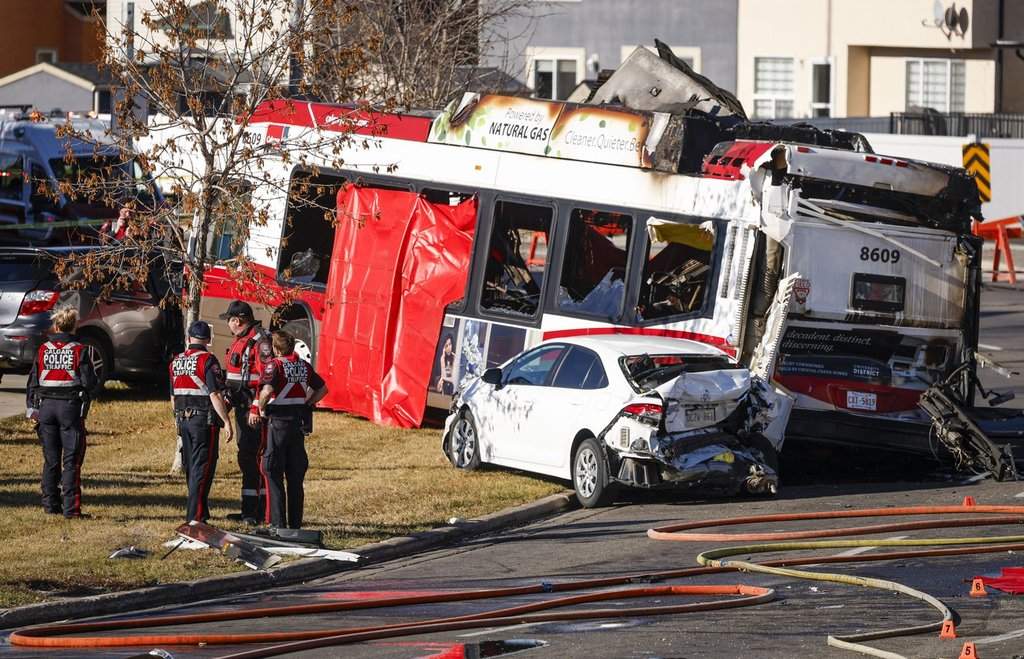
Three passengers died and 16 people were injured during the October 15, 2026 Calgary bus crash near Saddletowne Circle and 80 Avenue NE after a multi-vehicle collision ignited compressed natural gas tanks on a transit bus. Investigators have not yet confirmed whether speed, distraction, impairment, mechanical failure, or fuel-system damage triggered the chain reaction. Yet the real story reaches well past a single afternoon in northeast Calgary. When a routine urban bus ride turns into an explosion inside a passenger cabin, officials face an uncomfortable question about how transit agencies balance emissions targets against real-world crash physics.
Police say the pileup began when a bus collided with other vehicles and struck the rear of a second Calgary Transit bus powered by compressed natural gas, or CNG. Natural gas tanks on that second bus ignited, flames escalated rapidly, an explosion occurred inside the vehicle, and the bus hit a sedan before coming to a stop. Three passengers on the second bus lost their lives. One bus driver suffered life-altering injuries, another bus driver escaped, a police officer was hurt after rushing onto the burning bus to help a child, and 16 people overall sustained injuries across the scene.
Breaking news reports treat the fire as an isolated shock. Anyone who has covered public transit crashes for decades knows better. Catastrophic fires on mass transit vehicles rarely come down to one single defect. They usually happen when several ordinary assumptions fail at the exact same moment.
What Actually Happens When Natural Gas Ignites on a Bus
High-pressure fuel storage changes the math of a crash. Compressed natural gas sits inside heavy cylinders under immense pressure, typically routed with lines and valves connecting roof-mounted or chassis-mounted storage to the engine bay. Engineering specialists point out that certified CNG cylinders undergo tough qualification tests—including drop, puncture, and gunfire testing—and are built to vent safely under controlled thermal conditions rather than detonate like a movie prop.
On paper, those safeguards look reassuring. Out on a congested arterial road, real-world forces do not always follow test-bench geometry.
A transit crash should not end with passengers dying inside a burning cabin. When a fire moves from outside structure into the passenger compartment within seconds, evacuation time shrinks almost to zero.
A mechanical or collision chain can create hazards that laboratory tests never replicate cleanly. If an impact shears a high-pressure fuel line, damages a pressure regulator, or compromises shielding near an ignition source, escaping gas can feed an intense fire right where people are trying to get out. Unlike liquid diesel, which is relatively hard to ignite at ambient temperatures and tends to pool rather than flash rapidly, pressurized methane gas mixes quickly with air and burns fiercely once ignited.
None of that proves a manufacturing flaw in the Nova Bus fleet operated by Calgary Transit. Bus maker Nova Bus has stated it is cooperating with Calgary Transit and investigators while cautioning against premature speculation before the probe concludes. Still, claiming CNG is automatically safer than diesel in every crash scenario oversimplifies a complex engineering trade-off.
| Factor | Compressed Natural Gas (CNG) Buses | Traditional Diesel Transit Buses | Investigative Question in Calgary |
|---|---|---|---|
| Fuel Storage | High-pressure cylinders with lines and valves | Lower-pressure liquid fuel tank | Did impact or debris breach fuel lines or fittings? |
| Fire Behavior | Rapidly ignites if leaked near heat or sparks | Harder to ignite; slower initial spread | How did exterior roof flames enter the cabin so fast? |
| Emissions Profile | Lower tailpipe emissions than older diesel | Higher particulate and nitrogen oxide output | Are climate fleet targets outpacing crash-fire audits? |
| Emergency Response | Requires gas shutoff awareness and hazmat care | Familiar liquid-fuel suppression routines | How well do street-level layouts support rapid rescue? |
The Blind Spot Around Fleet Transition and Street Design
Watch city councils across North America and you see the same playbook every budget cycle. Transit agencies face pressure to cut greenhouse gases and air pollution, so they order hundreds of alternative-fuel buses—whether compressed natural gas or battery-electric—and celebrate lower tailpipe emissions in press releases. Calgary has operated CNG buses since 2014, with natural gas making up roughly a fifth of its fleet and plans to add more units to retire older diesel coaches.
What gets far less scrutiny is the operational environment around those buses. Ward 5 Councillor Raj Dhaliwal called for a broader look that goes beyond the collision itself to examine the design of Saddletowne Circle and whether the nearby bus terminal is strained by capacity. Ward 14 Councillor Landon Johnston likewise questioned alternative-fuel buses and whether an independent review would clarify risks tied to climate-driven fleet shifts.
Crowded terminals and busy suburban circles create constant friction. Buses weave near private cars, trucks, pedestrians, and riders rushing to make connections. Even a minor misjudgment in traffic—a moment of distraction, a misread gap, or a sudden stop—can cascade across multiple vehicles when heavy transit buses are involved.
There is also a counter-argument worth taking seriously. Replacing aging diesel buses reduces harmful exhaust emissions along neighborhood corridors, and transit agencies in cities such as Vancouver, Victoria, and Hamilton also run CNG buses without routine explosions. Writing off an entire fuel technology over one tragic crash would be knee-jerk policy. Yet pretending a high-energy fuel system carries zero special crash vulnerability is just as reckless.
Why Slow Investigations Frustrate Riders and Crews
Police in Calgary have been methodical about what they will—and will not—say while evidence is still being reconstructed. Investigators have noted that speed, distraction, and impairment all remain under review, and they have appealed to passengers who left the scene to come forward with witness accounts. Transit union leadership has pushed for answers quickly so drivers and riders can feel confident stepping aboard.
That tension is built into major crash investigations. A thorough reconstruction takes weeks or months because investigators have to trace vehicle trajectories, inspect damaged fuel and electrical components, review video, and interview witnesses without jumping to neat conclusions.
Consider a hypothetical scenario during a multi-vehicle impact. Suppose a bus strikes a rear corner at an angle that crushes a protective fairing, while a secondary impact shifts a line or valve right as hot exhaust or electrical arcing occurs. A casual observer sees a sudden fireball and blames the fuel tank. A careful engineer has to check whether a valve failed, a line tore, or a thermal release device activated—and why fire spread inside the cabin so rapidly.
Public trust erodes when officials speak in vague platitudes while waiting for lab reports. Riders do not need instant guesswork. They need straight talk about what inspectors are testing, what interim checks are happening on active buses, and whether a third-party review will examine road layout alongside vehicle hardware.
What Must Happen Before the Next Commute
Emergency responders have already started adjusting to the reality of high-consequence bus fires; firefighters in Langford, British Columbia, announced plans to incorporate CNG bus explosion response drills into training following the Calgary tragedy. Training drills help crews on the ground, but prevention starts earlier.
Transit systems and municipal planners can act on four concrete fronts right now:
- Audit high-risk corridors and terminals: Re-evaluate traffic flow, sightlines, merge points, and terminal congestion around busy hubs like Saddletowne Circle to reduce multi-vehicle conflict zones.
- Publish transparent component findings: Once mechanical inspections conclude, share plain-language findings on fuel lines, valves, shielding, and cabin fire spread rather than burying technical details.
- Standardize emergency training across agencies: Pair transit operators and local fire departments on fuel shutoffs, evacuation bottlenecks, and high-heat gas fires.
- Fund independent safety reviews: Pair police and fire probes with outside engineering and operations experts so neither city staff nor manufacturers grade their own homework.
Clean air and modern transit matter deeply to growing cities. They mean very little if a single collision can turn a public bus into a trap for the people paying to ride it.