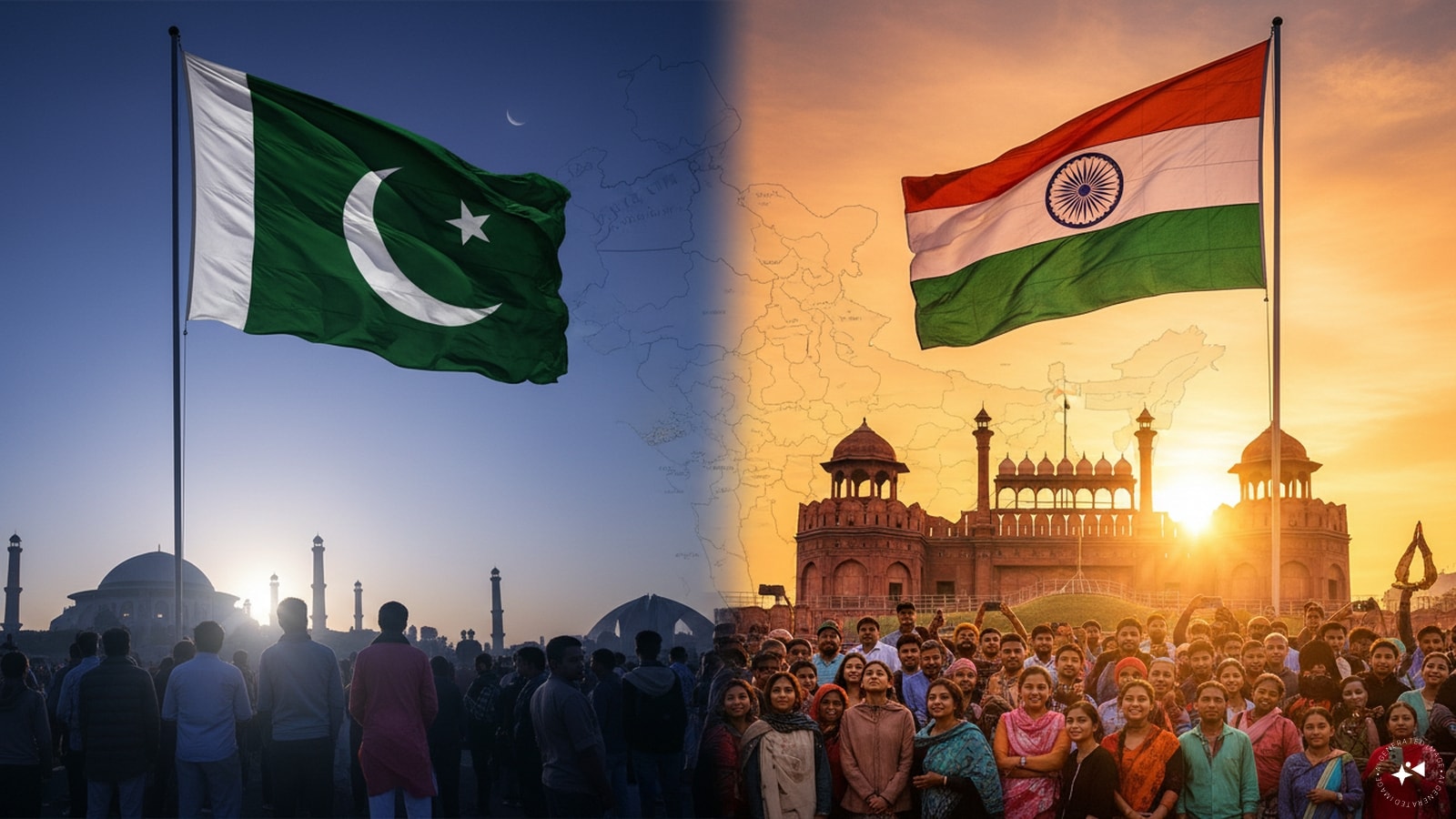
Geography shares a border, but history splits a clock. Millions of people get confused every single August because India celebrates its freedom on the 15th while Pakistan marks the occasion on the 14th. You might assume it's just a quirk of time zones. It's not. It comes down to a rushed administrative handoff, a midnight radio broadcast, and the chaotic logistics of breaking up an empire.
Lord Mountbatten, the last British Viceroy of British India, had a massive scheduling problem. He was tasked with overseeing the transfer of power for two brand-new nations, but he wanted to be personally present in both New Delhi and Karachi for the official ceremonies. Since he couldn't physically split himself in two, he chose to stagger the dates.
The Midnight Transfer of Power
Sir Cyril Radcliffe drew the boundaries on a map weeks before anyone actually saw them. The Radcliffe Line partitioned Punjab and Bengal, sealing the fate of millions who didn't even know which country they'd wake up in. Once the borders were set, the timeline accelerated rapidly.
British authorities decided the formal transfer of power should happen at midnight between August 14 and August 15. In astronomy and astrology, midnight marks the shift to a new day. In British parliamentary tradition, August 15 was the official date the Indian Independence Act took effect.
Pakistan decided to mark August 14 as its official Independence Day. Radio Pakistan broadcasted the news right at midnight, signaling the birth of the new state. Muhammad Ali Jinnah, the founding father of Pakistan, took his oath of office on August 14 in Karachi.
Meanwhile, Jawaharlal Nehru delivered his iconic "Tryst with Destiny" speech in New Delhi as the clock struck midnight, pushing India's official celebration into the early hours of August 15.
Why the Date Stuck
Tradition hardens quickly. Pakistan adopted August 14 because its constituent assembly met and power was transferred on that date in local time broadcasts, and early radio logs locked it in. India embraced August 15 because the British legislation dictated that specific calendar day for the legal birth of the dominion.
Both nations deal with the massive human cost of that split every single year. The boundary commission's hasty work triggered one of the largest mass migrations in human history. Over fourteen million people crossed the newly drawn borders. Violence flared up across Punjab and Bengal. Families got separated overnight. Towns that had lived together for centuries found themselves on opposing sides of a barbed-wire frontier.
When you look at the calendar today, the date difference looks minor. To the millions who lived through the partition, those twenty-four hours represent the exact moment an empire fractured.
If you want to understand how modern South Asia was shaped, look past the date discrepancy and study the documents left behind by the boundary force. Check out the archives at the Nehru Memorial Museum and Library in New Delhi or the National Archives of Pakistan in Islamabad to read the original transfer papers. History isn't just about when a flag goes up. It's about the paperwork and the panic that put it there.