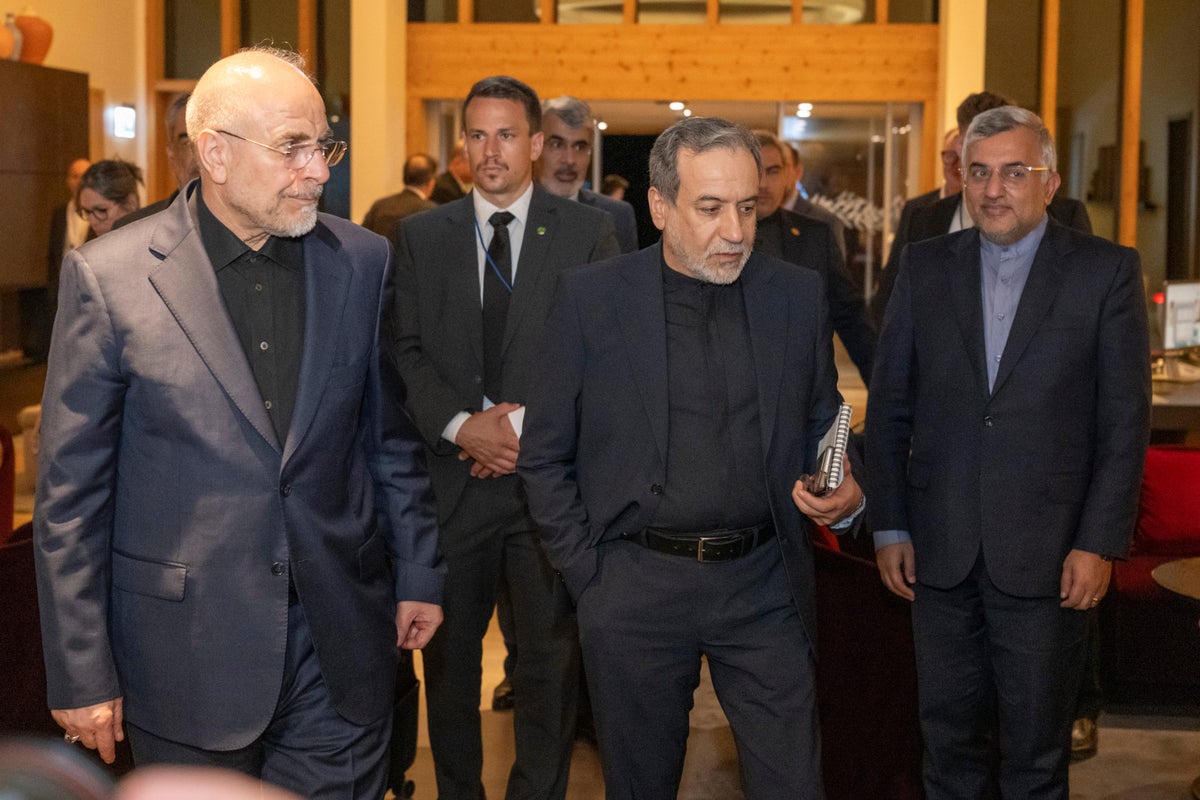
U.S. Vice President JD Vance arrived at the Bürgenstock resort near Lucerne, Switzerland, on Sunday to rescue a fragile interim deal with Iran that is already fracturing before the ink can dry. Ostensibly designed to hammer out technical details of a 60-day freeze to end a 100-day war, these high-stakes negotiations are facing immediate peril as Tehran threatens to shut down the Strait of Hormuz in response to ongoing Israeli military actions in Lebanon. Washington is discovering that signing a memorandum of understanding is vastly different from controlling the realities on the ground.
The Flaw in the Foundation
The luxury resort overlooking Lake Lucerne was supposed to provide a serene backdrop for the hard business of international diplomacy. Instead, the atmosphere is thick with mutual suspicion and strategic blackmail. When President Donald Trump signed the initial memorandum of understanding at the Palace of Versailles last week, the administration projected an image of rapid, decisive victory. The framework promised a path to regional stabilization, the unfreezing of billions in Iranian assets, and an end to a maritime conflict that has pushed global oil markets to the brink of panic.
That projection has hit a wall. The core problem with the Versailles framework is its structural asymmetry. The United States signed an agreement that binds its own behavior and promises specific concessions, yet the execution relies heavily on actors who are not even in the room.
Israel is not a signatory to the Bürgenstock talks. Neither is Hezbollah. Yet the very first clause of the memorandum demands a comprehensive halt to military operations on all fronts, including southern Lebanon. When Israeli airstrikes continued over the weekend, the political consensus in Tehran disintegrated. The Iranian delegation, led by parliament speaker Mohammad Bagher Ghalibaf and Foreign Minister Abbas Araghchi, initially threatened to boycott the Swiss summit entirely. It took a frantic, last-minute intervention by Pakistani and Qatari mediators to get the Iranians onto their planes.
The diplomatic friction highlights a deep systemic failure. Washington has leveraged its diplomatic credibility on an agreement where its primary ally, Jerusalem, feels no obligation to comply. Prime Minister Benjamin Netanyahu’s government views the conflict through an existential lens that does not align with Washington's desire for a quick economic fix to lower domestic energy prices. By making a Lebanon ceasefire the centerpiece of the Swiss negotiations, the White House has handed Tehran a permanent pretext for non-compliance.
The Weaponization of the Strait
Hours before the delegations landed in Switzerland, Iran’s central military command announced it was reinstating its blockade of the Strait of Hormuz. It was a calculated display of leverage. While U.S. Central Command quicky issued statements insisting that merchant vessels were still moving through the waterway, the psychological damage to global markets was already done.
The Strait of Hormuz is the ultimate economic choke point. Approximately 20 percent of the world’s petroleum passes through this narrow body of water. The Trump administration recently warned that global reserves of refined oil could face critical depletion within weeks if maritime transit remains restricted. For the White House, reopening the strait without paying a political premium is the primary objective of this entire foreign policy push. For Iran, keeping the strait under a shadow of perpetual threat is the only way to ensure the U.S. delivers on its promises.
Consider the economic mechanics at play during these technical sessions. The Iranian delegation did not just bring diplomats; they brought the governor of their central bank and the deputy oil minister. They want immediate, verifiable sanctions relief. They want specific waivers that allow them to sell oil directly into international markets without facing secondary sanctions. More importantly, they are demanding the immediate liquidation of frozen funds held in overseas accounts.
The U.S. team, which includes special envoys Steve Witkoff and Jared Kushner, is trying to build a sequenced timeline. Their strategy is to offer partial asset releases in exchange for verifiable steps toward winding down Iran’s nuclear enrichment. But the Iranians know that once they surrender their leverage—whether by diluting their enriched uranium stockpile or permanently lowering the threat level in the strait—their bargaining power disappears.
The Fractured Consensus in Tehran
To understand why these negotiations are so volatile, one must look past the public statements of the negotiators and examine the internal political war occurring inside Iran. The delegation in Switzerland represents a deeply divided regime that is fighting for its own survival.
President Masoud Pezeshkian has staked his limited political capital on achieving economic relief through these talks. The Iranian economy is buckling under inflation and the structural destruction caused by the military strikes of the past year. Pezeshkian needs a deal to maintain domestic order. Over the weekend, he publicly reasserted that Iran would never abandon its right to enrich uranium, a statement designed to protect his flank from domestic hardliners who view any negotiation with Washington as a betrayal.
The real authority, however, lies elsewhere. Supreme Leader Ali Khamenei recently permitted the talks to proceed only under strict conditions. In a communication regarding the initial diplomatic contacts, Khamenei expressed deep skepticism, noting that the outcomes achieved in preliminary rounds deviated significantly from the prerequisites required for legitimate negotiations. The powerful Revolutionary Guards are actively looking for reasons to scuttle the process. Their declaration of a renewed blockade on the strait, issued just as the diplomatic corps arrived in Lucerne, was a direct shot across the bow of their own civilian government.
The American negotiating team is dealing with a dual entity. The men sitting across the table at Bürgenstock may agree to a technical provision, but they do not command the forces operating the anti-ship missiles along the Iranian coast. This disconnect makes any progress achieved in the conference rooms highly conditional.
The Pakistani Mediation Mechanism
A major oversight in mainstream coverage of the Swiss summit is the role played by third-party intermediaries. This is not a direct, bilateral discussion. The structure of the talks relies on a complex mediation framework managed primarily by Pakistan and Qatar.
On Sunday morning, Vice President Vance’s first meeting was not with an Iranian official. He sat down with Pakistani Prime Minister Shehbaz Sharif and Army Chief General Asim Munir. Pakistan has quieted its own domestic crises to serve as the critical bridge between Washington and Tehran throughout this conflict. It was Pakistan’s interior minister, Mohsin Naqvi, who traveled to Tehran days ago to salvage the summit after the Iranians threatened to pull out.
The involvement of Pakistan's top military leadership underscores the transactional nature of these talks. Islamabad is not participating out of pure diplomatic altruism. The conflict has destabilized regional trade and heightened security risks along Pakistan’s western border. Furthermore, managing this channel gives Islamabad significant diplomatic leverage of its own with the White House.
The Qatari mediators are focusing on the financial architecture. If a deal is reached, Qatar will likely serve as the repository for the unfrozen Iranian funds, holding them in restricted accounts that can only be accessed for specific, approved transactions. This setup is intended to reassure domestic critics in the United States who argue that the administration is preparing to hand a cash windfall to a hostile regime.
The Nuclear Reality
Behind the immediate crisis in Lebanon and the shipping lanes lies the unresolved problem of Iran’s advanced nuclear program. The standard for these negotiations cannot be compared to previous diplomatic efforts. The strategic environment has fundamentally altered.
During the military exchanges of the past year, several of Iran's primary nuclear installations suffered significant structural damage from high-yield ordnance. This damage did not halt the program; instead, it drove it deeper underground and accelerated the enrichment process. International Atomic Energy Agency Chief Rafael Grossi is currently on the sidelines of the Bürgenstock summit, conferring with Swiss Foreign Minister Ignazio Cassis to determine how international inspectors can verify any agreement reached by the political teams.
The technical scale of the problem is unprecedented. Iran has accumulated a stockpile of enriched uranium exceeding 9,000 kilograms. Within that total, approximately 440 kilograms are enriched to levels hovering near weapons-grade capability.
The American objective is clear: the administration wants that high-enrichment material removed from Iranian territory or completely diluted under strict international supervision. The current memorandum sets out a baseline requirement for on-site dilution, but the technical mechanisms to execute this do not exist on the ground. Iran’s negotiators are treating the nuclear stockpile as their ultimate insurance policy. They will not dismantle the centrifuges that survived the bombardment unless they receive structural, permanent guarantees that the United States cannot simply reinstate sanctions during a future political transition.
The Limits of Personal Diplomacy
The decision to send Vice President Vance to Switzerland underscores the political high-wire act the White House is performing. Vance is scheduled to remain at the resort for only 48 hours before handing the day-to-day management of the technical files over to Witkoff and Kushner. This brief window is a calculated risk.
By deploying the vice president, the administration is attempting to project maximum political commitment. It is an effort to convince both the Iranian leadership and international energy markets that the White House is prepared to enforce the terms of the deal. However, this high profile also means that any public failure at Bürgenstock will land squarely on the administration's doorstep, creating an opening for domestic political opponents who view the negotiations as an act of weakness.
The presence of Jared Kushner in the delegation is equally telling. Kushner’s involvement indicates that the administration is trying to run a parallel track that connects these talks back to the broader regional architecture established during the first Trump administration. The underlying theory is that economic integration and regional security arrangements can provide the structural framework necessary to hold a deal together. But that framework was built on the explicit exclusion of Iran. Attempting to retroactively insert Tehran into a regional system designed to contain it is an exercise in geopolitical contradiction.
The immediate challenge for the next 24 hours is not the long-term future of the nuclear program. It is the creation of a rudimentary observation mechanism in Lebanon. Diplomats briefed on the initial sessions indicate that mediators are trying to establish a joint technical committee to monitor ceasefire violations along the Blue Line. The fundamental hurdle is that without the direct participation of the combatants who are pulling the triggers, any monitoring mechanism created in a Swiss resort will remain entirely theoretical.
The negotiators are working against a clock that is ticking in the oil markets, in the command bunkers of the Revolutionary Guards, and in the political backrooms of Washington. The Bürgenstock summit is not the beginning of a grand peace; it is a desperate stabilization effort by a superpower realizing that its diplomatic reach has exceeded its operational control.