We treat the wild like a living postcard. We view it through Gorilla Glass and windshields, assuming the borders we draw on maps are respected by the things that live inside them.
Carl Isom-McDaniel did everything right. He was not one of those viral "tourons" you see on social media, the ones who try to pet an elk or treat a mother bear like a photo opportunity. He was a sixty-five-year-old grandfather from Washington state taking an evening walk with his grandson through the Bridge Bay Campground in Yellowstone National Park.
They stood nearly a hundred yards away from a resting bull bison. That is the length of a football field. It is a distance the National Park Service deems safe.
But distance is a human concept. To a two-thousand-pound bull bison in the middle of the July mating rut, space is not measured in yards. It is measured in provocation.
The Weight of the Rut
To understand what happened next, you have to look past the standard park brochure warnings. July in Yellowstone is beautiful, but for the male bison, it is a period of chemical madness. This is the rut. The bulls are flooded with testosterone, their minds consumed by a single, desperate drive to prove dominance and secure a mate. They wallow in the dirt, roar like lions, and view the entire world as an adversary.
Mike MacLeod, a former Army combat photographer, was at the campground that Friday evening. He knew the signs of impending violence. He saw the bull enter the camping loop, agitated and aggressive, charging at a group of children who scattered just in time. The animal was looking for a fight. It even slammed its massive frame toward a passing white pickup truck, sending the driver speeding away in panic.
Then the bison sat down in the dust. It looked calm.
That was the trap.
Carl and his grandson, walking along the road, saw the animal. Like anyone would, they pulled out their phones to capture a memory of the magnificent beast from what they completely believed was a safe, respectful distance.
But the bison was already primed. The rumble of the pickup truck, the screams of shouting campers, the lingering adrenaline of the rut—it all converged. The massive mammal rose from the dirt.
Carl recognized the shift instantly. "Okay, time to leave," he told his grandson. They moved quickly, ducking behind a cluster of nearby trees for cover.
They thought the trees would protect them. They were wrong.
Eight Feet of Air
A bison looks clumsy. It looks like a slow, shaggy relic of the Ice Age. This is a dangerous deception. A mature bull can sprint at thirty-five miles per hour. It can outrun a horse, scale a steep embankment with the agility of a goat, and change direction on a dime.
The bull tore into the timber. The grandson managed to break away, sprinting clear of the path of destruction. Carl was not as fast.
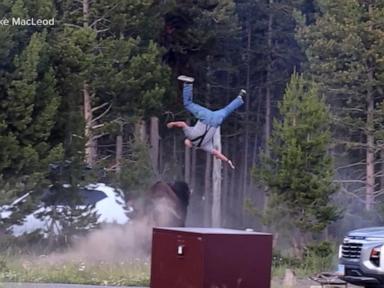
The animal closed the hundred-yard gap in seconds. It pursued Carl around the trunks of the trees, a two-thousand-pound wall of muscle and fury. Then came the impact. The bison hooked its left horn into Carl’s hip, using its massive neck muscles to launch the sixty-five-year-old man into the air.
He flipped completely upside down. MacLeod, watching through his camera lens, estimated Carl flew eight feet above the ground—higher than the six-foot-tall animal that threw him.
Time stretches during a trauma like that. There is the violent lift, the weightlessness of a human body suspended where it should never be, and then the inevitable, brutal reunion with the earth. Carl landed heavily on his side.
The bison stopped. It stood over the fallen man, shaking its massive head, deciding whether to finish the job.
The Instinct to Survive
This is where the story usually ends in the news briefs: Tourist injured, transported to hospital. But the human element does not stop when the ambulance arrives.
MacLeod did not just watch. His combat training overrode his instinct to film. He dropped his camera and ran directly toward the two-thousand-pound animal, shouting at the top of his lungs, trying to make himself look as large and intimidating as possible. Other campers joined him, forming a wall of human noise. The collective defiance worked; the bison turned and thundered away into the dusk.
What happened next reveals the true measure of a person. Carl lay in the dirt, his leg shattered, his body broken with multiple fractures. He was in agonizing pain. Yet, as the adrenaline surged and campers rushed to administer first aid, his first words were not about his leg or his hip.
He wanted to know if his grandson was safe.
Even later, as paramedics loaded him into the transport to face major surgery, witnesses noted Carl was cracking jokes with the medical staff. It was a coping mechanism, perhaps, but also a testament to a quiet resilience.
The Invisible Stakes
This was Yellowstone's second major bison encounter of the summer, following an incident where a twelve-year-old was injured near Mud Volcano. It serves as a stark reminder of a truth we often forget: nature does not operate on our schedule, nor does it care about our boundaries.
When we step into places like Yellowstone, we are stepping onto a stage where the actors are wild, unpredictable, and entirely indifferent to our safety guidelines. A hundred yards seems like an eternity until a two-thousand-pound animal decides to erase it.
Carl Isom-McDaniel survived the flight and the fall, but the recovery ahead is long, and as his family noted, he is not entirely out of the woods yet. The video of his flight will circulate online for years, a shocking piece of footage detached from the real human pain, the fractured bones, and the terrifying realization that the wild is never truly tamed.
The next time you stand on the edge of a meadow in the American West and watch a prehistoric giant graze against the sunset, look at the distance between you. Then cut that distance in half in your mind, and remember how fast a quiet evening can flip upside down.