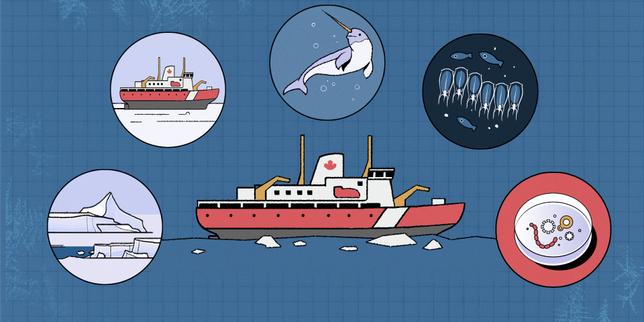
We tend to look at the Arctic as a vast, frozen wasteland. It's easy to dismiss it as an empty sheet of white ice doing nothing except melting too fast. That view is completely wrong.
Beneath that frozen crust lies a hyper-active, microscopic engine. Strange marine organisms are quietly shaping global weather patterns every single day. Four-week research voyages aboard heavy icebreakers give scientists a front-row seat to this hidden machinery. What researchers find trapped in the freezing water challenges everything we thought we knew about carbon capture and polar survival.
You won't hear about these organisms on the nightly news very often. Yet, understanding them is the key to predicting how our planet handles excess carbon. Let's look at what's actually happening beneath the ice pack.
The Invisible Workforce of the Polar Seas
Drop a sampling net through a three-meter crack in Arctic sea ice and you pull up a bizarre soup of life. It isn't just fish or familiar plankton. You find translucent, gelatinous creatures, single-celled algae with intricate glass shells, and bacteria that thrive in temperatures where your fingers would freeze solid in minutes.
These aren't random survivors. They are specialized architects.
Diatoms and specialized zooplankton form the base of an ecosystem that operates in total darkness for months at a time. When spring finally brings twenty-four-hour sunlight, these organisms explode in population. They feed on carbon dioxide dissolved in the water at rates that put temperate forests to shame.
Oceanographers onboard icebreaking research vessels measure these blooms constantly. The speed at which these tiny entities pull carbon out of the water column shocks first-time researchers. It's a high-stakes biological vacuum cleaner operating at the top of the world.
How Microscopic Life Sinks Carbon Deep
Pulling carbon into a living cell is only step one. The real magic happens when these organisms die or get eaten.
In normal oceans, dead organic matter floats or gets recycled near the surface. The Arctic behaves differently because of its sheer cold and deep vertical currents. When the microscopic algae finish their seasonal bloom, they clump together into dense flakes often called marine snow.
These flakes plunge straight down toward the abyssal plain. They drag trapped carbon with them, locking it away from the atmosphere for centuries.
Researchers working on polar icebreakers track this descent using automated sediment traps and high-definition underwater cameras. They watch millions of microscopic carbon parcels fall through the water column. If you disrupt this process by warming the surface water too fast, the entire pump stutters. The carbon stays near the surface, leaking back into the atmosphere and accelerating the very warming cycle we're trying to stop.
What Research Ships Actually Go Through
Life on an icebreaker isn't a comfortable cruise. It's a brutal, vibrating, twenty-four-hour-a-day endurance test against moving pack ice.
The hull groans continuously as the ship crushes through ridges three meters thick. You stand on the deck in heavy thermal gear while freezing winds strip the warmth from your face in seconds. Inside the labs, the air smells of wet wool, diesel exhaust, and cold seawater sloshing in plastic sampling tubs.
Marine biologists work in shifts that blur together. They extract DNA from water samples within minutes of collection to see which species are blooming. They measure salinity, light penetration, and nutrient levels while the ship rolls violently in open leads between ice floes.
This hands-on sampling proves that laboratory models are often too simple. Real Arctic biology is messy, adaptive, and surprisingly resilient. It relies on complex food webs where a single shift in water temperature can wipe out a keystone micro-species.
Why Climate Models Keep Missing the Microbes
Computer models predicting global temperature rises have historically treated the ocean as a chemical bathtub. They factor in temperature, salinity, and basic mixing. For a long time, they completely ignored the biological variable.
That omission is dangerous.
When you add living, breathing, mutating organisms into the climate equation, the math changes entirely. A sudden influx of freshwater from melting glaciers changes the density of the surface layer. That density shift stops the deep mixing that brings nutrients up to the micro-algae.
If the algae starve, the carbon pump shuts down.
Scientists gathering data on these month-long polar expeditions are feeding real biological parameters back into the models. The updated forecasts show that the Arctic climate system is even more sensitive to human disruption than older reports suggested. We cannot separate the ice melt from the biology living inside it.
Taking Action on Polar Data
You don't need to sail on a research vessel to care about what happens in the high north. The reality is that polar stability dictates weather patterns across North America, Europe, and Asia.
Support organizations funding independent polar research. Pay attention to how international policies handle Arctic shipping routes and commercial fishing expansions. Protecting these fragile microscopic habitats requires strict environmental guardrails that prevent industrial disruption in untouched polar zones.
The next time someone talks about the Arctic as just a melting block of ice, remind them of the invisible engine beneath the surface. Our climate future depends entirely on the tiny organisms working quietly in the dark.