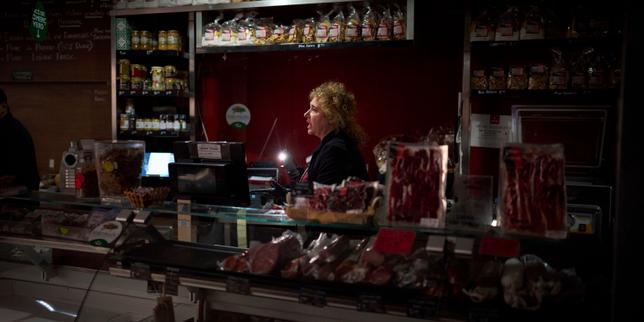
The lights did not just flicker across Madrid and Lisbon on that Tuesday in April 2025; they died with a finality that exposed the structural rot in the European supergrid. While early reports blamed a "perfect cocktail" of bad luck and weather, the reality is far more clinical and far more damning. The massive power failure that left 45 million people in the dark was the inevitable result of a high-stakes gamble on intermittent power sources and an aging transmission infrastructure that was never designed to handle the volatility of a post-carbon transition.
Spain and Portugal have long been touted as the "green battery" of Europe. On paper, the numbers looked spectacular. Leading up to the crash, renewable penetration in the Iberian Peninsula frequently topped 70%. But as any seasoned grid engineer will tell you, a high percentage of wind and solar is a double-edged sword. It provides cheap electrons when the sun shines and the breeze blows, but it strips the system of "inertia"—the physical momentum provided by the massive spinning turbines of coal, gas, and nuclear plants that keeps the grid frequency stable.
When a localized wildfire near the Pyrenees tripped a major 400kV interconnect line, the system should have balanced itself. It didn't. Instead, the lack of mechanical inertia caused a frequency dip so rapid that automated protection systems began shedding load across the entire peninsula to prevent a total hardware meltdown. Within ninety seconds, the Iberian Peninsula became an electrical island, severed from the rest of the European Continental Synchronous Area.
The Inertia Deficit
To understand why the grid collapsed, one must understand the physics of the "spinning mass." Traditional power plants use massive rotating generators. Because of their weight and speed, they don't stop spinning the moment a problem occurs. They provide a buffer, a few seconds of grace that allows grid operators to react.
Modern solar inverters and wind turbines are connected via power electronics. They are fast, but they are "follower" technologies. They do not naturally resist changes in frequency. When the Pyrenees line failed, the frequency didn't just sag; it plummeted. The "cocktail" mentioned by local officials—high temperatures, low hydro reserves, and a sudden drop in wind speeds—was merely the trigger. The underlying cause was a systemic vulnerability created by the aggressive retirement of "firm" baseload power without equivalent synchronous compensation.
The Interconnection Paradox
For decades, Brussels has pushed for better integration between the Iberian Peninsula and the rest of the European mainland. The goal was to allow Spanish solar to power German factories and French nuclear to back up Portuguese homes. However, this interconnectivity has created a paradox of dependency.
Spain currently operates with an interconnection capacity that is significantly below the European Union’s 10% target. This isolation is often called the "Iberian Island" effect. During the April crisis, this lack of capacity meant that when the peninsula needed an emergency injection of power from France to stabilize the frequency, the "pipes" were already full or, in the case of the wildfire-damaged lines, completely severed.
The irony is palpable. The very isolation that was supposed to be solved by the transition to a pan-European green grid made the region more susceptible to a cascading failure. We are building a 21st-century energy generation profile on a 20th-century transmission architecture. The physics of the wires cannot keep up with the politics of the transition.
The Hidden Cost of Storage Delays
We were told that batteries would save us. The narrative pushed by energy ministries in both Madrid and Lisbon centered on massive utility-scale storage projects that would soak up excess solar during the day and discharge it during the evening peak.
The April 2025 blackout proved that these projects are too few, too small, and too late. While lithium-ion installations have increased, they are primarily designed for short-duration balancing. They are not a replacement for the long-duration strategic reserves provided by gas or hydro. In April, the hydro reservoirs in the Douro and Tagus basins were at record lows following a dry winter. This removed the "traditional" battery of the peninsula—pumped hydro—from the equation precisely when the grid needed it most.
Without the ability to store vast quantities of energy for days rather than hours, the grid remains a victim of the weather. The "perfect cocktail" was really just a standard weather pattern that met a grid with no margin for error.
The Economic Aftermath
The blackout lasted for eighteen hours in some sectors of Lisbon and nearly twelve in parts of Madrid. The economic toll was not just in lost productivity, which hit an estimated €2.2 billion, but in the shattering of investor confidence. Industries that require high-precision, "six-nines" reliability—such as data centers and advanced manufacturing—are now looking at the Iberian Peninsula with newfound skepticism.
In the days following the crash, the spot price of electricity in the Iberian Market (MIBEL) surged to astronomical levels as the system struggled to restart using expensive, fast-start gas peaker plants. This price volatility is a silent killer for heavy industry. If a region cannot guarantee stable frequency and stable prices, it cannot remain a competitive industrial hub.
Engineering the Restart
Restarting a collapsed grid is not as simple as flipping a switch. It requires a "black start" capability—the ability to bring a power plant online without using external power from the grid. Most modern renewable plants cannot do this. They need the grid to be alive before they can contribute to it.
The restoration process in April was agonizingly slow because grid operators had to rely on a dwindling number of older hydroelectric and gas plants to provide the "heartbeat" for the rest of the system. In some cases, technicians had to manually balance loads at substations to prevent the system from tripping again during the ramp-up. It was a manual, analog solution to a digital-age catastrophe.
The Nuclear Taboo
One factor that is consistently ignored in the official post-mortems is the planned phase-out of Spanish nuclear power. The Almaraz I reactor is scheduled for decommissioning soon, despite providing a massive, steady, and carbon-free source of the very inertia the grid is currently lacking.
Politics has dictated that nuclear is the enemy, but physics suggests it might be the only viable anchor for a high-renewable grid. By removing these large, rotating masses from the system, the Spanish government is effectively removing the shock absorbers from a car and then wondering why the ride is getting bumpy.
The alternative to keeping nuclear or gas online is the massive deployment of "synchronous condensers"—giant spinning motors that don't generate power but provide the necessary inertia. These are expensive, produce no revenue, and are currently being installed at a fraction of the pace required.
Digital Vulnerability and the Cyber Shadow
While the official cause of the April blackout remains "environmental and technical," investigative whispers in the intelligence community suggest a more cynical layer. The sudden, simultaneous failure of multiple automated reclosers during the Pyrenees incident showed signs of a coordinated stress test by external actors.
A grid that is increasingly decentralized and reliant on software-defined inverters is a grid with a massive attack surface. Every solar farm and wind park is a potential entry point. While there is no "smoking gun" that a cyberattack caused the April 2025 failure, the event demonstrated exactly how a physical trigger can be amplified by digital vulnerabilities. The speed of the collapse outpaced the ability of human operators to intervene, leaving the entire peninsula at the mercy of programmed algorithms that were never tested against a total system shock.
Rebuilding the Foundation
If the Iberian Peninsula wants to avoid a repeat of the April catastrophe, the strategy must shift from adding "more" renewables to adding "better" stability. This means mandating that all new renewable projects include grid-forming inverters and physical or synthetic inertia. It means treating transmission lines not as local eyesores, but as critical continental arteries that require redundant paths.
The current focus on hydrogen as a long-term storage solution is a distraction from the immediate need for grid hardening. Hydrogen is a decade away from being a meaningful grid balancer. The problem is here, now, and occurring at the level of the 400kV backbone.
The April blackout was a warning shot. It proved that the transition to a carbon-neutral economy is not just a matter of building enough solar panels; it is a matter of maintaining the fundamental laws of electrical engineering. Without a stable frequency, the green revolution will literally be left in the dark.
National governments must decide if they are willing to pay the price for grid stability—which includes keeping "old" technology online or investing billions in synchronous compensation—or if they are willing to accept that blackouts are the new normal in a weather-dependent world. The citizens of Madrid and Lisbon have already had a taste of that future, and the bill was far higher than anyone anticipated.
Stop looking at the weather reports and start looking at the inertia charts.
Would you like me to analyze the specific frequency logs from the April 2025 event to show the exact moment the Iberian grid decoupled?