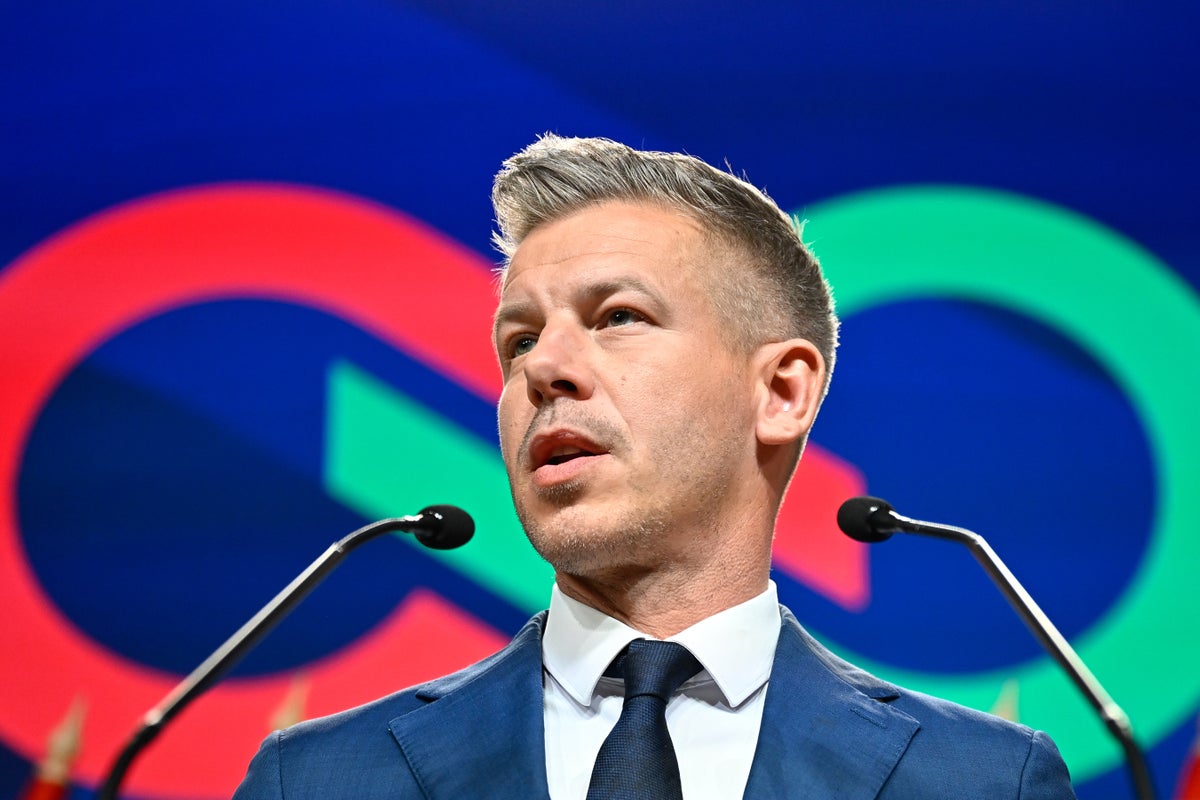
The political architecture of Central Europe shifted on its axis this past Sunday. For sixteen years, Viktor Orbán reigned over Hungary as an immovable object, a pioneer of "illiberal democracy" who turned a European Union member state into a personal fiefdom. That era ended with a landslide. Péter Magyar, a former government insider who only broke ranks months ago, has secured a staggering two-thirds parliamentary majority. His Tisza party has not just defeated the old guard; it has erased the previous political map.
Magyar’s victory is built on a simple, devastating promise: to return Hungary to the "European mainstream" while purging the systemic corruption that defined the Orbán years. But as the champagne flatlines, the reality of governing a captured state is setting in. Magyar has inherited a country where the judiciary, the media, and the economy are deeply entwined with the interests of the men he just deposed. To understand what happens next, one must look past the victory rallies and into the specific, often contradictory, levers of power Magyar now intends to pull.
The Illusion of a Clean Break
The international press has characterized this as a pro-EU revolution. That is a dangerous oversimplification. Magyar is not a federalist liberal in the mold of Emmanuel Macron. He is a conservative who emerged from the very belly of the Fidesz beast. He speaks the language of sovereignty, national interest, and traditional values. The difference is that he believes these goals are compatible with EU membership, whereas Orbán used them as a shield for graft.
Magyar’s first priority is the unblocking of nearly €19 billion in frozen EU funds. This is not merely a diplomatic goal; it is an existential necessity for his new government. Hungary’s economy has been hollowed out by inflation and a lack of investment. To get that money, Magyar must dismantle the "Model Change" that saw public universities and state assets handed over to Fidesz-controlled foundations.
However, the new Prime-elect faces a paradox. To restore the rule of law, he must act against a civil service and a court system still packed with Orbán loyalists. If he purges them too quickly, he risks being accused of the same authoritarian overreach he campaigned against. If he moves too slowly, the EU funds remain locked, and his voters—who expect immediate economic relief—will grow restless.
The Ukraine Veto and the Russia Pivot
For years, Budapest was the Kremlin’s favorite backdoor into Europe. Orbán’s frequent use of the veto to stall aid to Kyiv made him a pariah in Brussels. Magyar has pledged to end this "veto-politics," but his stance on Ukraine remains remarkably guarded.
While he has condemned the Russian invasion as an act of aggression, Magyar has pointedly refused to commit to military aid. He opposes Ukraine’s fast-track accession to the EU, suggesting instead a decade-long roadmap and a national referendum. More critically, he has indicated a desire to maintain "pragmatic" energy ties with Moscow.
Hungary remains heavily dependent on Russian gas and oil. Magyar knows that a sudden decoupling would trigger an energy price spike that could sink his government in its first six months. He is playing a high-stakes game: promising Brussels a "constructive" partnership while telling his domestic base—many of whom have been fed a decade of pro-Russian propaganda—that he won't let Hungary be "dragged into a war."
The €90 billion EU loan package for Ukraine is the first true test. Magyar has signaled he might lift the veto, but only if Hungary’s "opt-out" from the financial liability is strictly honored. This is a negotiator's stance, not a crusader's.
The LGBTQ+ Question and the Conservative Base
Perhaps no issue highlights Magyar’s balancing act better than the "Child Protection Act," the controversial legislation that conflated LGBTQ+ content with pedophilia. Under Orbán, this was a central pillar of the culture war.
Magyar’s approach is a tactical retreat rather than a total reversal. He has stated that "everyone can live with whoever they love," but he has avoided specific promises to repeal the most restrictive elements of the law. He frames the issue as "settled" or "marginal," an attempt to depoliticize a topic that Orbán used to polarize the nation.
For the liberal voters in Budapest who supported Tisza as the "lesser evil," this is a bitter pill. They expect a restoration of civil liberties and an end to state-sponsored homophobia. But Magyar’s majority was won in the countryside, in the medium-sized towns where traditional social views still hold sway. He cannot afford to look like a "Brussels puppet" on social issues. His strategy is to pivot the national conversation toward "bread-and-butter" issues—healthcare, education, and the cost of living—while leaving the culture war to simmer on the back burner.
Dismantling the Oligarchy
The most daunting task on Magyar’s desk is the "de-Orbánization" of the Hungarian economy. Over the last decade, a handful of businessmen close to the former Prime Minister have acquired vast swaths of the country’s construction, media, and telecommunications industries.
Magyar has pledged to join the European Public Prosecutor’s Office (EPPO). This is a seismic shift. By allowing European investigators to look into the misuse of EU funds, he is effectively inviting an external force to help him dismantle the local oligarchy. It is a brilliant move of political theatre, but the practical execution will be bloodier than expected.
Many of these contracts are legally binding. The assets are held in private hands. To reclaim them, Magyar’s government would need to prove criminal activity in courts that—until yesterday—were overseen by the very people involved. He has already called for the resignation of the President and several high-profile officials, but a "regime change" of this scale often takes years, not weeks.
The Two-Term Trap
In a move designed to permanently disable the Fidesz machine, Magyar has proposed a retrospective two-term limit for Prime Ministers. If enacted, this would legally bar Viktor Orbán from ever returning to the office he held for nearly two decades.
It is a popular proposal, but it highlights the central tension of the Magyar era. He is using his supermajority to change the rules of the game to prevent a return to the past. The danger is that by creating a system designed to exclude one man, he may be inadvertently building a new set of tools for the next one.
Magyar is not a savior; he is a technician who knows exactly how the old machine worked because he helped maintain it. He is betting that he can use that knowledge to build something more transparent and more European without losing the conservative heart of the country. The "tsunami" has washed away the old leadership, but the wreckage of the illiberal state remains. Clearing it will require more than just slogans; it will require a level of political surgical precision that Hungary hasn't seen in a generation.
The honeymoon will be short. The bills are coming due. And in Brussels, the "relief" at Orbán's exit is already being replaced by a cautious, watchful skepticism of the man who replaced him.
Join the European Public Prosecutor's Office immediately. That is the only move that proves this wasn't just a change of management.