Headline-driven coverage of naval mine incidents in the Strait of Hormuz treats a single explosion as a self-contained news flash. That framing misses the real mechanism: maritime chokepoint warfare operates through information asymmetry, transit routing friction, and insurance repricing rather than physical destruction alone.
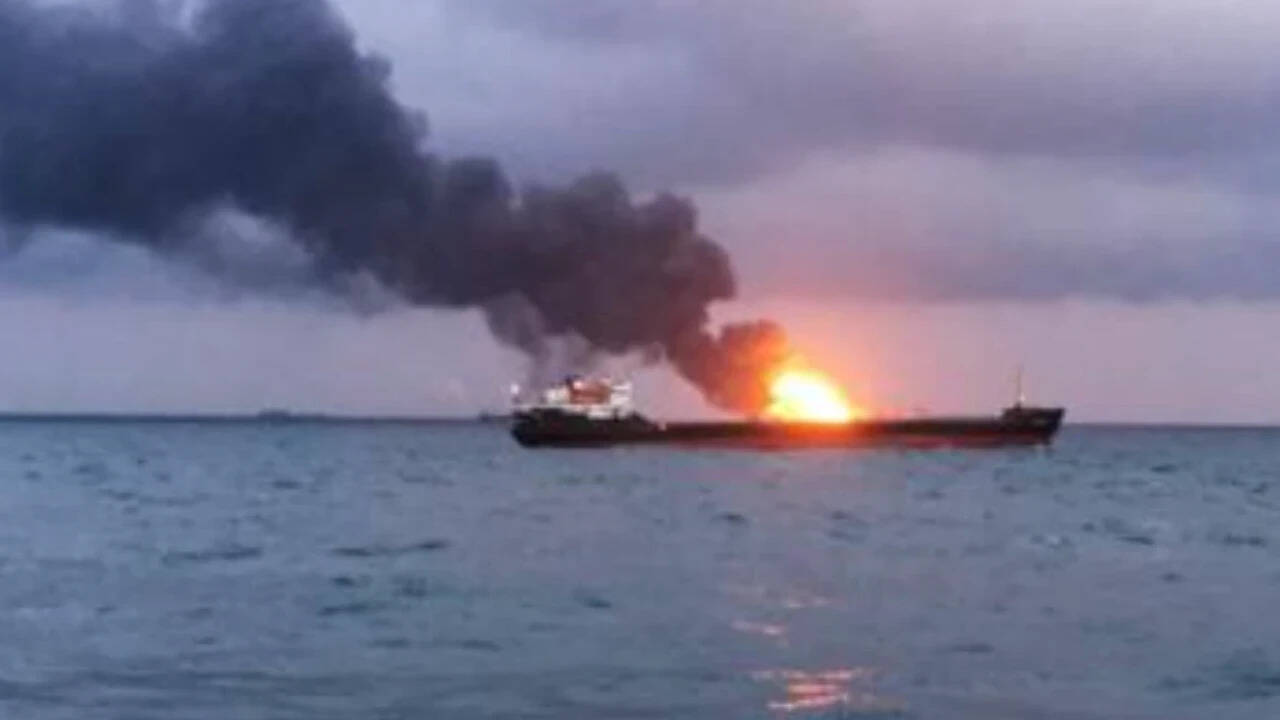
A standard breaking-news dispatch on two oil tankers catching fire after striking mines typically rests on a simple linear chain: Iranian forces announce mine strikes, vessels catch fire, and global energy markets react. That chain is incomplete. It treats unverified state statements as settled physical facts, conflates alleged mine strikes with confirmed projectile impacts or escorted transit disputes, and ignores how commercial operators price ambiguity even when physical clearance claims conflict.
Deconstructing Standard Chokepoint Coverage
Typical reporting around Islamic Revolutionary Guard Corps (IRGC) claims of tankers hitting sea mines relies on four structural habits that obscure how maritime risk actually transmits to commodity prices and shipping lanes:
- Unverified claim equivalence: Statements issued by military actors asserting that vessels struck mines on "unauthorized" routes are frequently presented alongside or ahead of independent maritime verification, even when vessel identities, hull damage, and casualty reports remain unconfirmed.
- Counter-narrative flattening: Assertions by U.S. Central Command regarding mine clearance and escorted barrel volumes are often treated as a simple cancellation of Iranian claims rather than evidence of a contested information and routing environment.
- Single-asset fixation: Focusing on two vessels or a claimed cargo volume draws attention to discrete physical incidents while overlooking how route restrictions alter fleet utilization across the entire Persian Gulf and Gulf of Oman.
- Missing second-order links: Reports rarely trace how disputed mine warnings interact with ceasefire breakdowns, naval escorts, and alternative commodity flows such as liquefied natural gas and fertilizers.
Distinguishing between verified telemetry and contested assertions is the baseline requirement for reading any Strait of Hormuz incident. When a statement omits vessel names, coordinates, and independent confirmation, the confirmed fact is the announcement and the surrounding maritime alert environment—not the physical sinking or mine origin itself.
The Four Pillars of Maritime Chokepoint Friction
To evaluate how mine claims in the Strait of Hormuz affect shipping and markets without inventing unverified metrics, analysts can track four interlocking mechanisms.
1. Verification Asymmetry and Signal Warfare
Naval mines are uniquely suited to psychological and operational ambiguity. Unlike a visible surface raid or a public radar track, an underwater mine claim forces commercial actors to weigh two conflicting realities: military assurances that lanes are cleared or escorted against warnings that adjacent or "unauthorized" corridors carry lethal risk.
When an announcement claims tankers struck mines while transiting with tracking transponders off or outside designated corridors, two distinct possibilities exist. One hypothesis is that covert or non-standard transits encountered residual or newly laid sea mines. A competing hypothesis is that state actors use mine narratives to deter uncoordinated passage, assert sovereign control over routing, or explain strikes and fires whose exact cause—mine, projectile, or operational accident—remains unverified independently. Treating both as proven fact distorts risk assessment; treating mine claims as zero-signal noise ignores how shipowners react to perceived hazard.
2. Route Control and Transit Friction
Commercial shipping through narrow waterways depends on predictable sea lanes, clear traffic separation, and reliable navigation aids. When warring parties contest routing—whether through Iranian assertions of "unauthorized" paths and traffic coordination demands or U.S. naval escorts and counter-blockade measures—the bottleneck widens from physical blockage to routing friction.
A vessel that must alter course, wait for escort scheduling, avoid specific corridors, or rely on offshore transfers absorbs higher time-charter costs and longer turnaround cycles. Even when aggregate oil flows partially recover from near-zero troughs through escorts or alternative transfer points, constrained routing reduces effective vessel supply and keeps freight premiums elevated.
3. The Maritime Risk and Insurance Cost Function
Commercial shipping economics do not wait for an official diplomatic or military verdict before repricing risk. A shipowner, charterer, and marine insurer evaluate exposure through a practical cost function shaped by several variables:
- Incident frequency and recency: Repeated reports of fires, explosions, or projectile strikes in the same waterway compress the perceived safety margin between transits.
- Escort and corridor clarity: Whether a vessel operates inside a defined naval escort regime or outside contested boundaries changes how underwriters price war risk and hull exposure.
- Escalation linkage: Broader military actions—such as collapsed truces, strikes on regional infrastructure or island positions, or retaliatory attacks across neighboring states—raise the probability that a localized mine claim precedes wider maritime disruption.
- Cargo sensitivity: Crude oil, liquefied natural gas, and agricultural inputs like urea and ammonia carry different storage, rerouting, and spoilage constraints when transit times stretch.
When any of these inputs spikes, freight rates and war-risk premiums can rise sharply even if the number of confirmed damaged hulls remains small relative to total regional trade volume.
4. Spillover Across Energy and Agricultural Supply Chains
Coverage of tanker fires almost always centers on crude oil barrels, yet the Strait of Hormuz anchors a broader set of industrial inputs. Prior to the 2026 conflict, roughly a quarter of global seaborne oil trade and a fifth of global liquefied natural gas trade moved through the strait, alongside substantial shares of internationally traded fertilizers such as urea and ammonia.
Disruption along this corridor therefore transmits along two parallel channels. The first is the energy channel, where tighter physical availability or higher transport cost feeds into refinery margins, power generation, and industrial fuel expenses. The second is the input-cost channel, where restricted movement of LNG and nitrogen fertilizers raises production costs for agriculture and chemicals downstream. An analyst who tracks only crude headlines misses how chokepoint friction compounds into broader inflation and food-supply pressure.
Cause and Effect in Contested Chokepoints
Simple accounts often reverse or compress cause and effect. In a prolonged maritime confrontation like the 2026 Strait of Hormuz crisis, causality runs in loops rather than straight lines.
Military escalation and stalled negotiations do not merely coincide with mine announcements; shifts in diplomatic and military posture alter where forces operate and how aggressively narratives are deployed. When ceasefires fracture or retaliatory strikes expand, maritime risk rises immediately, prompting tighter naval escorts or route restrictions. Those restrictions, in turn, create friction over "authorized" versus "unobserved" transits, increasing the chance of miscalculation, projectile strikes, or mine encounters.
A concrete operational example illustrates the trap of taking a single claim at face value. Suppose a supertanker is reported on fire after hitting a mine in the southern approach, while military authorities simultaneously report ongoing mine-clearance efforts and escorted shipments. If an analyst assumes the mine claim proves the strait is unnavigable, they overstate a complete physical closure; if they assume the clearance claim proves zero hazard, they underestimate tail risk from a single strike or stray ordnance. The actual market impact sits between those poles: higher friction, selective routing, and elevated risk pricing.
Operational Playbook for Analyzing Incidents
To move from headline reaction to structured assessment whenever a new tanker-and-mine report surfaces, apply a five-step verification sequence:
- Audit the source and corroboration: Separate the primary claim (such as an IRGC statement) from independent maritime monitors (such as UKMTO), naval commands, and regional authorities, noting explicitly what remains unconfirmed.
- Isolate physical facts from attribution: Record confirmed fires, explosions, or crew rescues separately from disputed explanations such as specific mine types, route violations, or vessel identities.
- Map the exact corridor and transit mode: Check whether the reported event occurred in a southern or northern approach, near strategic islands, during an escorted passage, or along an uncoordinated route.
- Evaluate concurrent escalation triggers: Cross-check the incident against recent diplomatic breakdowns, naval blockades, airstrikes, or regional retaliations that change rules of engagement.
- Trace downstream commodity sensitivity: Assess exposure across crude grades, LNG cargoes, and fertilizer shipments rather than treating all maritime traffic as homogeneous.
Limitations of This Framework
No analytical framework eliminates fog of war in an active maritime theater. Underwater mines can remain undetected until triggered, and official statements from any party in a conflict may withhold operational details or shape public perception. Furthermore, structured categorization cannot substitute for real-time satellite, hydrographic, or commercial shipping telemetry when precise vessel status is undisclosed. Analysts must treat every assessment as conditional and update it as verified reports accumulate.
Strategic Action for Decision-Makers
Commercial shipping operators, energy buyers, and risk managers should treat mine announcements in the Strait of Hormuz as routing and risk-pricing signals rather than standalone proof of total waterway closure. Build contingency plans around corridor flexibility, escorted-transit lead times, and multi-commodity exposure (crude, LNG, and fertilizers), while requiring corroborated maritime reporting before adjusting long-term supply commitments.