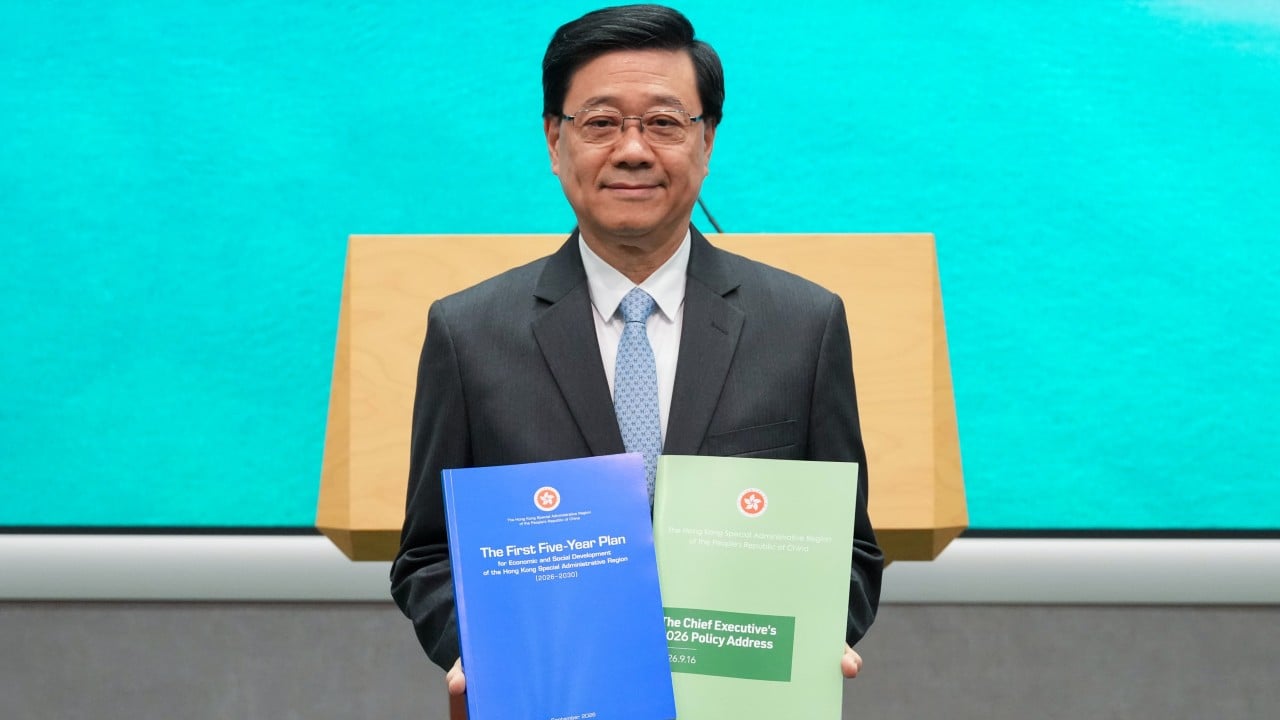
Chief Executive John Lee has made it abundantly clear that Hong Kong’s inaugural five-year plan is designed to set performance targets rather than dismantle the territory's foundational economic machinery. For decades, the global financial hub operated on a hands-off creed of positive non-interventionism. Markets breathed, speculators thrived, and property tycoons shaped the skyline. Now, facing persistent geopolitical pressure and slowing structural growth, Beijing’s preferred administrator is turning to mainland-style technocracy. Yet, declaring that the economic system remains untouched while introducing rigid targets creates a fundamental contradiction. You cannot import top-down target-setting without altering the DNA of a market historically built on laissez-faire spontaneity.
Markets abhor ambiguity, but they also suffocate under poorly fitted blueprints. When Lee outlines a framework modeled loosely on national planning vectors, financial analysts immediately search for the hidden gears of systemic reform. They will not find them. The core pillars—property dominance, financial services concentration, and low taxation—stay bolted to the floorboards. Instead, the upcoming strategy focuses on KPI-driven governance, attempting to force innovation, housing delivery, and talent retention through sheer administrative will. This approach misreads the core pathology of the territory's current malaise. The friction points are not missing benchmarks. The friction points are structural anxieties, shifting global capital flows, and a contracting pool of autonomous enterprise.
To understand why this strategy carries profound risks, one must examine how Hong Kong historically functioned as an economic valve. For generations, the city acted as the primary conduit between mainland production capacity and Western liquidity. That pipe is leaking. Global funds reallocate capital elsewhere, domestic consumption remains sluggish, and the commercial real estate market sits under unprecedented debt pressures. Setting a five-year target for GDP growth or technology adoption without altering the underlying cost of doing business is roughly akin to painting a broken engine and expecting it to run faster. The constraints are systemic, and administrative optimism is poor substitute liquidity.
The administration points to integration with the Greater Bay Area as the ultimate horizon. Synergy sounds magnificent in policy addresses, but corporate reality tells a different story. Cross-border integration requires a harmonization of legal frameworks, tax regimes, and data flows that simply does not exist. Hong Kong operates under common law, distinct currency systems, and free information access. The mainland operates under state-directed capital controls and civil law traditions. Attempting to force economic integration while preserving these fundamental divergences creates a perpetual friction zone. Businesses caught in the middle spend more energy navigating compliance chokepoints than generating commercial value.
Housing serves as the starkest illustration of this policy paralysis. For decades, residential property prices have functioned as both the primary engine of government revenue through land sales and the ultimate anchor of middle-class wealth destruction. Every administration promises structural relief, yet the underlying land supply mechanism remains tethered to high-value scarcity. A five-year plan that sets targets for public housing units without dismantling the land monopoly merely treats symptoms while protecting the disease. When real estate devours a staggering portion of disposable household income, discretionary spending contracts, retail sectors wither, and young talent packs its bags for Singapore, Tokyo, or London.
Talent retention is perhaps the most critical metric where the new framework faces an existential test. Bureaucrats love numerical quotas. Programs designed to import professionals have successfully brought thousands of applicants across the border, but quantity does not equal integration. Retention requires institutional trust, predictable legal environments, and cultural vibrancy. If the territory pivots toward heavy-handed administrative direction, the very qualities that attracted global talent in the first place—agility, neutrality, and cosmopolitan independence—erode. You cannot mandate a creative class into existence through annual key performance indicators.
The financial sector faces a similar identity crisis. For years, the stock exchange relied on a steady pipeline of mainland initial public offerings to maintain its global ranking. With mainland equity markets experiencing prolonged valuation slumps and regulatory tightening, that pipeline slowed to a trickle. International investors, spooked by shifting geopolitical alignments and stricter compliance mandates, pulled back. Setting an arbitrary goal to attract a certain number of foreign financial institutions or sovereign wealth funds ignores the macro-level reality. Capital goes where it is treated best and kept safest. Without addressing the underlying geopolitical anxieties driving capital flight, administrative encouragement falls flat against balance sheet logic.
Furthermore, the relationship between the local government and the business community has fundamentally shifted. In the past, tycoons held immense sway over urban planning and economic direction, often prioritizing property returns over broader industrial diversification. While breaking that monopoly power might sound appealing on paper, replacing it with bureaucratic oversight does not automatically spawn a dynamic technology sector. Innovation thrives on failure, risk-taking, and decentralized capital allocation. State-directed venture capital funds tend to suffer from political risk aversion, backing safe, legacy-adjacent projects rather than disruptive breakthroughs.
Consider the ongoing push to establish artificial intelligence and biotechnology hubs in the northern metropolis zones near the border. Millions of dollars flow into physical infrastructure, gleaming research parks, and tax incentives. Yet, without deep pools of venture capital willing to fund early-stage risk, and without seamless global academic exchanges, these zones risk becoming expensive real estate developments rather than engines of discovery. The hardware of innovation is present, but the software of entrepreneurial freedom remains heavily constrained by risk-averse institutional behavior.
John Lee’s insistence that the economic system remains unaltered is a political necessity designed to reassure skittish investors that the capitalist lifestyle persists. Simultaneously, the introduction of five-year targets is an administrative necessity designed to prove to Beijing that local leadership is proactive and accountable. These two imperatives pull in opposite directions. You cannot maintain an unfettered market while imposing bureaucratic KPIs on structural economic outcomes.
As the calendar moves forward and the benchmarks come due, the administration will likely discover that economic vitality cannot be legislated into existence. Real reform requires difficult choices: dismantling entrenched monopolies, confronting the land economy's stranglehold on public wealth, and restoring absolute confidence in institutional autonomy. Dodging these foundational battles in favor of numerical scorecards only delays the reckoning. The clock is ticking, and the market cares very little about bureaucratic intentions.