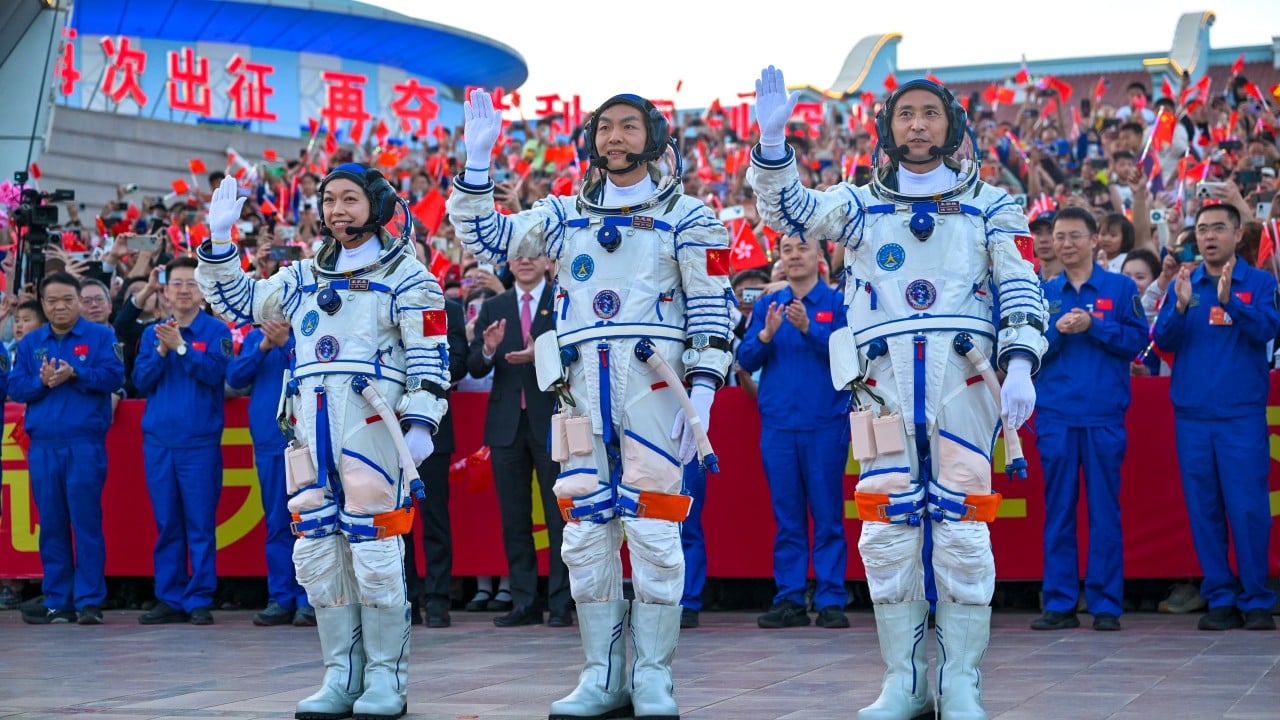
The mainstream press is currently swooning over the narrative that Hong Kong will play host to the Shenzhou-23 crew in 2027. They are hyper-focusing on payload specialist Lai Ka-ying, hailing her selection as a monumental leap for local science.
It is a comforting, patriotic bedtime story. It is also entirely wrongheaded.
If you look past the glossy government press releases, China’s inclusion of a Hong Kong astronaut in the upcoming Shenzhou-23 timeline is not a validation of the city's scientific infrastructure. It is a masterclass in geopolitical theater. By treating Lai Ka-ying’s upcoming mission as a celebratory destination rather than an urgent wake-up call, Hong Kong is masking a painful truth: the city is profoundly unprepared to sustain a real presence in the global space economy.
We need to stop cheering for the photo-op and start questioning the lack of substance underneath.
The Lazy Consensus: Representation Is Not An Aerospace Strategy
The prevailing media narrative suggests that having a local body aboard the Tiangong Space Station automatically elevates Hong Kong into a hub of aerospace innovation.
This is a dangerous conflation of representation and capability.
I have watched tech sectors burn through billions in capital because they mistook a high-profile brand ambassador for structural readiness. Forcing a local face into a rocket cockpit does not magically generate a homegrown space sector.
Let us break down the brutal mechanics of how the China Manned Space Agency (CMSA) operates. The selection of a payload specialist from the Hong Kong Special Administrative Region (HKSAR) was a political necessity to demonstrate national unity and integration. It was about optics, not an admission that Hong Kong’s laboratories are suddenly outperforming the mainland's top-tier institutions in aerospace engineering.
When Lai Ka-ying lifts off, she will be operating equipment engineered on the mainland, utilizing software written in Beijing, and executing experiments designed to fit a national agenda. Hong Kong is providing the human capital for a public relations victory, but it is borrowing the entire technological backbone.
Dismantling The Premise: The Wrong Questions About 2027
If you look at public forums and media commentary, the questions being asked are fundamentally flawed.
- When will the Shenzhou-23 crew arrive in Hong Kong?
- How can local universities get more experiments onboard the Tiangong Space Station?
These questions assume that the ultimate goal of space science is to secure a slot on someone else’s manifest. That is a submissive approach to technology.
Instead of asking how Hong Kong can hitch a ride, we should be asking: Why does Hong Kong lack the industrial base to manufacture a single component of that spacecraft?
The harsh reality is that Hong Kong’s economy remains obsessively tethered to real estate, banking, and logistics. It is an ecosystem built on quick financial returns, not the grinding, low-margin, high-risk decade-long R&D cycles required for aerospace hardware. You cannot build a space sector when your venture capital culture expects a 10x return on an app within three years.
The Illusion Of Academic Readiness
Defenders of the current status quo will quickly point to local institutions like the Hong Kong Polytechnic University (PolyU), which has genuinely contributed to national deep-space missions, including manufacturing instruments for Mars and Moon landers.
But let us be precise about definitions here. Contributing specialized precision instruments to a state-run program is a niche academic capability. It is not an industry.
An industry requires a supply chain. It requires commercial launch providers, private satellite operators, data analytics firms, and specialized component manufacturers. Right now, Hong Kong has a handful of brilliant academics working in siloed university labs, while the actual industrial execution happens across the border in Shenzhen and Zhuhai.
If a city only produces the scientists who use the tools, but lacks the factories, engineers, and capital markets to build the tools, it remains a consumer of aerospace, not a producer.
The Downside Of Sounding The Alarm
Taking this contrarian stance comes with an obvious risk. It sounds cynical. It risks dampening the genuine enthusiasm of young local students who look at Lai Ka-ying and see a future for themselves in STEM.
That inspiration is real, and it has value. But inspiration without an industrial runway leads directly to brain drain.
Imagine a scenario where thousands of Hong Kong students are inspired by the 2027 Shenzhou-23 tour to study aerospace engineering. They graduate in 2031. Where do they work? Hong Kong has no commercial rocket testing facilities. It has no satellite manufacturing plants. The strict security regulations surrounding aerospace tech mean these graduates cannot easily move to Western countries to work for private space firms, and competing for top-tier roles on the mainland means going up against an army of graduates from Tsinghua and Harbin Institute of Technology.
By hyping the astronaut without building the local market, Hong Kong is actively training a generation of specialized talent for jobs that do not exist within its borders.
Stop Celebrating The Tour, Do This Instead
If Hong Kong wants to be more than a stop on a post-mission celebratory tour, the entire approach to the space economy needs a radical rewrite.
1. Pivot From Hardware To Space Data Arbitrage
Hong Kong cannot compete with the mainland on heavy industrial manufacturing or launch infrastructure. It shouldn't try. Instead, the city must exploit its unique legal and financial status to become the global hub for space data, satellite insurance, and international space law.
The city needs to build an ecosystem that processes the massive torrents of climate, maritime, and logistical data coming off low-Earth orbit constellations. That fits the city's existing strengths in data science and finance.
2. Force A Venture Capital Shift
The government needs to stop handing out small academic grants and start aggressively subsidizing long-term deep-tech funds. If the tax incentives for investing in a satellite component startup are not drastically better than buying up luxury commercial real estate in Central, the money will never move.
3. Establish Autonomous Aerospace Zones
Create dedicated industrial zones with specialized regulatory frameworks that allow international space tech startups to collaborate with mainland entities without running into crippling intellectual property walls. Use the city's unique position as a bridge, rather than just acting as a passive spectator to Beijing's achievements.
The 2027 Reality Check
When the Shenzhou-23 crew steps off the plane in Hong Kong in 2027, the cameras will flash, officials will give speeches, and children will wave flags. It will look like a triumph.
But do not confuse a victory lap with winning the race.
If by 2027 Hong Kong has not fundamentally altered its economic DNA to support a private, self-sustaining space ecosystem, then Lai Ka-ying’s mission was not the start of something new. It was simply an expensive piece of political choreography designed to make a financially obsessed city feel like it is reaching for the stars while its feet remain firmly glued to the boardroom floor.


