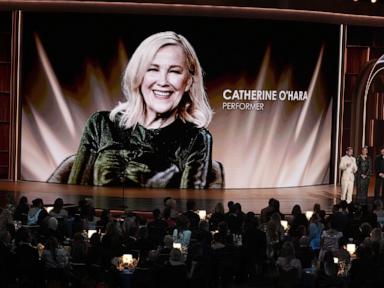
The internet collective wiped a tear from its collective eye when Macaulay Culkin and the principal cast of Schitt’s Creek stood on stage to honor Catherine O’Hara. X was flooded with slow-down clips of trembling lips, warm embraces, and declarations about how wholesome television can be. Millions watched, sighed, and felt a warm spike of serotonin.
It was a masterclass in emotional theater. And it missed the entire point. If you found value in this article, you should read: this related article.
Let us drop the polite fiction for a moment. Hollywood loves nothing more than throwing a lavish, tear-soaked memorial service for a living legend. It makes the executives feel like art patrons. It gives the actors a chance to prove they possess empathy on camera. Most importantly, it creates a convenient smoke screen over the reality that the entertainment industry spent the better part of four decades completely underestimating the most dangerous comedic mind of her generation.
Catherine O’Hara does not need your tears. She needed a system that funded her risky, avant-garde instincts before it became safe and profitable to applaud them. For another angle on this story, see the latest coverage from IGN.
The Sanitization of Anarchy
The viral narrative surrounding these tributes insists on framing O'Hara as a comforting, eccentric national treasure. She is the quirky TV mom. She is the nostalgic voice from Christmas past. This is a sanitized, neutered version of an artist who spent her career terrifying polite society.
Go back and watch Second City Television. Look at Lola Heatherton or Vicki Dubcek. These were not lovable, quirky aunt figures. They were psychological horror shows wrapped in cheap sequins and bad hair. O’Hara played women on the absolute edge of hysterical breakdown, driven by desperate vanity and casual cruelty. She did not want you to feel warm and fuzzy. She wanted you to squirm.
When Hollywood reduces that level of ferocious, unhinged performance art to a wholesome internet meme about a Kevin McCallister reunion, it commits an act of artistic vandalism. It takes an acid-tongued terrorist of comedy and dresses her up in the respectable velvet of prestige television.
Schitt's Creek was a triumph, yes. Moira Rose became a pop culture deity. But let us be entirely honest about why Moira resonated: audiences had spent fifteen years drowning in bleak, prestige anti-hero dramas about miserable men doing bad things in dark rooms. O'Hara came along with a fake accent that sounded like a blender full of glass and reminded everyone that performance could be theatrical, ridiculous, and incandescently joyful. Yet, the industry treated her Emmy win for that role as a lifetime achievement award masquerading as a current
Stop Buying Into The Manufactured Tears Of Hollywood Award Shows
entertainment
Tear-soaked speeches, trembling lower lips, and a parade of former child stars and Canadian television royalty standing on a Los Angeles stage to applaud Catherine O’Hara. The internet swooned. Entertainment blogs called it a masterclass in heart.
It was a masterclass in public relations.
Let us stop pretending that television industry award ceremonies are spontaneous gatherings of pure artistic appreciation. They are tightly budgeted, highly calculated marketing loops. Every tear shed under high-definition studio lights carries a multi-million-dollar collateral value. When Macaulay Culkin and the Schitt’s Creek ensemble line up to crown O’Hara, they are not just honoring a legendary comedic force; they are reinforcing their own cultural relevance by tethering themselves to an undisputed titan who spent decades being ignored by the very institution now giving her a standing ovation.
The lazy consensus in modern entertainment journalism dictates that when famous people cry about other famous people, we are witnessing humanity breaking through the cynical crust of show business. This is a fairy tale sold to consumers who desperately want to believe that Hollywood is a warm, supportive summer camp where talent is always recognized and elders are revered with unvarnished sincerity.
The reality is far more transactional.
Let us look at the historical record. Catherine O’Hara did not become brilliant in 2020. She was incandescently talented in 1982 while working on SCTV, writing characters that subverted gender norms and Midwestern tropes before most of the people currently praising her were old enough to chew solid food. She spent forty years crafting an uncompromised body of work that included working with Martin Scorsese, defining the dark suburban satire of Tim Burton in Beetlejuice, and improvising her way through Christopher Guest mockumentaries with surgical precision.
Yet, for decades, the mainstream industry marginalized her. She was too strange, too abrasive, too committed to character absurdity over conventional glamour to be handed leading film roles on a silver platter. Hollywood only loves an eccentric icon after it is safe, profitable, and culturally mandated.
When Schitt’s Creek finally gave her a vehicle that swept the Emmys, the industry treated it as a revelation. It was not a revelation; it was an overdue apology disguised as a triumph. And the subsequent tributes built upon that victory lap were designed to manufacture a narrative of collective warmth that masks the underlying ruthlessness of the studio system.
Consider the mechanics of the Culkin connection. The internet treats their reunion like a sacred family artifact because they played mother and son in a Christmas movie released over three decades ago. Every time they share a frame, social media engagement spikes because pop culture runs on the cheap fuel of recognition. We crave the comfort of things we remember. The industry knows this. They feed us our own childhoods back to us in tailored packages, complete with teary-eyed testimonials, and we thank them for the privilege of manipulation.
Let us address the broader economic engine driving these emotional displays. Award shows are declining in traditional television ratings year over year. Networks and streaming platforms need viral collateral to survive the news cycle. A genuinely heartfelt, unscripted moment of professional respect is rare; a choreographed spectacle of nostalgia is a reliable currency. When publicists coordinate these tributes, they are calculating reach, impressions, and cultural mindshare. Culkin gets a fresh wave of career interest and generational goodwill. The network gets trending topics. O’Hara gets flowers she should have received twenty-five years earlier.
Everyone wins, provided the audience is willing to suspend disbelief and swallow the performance whole.
The Myth Of The Cozy Industry
People love to ask whether Schitt’s Creek deserved its historic Emmy sweep. The lazy consensus says yes, it was a heartwarming triumph of independent television that proved kindness could conquer cynicism.
The truth is much more mechanical.
Schitt’s Creek was a late-stage beneficiary of a streaming monopoly desperate for cozy, low-stakes comfort food during a period of intense cultural fracture. O’Hara carried that show on a linguistic prosthetic of her own design—an accent that sounded like a transatlantic aristocrat swallowing a dictionary in a wind tunnel, combined with posture that suggested a woman perpetually balancing a book of etiquette on her skull while fleeing a crime scene. She was, and is, a masterclass in physical comedy.
However, the show itself was safe, middle-of-the-road syndication fodder that only swept every major category because the television academy ran out of innovative ideas to validate during a transitional broadcast era. When an entire creative team sweeps the board, you are not witnessing peak artistic consensus. You are witnessing industry exhaustion. The voters chose safety, comfort, and familiarity over risk.
To point this out is not to diminish O’Hara’s genius. It is to separate the artist from the apparatus that exploits her legacy. I have spent years watching the gears grind behind the velvet rope of entertainment media. I have seen publicists script "spontaneous" emotional outbursts months before a telecast. I have watched network executives hand-pick presenters based not on creative kinship, but on algorithmic cross-pollination data.
When an actor stands at a podium and talks about how an older colleague changed their life, they are participating in a well-rehearsed ritual of professional passing-of-the-torch. It looks organic because the participants are professionals. They know how to hit their marks, drop their voices by an octave to signal emotional gravity, and let a tear catch the key light at precisely the right angle.
The Downside Of Cynicism
Admitting all of this comes with a heavy cost. It ruins the magic.
It is deeply uncomfortable to look at joy and immediately search for the balance sheet. It is miserable to watch a room full of artists stand and applaud and wonder which publicist pitched the bit during a morning strategy session. Most people watch award shows because they want to escape the transactional harshness of everyday life. They want to believe in a sanctuary where art matters more than metrics.
I concede the downside of this perspective completely: living in a state of permanent media skepticism strips the sparkle from the tinsel. If you dismantle every touching moment, you risk becoming someone who can no longer enjoy a well-told story or a genuine expression of gratitude.
Even the most calculated Hollywood tribute often contains a kernel of real affection. Culkin grew up in an extraordinarily chaotic, predatory child-stardom environment. Working with actors like O’Hara on a film set provided a baseline of professional stability and maternal warmth that likely left a permanent mark on his childhood psyche. When he looks at her now, the emotion is probably real.
The problem is not that the actors feel nothing. The problem is that the corporate machinery packages their personal feelings and sells them back to us as proof of systemic benevolence.
The Historical Amnesia Of The Machine
Notice how selective Hollywood is when it grants these canonization ceremonies. The industry loves to celebrate veterans who survived the grinder, but it rarely changes the conditions that grind the next generation down.
O’Hara survived by pivoting across mediums, writing her own material, and maintaining a standard of eccentricity that made her irreplaceable. She did not succeed because the studio system protected her; she succeeded despite a system that historically had no idea what to do with funny women who refused to age into traditional romantic leads.
For decades, Hollywood pigeonholed women of her caliber into the background. They were cast as the shrill mother, the eccentric neighbor, the disposable punchline, or the tragic spinster. They were discarded the moment their youth faded from the frame.
Yet, when the academy hands out a lifetime achievement award or orchestrates an all-star tribute, the narrative shifts overnight. Suddenly, the industry acts as though it has always been a nurturing incubator for female comedic genius. It rewrites its own history in real-time, casting itself as the benevolent patron of the arts rather than the historically hostile environment it actually was.
This is the core deception of the celebrity tribute. It asks us to applaud the survival of an artist while ignoring the wreckage left behind by the road they had to travel.
Stop Falling For The Performance
If you want to honor Catherine O’Hara, do not watch a compressed TikTok clip of a room full of millionaires weeping into their designer lapels. Go back and watch SCTV sketches from 1981. Watch her play Lola Heatherton or Sue Ellen Mischke on Seinfeld. Study how she constructs a character from the vocal cadence outward, building a fortress of affectation that hides the razor-sharp intelligence underneath.
Stop confusing the corporate red carpet with the cathedral of art.
The entertainment complex does not care about your emotional well-being, and it does not care about preserving the sanctity of comedy. It cares about retention, engagement, and the eternal recycling of intellectual property.
Applaud the artist. Celebrate the work. But the next time a room full of actors starts crying on cue to sell you a nostalgic memory, turn off the television and remember that the machinery doesn't have a heart. It only has an audience.