Most universities talk about "regional innovation" in glossy brochures while their best research gathers dust on library shelves. The Hong Kong University of Science and Technology took the opposite route. Founded in 1991 with a specific mandate to help transition Hong Kong from a manufacturing hub into a knowledge economy, HKUST didn't just build classrooms. It built a commercialization machine.
Thirty-five years later, that original blueprint isn't just intact—it's driving billions in economic value across the Greater Bay Area. If you're looking at how academic institutions actually move the needle on deep tech, robotics, and biotech, HKUST is the case study everyone else is trying to copy.
The 1991 Gamble That Paid Off
Back in the late 1980s, Hong Kong had a problem. Factory jobs were moving across the border into mainland China, and the city lacked a dedicated research university focused purely on science, technology, and business. Critics called the Clear Water Bay campus project too expensive and too ambitious. They were wrong.
When HKUST opened its doors in October 1991, it recruited top-tier faculty from North America and Europe—people who understood not just how to publish papers, but how to spin out companies. That DNA mattered. Unlike older institutions bogged down by centuries of academic tradition, HKUST treated entrepreneurship as a core metric of success right from day one.
You can see the results in the numbers. Companies founded by HKUST faculty, students, and alumni have generated over HK$400 billion in economic impact. That isn't theoretical value. It's real hardware, real software, and real market dominance.
The DJI Blueprint
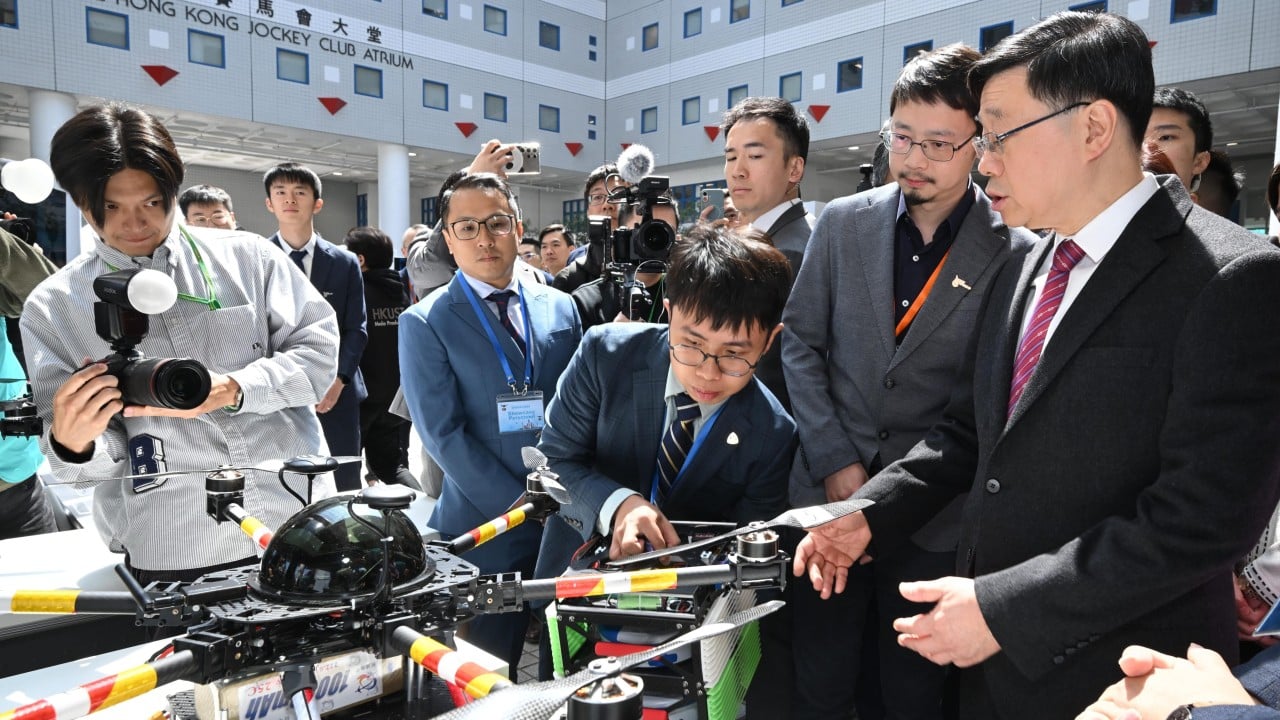
You can't talk about HKUST's impact without mentioning DJI. In 2006, Frank Wang started building flight controllers in his HKUST dorm room with support from his robotics professor, Li Zexiang. Today, DJI controls roughly 70% of the global commercial drone market.
What most people miss about the DJI story is that it wasn't a lucky accident. Professor Li didn't just give Wang a good grade and wish him luck. He helped secure early funding, connected him with Shenzhen's supply chain just across the border, and proved that a student sitting in Hong Kong could prototype in a university lab and manufacture at scale thirty miles away. That cross-border model became the exact template for modern Greater Bay Area innovation.
Why the Clear Water Bay to Nansha Pipeline Works
If you want to understand why HKUST punches way above its weight class, look at geography. Hong Kong has world-class basic research, strong intellectual property protection, and global capital. What it lacks is cheap land and massive manufacturing capacity.
Guangdong province—specifically Shenzhen and Guangzhou—has the exact opposite profile. It has unmatched supply chains, rapid prototyping capabilities, and a massive consumer market.
HKUST spent the last decade wiring these two worlds together. With the opening of HKUST (Guangzhou) in Nansha in 2022, the university officially created a "Unified HKUST, Complementary Campuses" framework. Students and researchers can move seamlessly between both campuses, share lab equipment, and transfer credits without bureaucratic friction.
Here's why this matters if you're building a hardware or deep-tech startup:
- Research happens in Hong Kong. You get access to international talent, global academic networks, and strict IP laws that protect foundational patents.
- Prototyping and scaling happen in Guangzhou and Shenzhen. You can walk down the street in Shenzhen and source custom sensors, PCBs, and injection-molded parts in 48 hours instead of six weeks.
- Funding bridges both sides. HKUST's entrepreneurship funds, including its Red Bird Innovation Fund, co-invest alongside mainland venture capital firms to get startups past the dreaded "valley of death" between lab prototype and commercial product.
Many Western universities try to replicate Silicon Valley by throwing money at campus incubators. It usually fails because they lack the manufacturing density nearby. HKUST didn't try to invent a supply chain from scratch. It plugged directly into the Pearl River Delta's existing industrial muscle.
The Knowledge Transfer Engine Behind the Scenes
Academic research dies when universities get greedy about intellectual property. I've seen countless promising biotech and AI projects stall for two years because a university tech transfer office demanded unreasonable equity stakes or licensing fees before a startup even had a customer.
HKUST took a much more pragmatic approach through its Office of Knowledge Transfer (OKT). Instead of treating patents like hoarded treasure, the university actively pushes IP out the door.
How HKUST Structures Startup Support
- Flexible IP Licensing. Faculty and student founders get straightforward terms to license university-owned patents, lowering the barrier to raising seed capital from institutional VCs.
- The Entrepreneurship Center and Base. Located right on campus, these spaces give student teams free desk space, mentorship from veteran founders, and direct introductions to angel investors.
- One Million Dollar Entrepreneurship Competition. Running annually for over a decade, this isn't just a polite pitch event. It's a grueling, multi-region competition spanning Hong Kong, Shenzhen, Guangzhou, Foshan, and Beijing that forces student teams to validate real business models.
The track record speaks for itself. Beyond DJI, HKUST alumni and faculty have built unicorns and major tech players like Insta360 (a dominant force in 360-degree action cameras), SmartMore (industrial AI and smart manufacturing), and Yunzhou-Tech (unmanned surface vessels). These aren't lightweight consumer apps. They're hard engineering companies solving tough physical and computational problems.
Shifting Focus to AI, Biotech, and Green Tech
Celebrating a 35-year milestone is great for fundraising dinners, but technology doesn't care about anniversaries. HKUST knows its historical wins in robotics and drones won't carry it through the next decade. Right now, the university is aggressively reallocating resources toward three specific battlegrounds.
Artificial Intelligence and Embodied Robotics
AI has moved past chatbots. The real race in Asia right now is embodied AI—putting foundation models into physical machines that can navigate warehouses, assemble electronics, and assist in hospitals.
HKUST's Department of Electronic and Computer Engineering and its Robotics Institute are heavily focused on this intersection. By combining computer vision, tactile sensing, and large-scale simulation, researchers are training robots to handle delicate, unpredictable tasks that traditional industrial arms can't touch. Because of the Guangzhou campus connection, these algorithms get tested in real Guangdong factories almost immediately.
Life Sciences and Medical Technology
Hong Kong has always been strong in clinical medicine, though HKUST historically lacked a traditional medical school. That's changing fast. The university is actively pushing to establish Hong Kong's third medical school, aiming to train a new generation of clinician-scientists who understand both patient care and data science.
Even before a medical school opens, HKUST's Division of Life Science has produced major breakthroughs in neurodegenerative disease research—particularly Alzheimer's diagnostics—led by President Nancy Ip and her team. Identifying blood-based biomarkers for early Alzheimer's detection isn't just an academic triumph; it's a massive commercial opportunity for regional biotech startups spinning out of the university's labs.
Sustainable Energy and Materials
With Hong Kong and mainland China pushing aggressive carbon-neutrality targets, clean tech has become a top priority. HKUST researchers are working heavily on next-generation battery chemistries, green hydrogen catalysts, and sustainable building materials. Again, the playbook remains identical: prove the electrochemistry in Clear Water Bay, then partner with Guangdong energy giants to test pilot production lines.
What Other Universities and Founders Can Learn From HKUST
You don't need to be in Hong Kong to steal parts of HKUST's playbook. Whether you're running a corporate innovation lab, managing a university incubator, or launching a deep-tech company, three practical lessons stand out from HKUST's 35-year run.
First, stop separating research from manufacturing. If your engineers don't understand how a product gets built at scale, your prototypes are just expensive toys. Force your R&D teams to spend time on factory floors early in the design process.
Second, lower the friction on intellectual property. Speed beats perfection in early-stage tech. Give founders clean, fast access to foundational patents so they can spend their time talking to customers instead of negotiating with lawyers.
Third, build cross-border bridges before you need them. Innovation rarely happens in isolation anymore. Find regions that complement your weaknesses—pair high-end research hubs with low-cost production centers, or pair deep engineering talent with aggressive commercial markets.
HKUST proved that a young institution without centuries of prestige could reshape an entire region's economy in a single generation. Thirty-five years in, the university isn't slowing down to admire its trophy case—it's too busy building the next wave of hardware, AI, and biotech companies that will define Asian tech for the next thirty-five.