You probably don't think of Brazil when discussing the world's highest consumption of shark meat. Most people look at Asia, pointing fingers at the long-debated shark fin trade. But recent marine data drops a different reality check on us: Brazil actually ranks as the largest consumer of shark meat on the planet. Even worse, most locals eating it have absolutely no idea what's on their plate.
When you order a fish dish called "cação" at a coastal Brazilian market, you're not getting a generic whitefish. You're eating shark.
This hidden seafood crisis just collided with a massive biological revelation. Marine biologists tracking apex predators along Rio de Janeiro's coastline just verified that a tiny, emerald-green cove in Ilha Grande Bay serves as a critical, high-density nursery for pregnant blacktip sharks. The discovery at Piraquara de Fora cove changes our understanding of Atlantic shark migration, while throwing a wrench into regional fishing habits.
The Surprise Sanctuary in Piraquara de Fora
Marine habitats don't get much more stressed than the coastlines of Rio de Janeiro state. Between heavy shipping lanes, industrial runoff, and historic overfishing, you wouldn't expect a vulnerable apex predator to set up a maternity ward here. Yet, that's exactly what the team at the Sharks of Ilha Grande Bay project discovered.
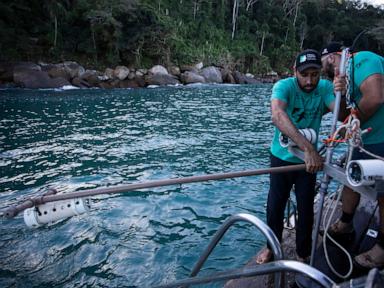
Using a mix of drone surveillance and Baited Remote Underwater Video Systems (BRUVS), researchers started capturing footage of dozens of heavily pregnant blacktip sharks cruising the shallow waters.
For a long time, the fishing communities surrounding the bay viewed these sharks as an easy food source or a regular byproduct of their daily catch. If a shark got tangled in the nets, it went to the market. Now, the revelation that this specific cove functions as an essential breeding ground has flipped local dynamics on their head.
Sharks are distinct from most bony fish because they reproduce incredibly slowly. They don't spawn millions of eggs; they have long gestation periods and produce only a few live pups at a time. If you overfish an area where pregnant females gather, you aren't just killing individual animals. You're wiping out entire future generations across the whole Atlantic ecoregion.
Why Cação is a Public Health Trap
The conservation strategy led by José Truda Palazzo, a core coordinator of the Ilha Grande Bay project, isn't just about appealing to people's love for marine biology. Let's be real: when you're running a low-resource household in a remote coastal community, abstract biodiversity arguments don't pay the bills or feed your kids.
Instead, the project is tackling the issue through two distinct angles: human health and alternative economics.
The public health argument is alarming. Because sharks sit at the absolute top of the marine food chain, they accumulate everything their prey eats. This process, known as bioaccumulation, means shark meat often carries toxic loads of heavy metals. We're talking about dangerous levels of arsenic, mercury, and lead sitting right inside that fish taco. If that doesn't put you off, consider a bizarre 2024 study that found Brazilian sharpnose sharks testing positive for high concentrations of cocaine.
The message conservationists are taking to the schools and community centers in Angra dos Reis is straightforward: cação is shark, and shark meat is toxic.
Flipping the Economic Script
You can't just tell fishers to stop catching a valuable animal and leave it at that. Marlene Fernanda do Nascimento Martins, a 35-year-old community leader in the bay, pointed out the stark economic realities of the region. She fishes and sells ice on the beach to support her three children. For families like hers, marine life is a survival asset.
The long-term play here isn't just locking down the bay and banning human activity. It's shifting the local economy toward structured ecotourism.
Because the water in Piraquara de Fora cove is relatively shallow and clear, it's highly viable for controlled shark-watching excursions. Sharks are worth far more alive as a recurring tourist draw than dead on a fish market slab for a one-time payout. Locals are already beginning to see the shift, with younger generations actively discouraging their families from targeting these animals.
The Loopholes in Brazilian Environmental Law
While local mindsets are shifting, the legal frameworks still have massive gaps. Brazil officially bans targeted shark fishing, but there's a giant loophole: bycatch.
If a fisher catches a non-protected shark species incidentally while looking for other fish, they're legally allowed to bring it to shore and sell it. Because the meat is instantly stripped down and sold under that generic "cação" label, enforcement at the docks is notoriously difficult.
The data being gathered by Leonardo Mitrano Neves and his scientific team aims to change this. By mapping exactly where these pregnant blacktips, sand tigers, and hammerheads congregate, the project is building a legal framework to establish a fully protected marine sanctuary where all fishing netting is banned, regardless of intent.
If you want to support this shift away from toxic, unsustainable seafood, the most immediate thing you can do is change your ordering habits. Stop buying cação at South American markets or restaurants. Ask vendors exactly what species they're selling. Force transparency at the counter, because cutting off the consumer demand is the fastest way to keep these pregnant sharks safe in the water where they belong.