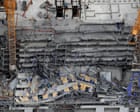
Six years after a catastrophic structural failure rattled downtown New Orleans, a massive legal chapter is finally closing. Orleans Parish Civil District Court Judge Kern Reese officially approved a $106 million combined settlement. This resolves years of intense litigation stemming from the October 2019 partial collapse of the Hard Rock Hotel under construction on Canal Street.
If you followed the disaster back when it happened, you remember the sheer scale of the chaos. The 18-story building pancaked, killing three workers—Anthony Magrette, Quinnyon Wimberly, and Jose Ponce Arreola—and leaving bodies trapped for months amid dangerous, unstable ruins. It also paralyzed a major economic hub, shut down traffic, and devastated local business owners.
Now, a massive consolidation of 490 plaintiffs—including injured workers, grieving families, and disrupted businesses—against 21 defendants has reached its financial conclusion. Here is what actually happened, what the payout means, and why this case remains a stark warning for urban construction projects.
Inside the Massive $106 Million Agreement
Lawsuits started piling up almost immediately after the dust settled in late 2019. The city of New Orleans filed suit in August 2020 targeting building owners, partners, and contractors. Over the years, those scattered claims morphed into a single, massive consolidated lawsuit.
Co-lead plaintiffs' counsel Mark Glago noted that navigating more than half a decade of legal gridlock took an immense toll on everyone involved. When Judge Reese signed off on the $106 million package, it brought a sense of finality.
"This will be an honor to, you know, these claimants that have been through so much," Glago stated following the approval.
Rather than dragging things out through individual trials where liability finger-pointing could have stalled justice for another decade, the combined funds will be distributed through a special master. John Perry Jr., appointed earlier as a special master and mediator, will oversee how the insurance funds from the defendants are funneled out to the hundreds of affected parties.
The Human and Economic Toll of the Disaster
Construction disasters of this scale don't just happen in a vacuum. When the upper floors gave way on October 12, 2019, the ripple effects hit the entire city. Canal Street was crippled for over a year. Nearby hotels, retail shops, and restaurants lost millions in revenue while the skeleton of the building sat as a dangerous monument to corporate and engineering failure.
For the families of the workers who lost their lives and the survivors dealing with permanent injuries, money will never undo the trauma. Safety violations cited by federal regulators painted a grim picture of oversight failures during construction. Yet, despite the intense public outcry and federal Occupational Safety and Health Administration (OSHA) penalties, a grand jury ultimately chose not to hand down criminal indictments against any individuals.
That lack of criminal accountability left many residents furious. It placed the entire burden of justice onto the civil legal system. For nearly seven years, victims had to wait while lawyers debated liability, insurance coverage limits, and demolition safety protocols.
Why This Case Set a Brutal Precedent for Developers
Urban infill construction is tricky, but the New Orleans project became a textbook example of what goes wrong when multiple layers of contractors, developers, and engineers fail to maintain rigorous safety standards.
- Complex Multi-Party Litigation: When 21 different defendants are tied to a single project, finding a settlement baseline is nearly impossible without court-mandated mediation.
- Preservation vs. Public Safety: The site itself became a hazard zone. Authorities had to manage unstable tower cranes, controlled demolitions, and the agonizingly slow recovery of human remains before investigations could even proceed properly.
- The Insurance Puzzle: Getting dozens of insurance carriers to cough up $106 million requires relentless negotiation. Without a special master driving the process, these claims could have easily tied up Louisiana courts for another decade.
The payout signals that while corporations and insurers can eventually settle their way out of civil liability, the reputational and operational scars remain visible. Downtown New Orleans still carries the memory of that dust cloud on Canal Street every time a major new high-rise project breaks ground.
If you are tracking urban development or legal accountability in major infrastructure projects, this settlement shows that civil courts will eventually force accountability—even if the path takes six grueling years to travel. The money is finally moving, but the industry needs to ensure mistakes like these never happen again.