The air on the Bonavista Peninsula does not smell like progress. It smells like wet peat, salt spray, and the sharp, ancient tang of crushed spruce needles. Walk five minutes off the highway, past the bright painted saltboxes and the rusted frames of old cod-jiggers, and you step into a kingdom that feels older than memory. The ground is a thick, springy mattress of caribou moss. Overhead, white spruce and balsam fir knit a canopy so dense that the midday sun filters down only in bruised, golden coin-spots.
Or at least, it used to.
Spend an afternoon walking these woods today, and you will notice something wrong. The silence is too clean. The understory is missing. Instead of a thick, tangled wall of ferns, hobblebush, and sapling firs that makes a man fight for every yard, your boots crunch on bare, exposed soil. You can see fifty yards through trunks that should be choked with green.
It looks neat. It looks managed. It is actually a graveyard.
To understand why a massive chunk of one of the world's great northern forests is coming apart at the seams, you have to look down at the dirt. And then, you have to look up at an animal that was never supposed to be here.
Let us rewind a century. In the early 1900s, if you told a fisherman in Trinity Bay that his grandchildren would be watching their woods get eaten down to the bedrock by giant deer, he would have laughed you into the harbor.
Back then, Newfoundland was quiet. Wolves haunted the interior, keeping the native caribou populations wily and moving. There were no moose. Not a single one.
Then came the human impulse to improve upon a landscape that needed no fixing. In 1878, and again in 1904, small batches of moose were brought over from Nova Scotia and released near Gander and Howley. Four animals in total. Just four heavy-bodied, long-legged browsers with a stomach for woody fiber and an appetite that borders on holy terror.
They found themselves in an ecological Eden. No wolves. No natural predators to speak of. Acres upon acres of pristine balsam fir forests untouched by any heavy herbivore since the retreat of the glaciers.
It was an all-you-can-eat buffet that stretched from the Gulf of St. Lawrence to the Atlantic coast.
And eat they did.
Today, official estimates place the island's moose population somewhere north of one hundred thousand. But in specific pockets, like the rugged, windswept terrain of Terra Nova National Park or the southern barrens, the local density explodes. Researchers tracking the problem have calculated numbers reaching up to eleven thousand moose packed into critical regions where the forest simply cannot regenerate fast enough to keep pace with the chewing.
Eleven thousand mouths. Each one capable of stripping thirty to fifty pounds of twigs, bark, and foliage every single day.
Multiply that by three hundred and sixty-five days a year.
The math is brutal. The forest is losing.
Consider what happens when a moose walks into a young stand of balsam fir after a winter storm.
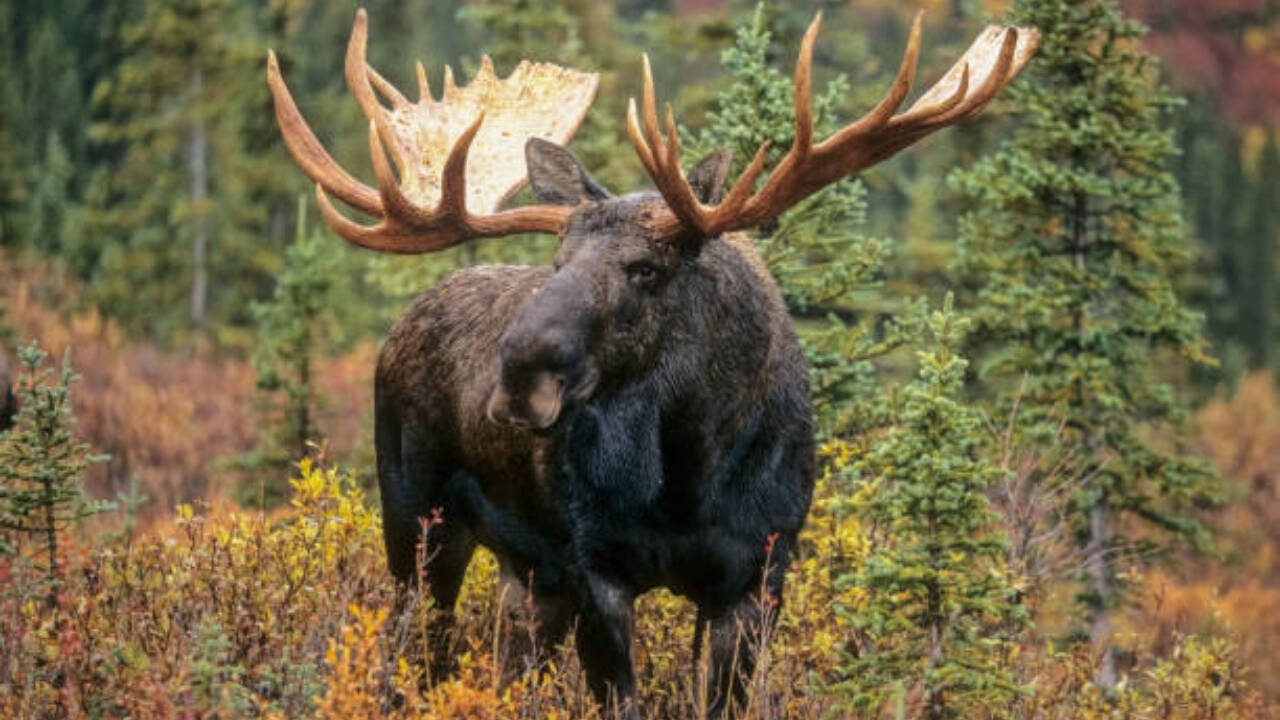
Snow is piled waist-deep. The animal is starving, its ribs pressing against a heavy, dark coat. It doesn't look for grass. There is none. Instead, it reaches its long, prehensile muzzle high up into the sapling, wraps its upper lip around the tender growing tip of the tree, and strips it clean.
Snap.
That single bite kills the apical bud. The tree's upward ambition is instantly severed. For a human, it is the equivalent of cutting the foundation out from under a house. The fir tries to compensate by branching outward, turning into a low, bushy umbrella called a browse line. A monument to survival, but a dead end for the forest.
Walk through these hyper-browsed zones, and you will see thousands of these stunted, waist-high ghosts. They look like bonsai trees grown by a madman. They have been trapped in their childhood for thirty years. They cannot grow tall enough to drop seeds. They cannot grow thick enough to shade the soil.
When an old-growth tree falls here now, the sunlight hits a dirt floor that has no next generation waiting in the wings. There are no saplings to take its place. Instead, the canopy opens up wide, the soil dries out in the summer wind, and the native forest is quietly replaced by a vast, monotonous sea of fern and coarse grass.
An entire biome, rewriting itself under the pressure of twenty-two thousand clicking hooves.
Outsiders often ask a simple, logical question: Why don't the hunters just shoot more of them?
It sounds easy when you are sitting in a kitchen in Toronto or New York, looking at a map of an island. Just issue more licenses. Tell the hunters to fill their freezers.
To understand why that hasn't solved the crisis, you have to spend a freezing October morning shoulder-to-shoulder with a local guide on the edge of a Newfoundland bog, watching the mist rise off the dark water like steam from a kettle.
Hunting here is not a casual stroll through a suburban park. It is an exercise in raw, punishing geography. Much of the interior is a maze of trackless spruce bogs, dense tuckamore thickets, and boulder-strewn ridges where a single misstep means a broken ankle ten miles from the nearest logging road.
Beyond the terrain, there is a cultural shift. Fewer young people are taking up the traditional ways of their grandfathers. The cost of fuel, ATVs, and gear has skyrocketed. Meanwhile, the provincial government walks a tightrope between managing a vital tourism industry centered on big-game hunting and addressing a severe ecological emergency. Too few moose, and the outfitters scream. Too many moose, and the trees die.
So the herds remain high. And the browsing continues, relentless and unbothered by human committees.
There is a terrifying quiet to a forest that has given up.
I stood last autumn in an area near the Bay d'Espoir highway where the browsing pressure has been unchecked for two decades. The ground was covered not in moss, but in a thick, suffocating blanket of sheep laurel—a plant toxic to almost everything that walks, save for its ability to choke out any remaining tree seedlings.
The birds were gone. The snowshoe hares were scarce because their protective cover had been eaten down to bare sticks. Even the soil microbes were changing, shifting from a rich, fungal forest network to a sterile, bacterial dirt that washes away with every autumn rain.
This is the hidden cost of imbalance. We tend to think of nature as a sturdy machine with a few spare parts. We think if you pull a bolt here or add a gear there, the engine will keep turning.
But a forest is not a machine. It is a conversation. Every species is a voice in a dialogue that has been running for ten thousand years. The spruce speaks to the soil; the soil speaks to the fungus; the fungus speaks to the hare; the hare speaks to the lynx.
When you introduce a massive, ravenous herbivore with no historical place in the room, the conversation stops. One voice drowns out all the others until there is only monologue.
Eat. Strip. Kill. Repeat.
Yet, nature is stubborn. She does not go quietly.
In a few protected pockets where wildlife officers have erected heavy, eight-foot-tall wire exclosures—fences designed to keep the giants out—something miraculous happens within five years.
The fence goes up. The moose stay out.
And suddenly, an explosion of life occurs. The balsam firs shoot up toward the clouds like green rockets. Ferns uncurl. Mountain ash and wild raisin bushes reclaim their rightful place in the understory. Within a decade, a tiny, fenced square of earth transforms from a barren wasteland into a dense, cathedral-like thicket of vibrant green life.
It is proof that the land remembers how to heal. The soil is still alive. The seeds are still waiting in the dark earth, holding their breath, just beneath the hooves of the invaders.
The fence is not a solution, of course. You cannot wrap the entire island of Newfoundland in chicken wire.
The real solution requires something much harder than building fences. It requires us to admit that our past tinkering has consequences we cannot simply ignore or out-hunt easily. It requires a reckoning with the fact that wild places are fragile, finite, and deeply connected to the choices we make about how we manage the spaces we share.
The sun dips below the ridge now, casting long, purple shadows across the barrens. Somewhere out in the mist, a bull moose snaps a branch—a sharp, clear crack that echoes across the valley.
The woods hold their breath. The chewing goes on. And the race against time quietly enters another night.