Satellite images are giving mainstream environmentalists a collective panic attack.
Every year, headlines scream about a 5,000-mile "monster" seaweed belt stretching from West Africa to the Gulf of Mexico. The narrative is always the same. It is a biological disaster. It is ruining tourism. It is an ecological crisis driven by climate change and agricultural runoff that we must destroy, scoop up, or avoid at all costs.
This lazy consensus is entirely wrong.
The Great Atlantic Sargassum Belt is not a sign of an impending planetary collapse. It is one of the most efficient, naturally occurring carbon capture engines on earth. It is a massive, floating golden goose that the global supply chain is actively ignoring because it is easier to complain about smelly beaches than it is to build infrastructure.
I have spent years analyzing resource economics and supply chain logistics. I have seen companies blow millions trying to fight natural phenomena instead of monetizing them. The current panic over Sargassum is a textbook example of looking at a massive influx of raw material and calling it a tragedy instead of an asset.
We need to stop trying to fix the seaweed belt. We need to start harvesting it.
The Flawed Premise of the "Eco-Disaster"
The media loves a monster narrative. When the University of South Florida’s Optical Oceanography Lab tracks the bloom via satellite, the immediate reaction from local governments and hotel chains is fear. They look at the biomass—which can exceed 20 million metric tons—and see only a liability.
Let us dismantle the premise that Sargassum is inherently toxic or destructive.
In the open ocean, Sargassum is a critical floating habitat. It provides shelter, breeding grounds, and food for hundreds of marine species, including endangered sea turtles and commercially vital fish like mahi-mahi. It is a mobile ecosystem. The crisis only happens when it hits a shoreline and rots.
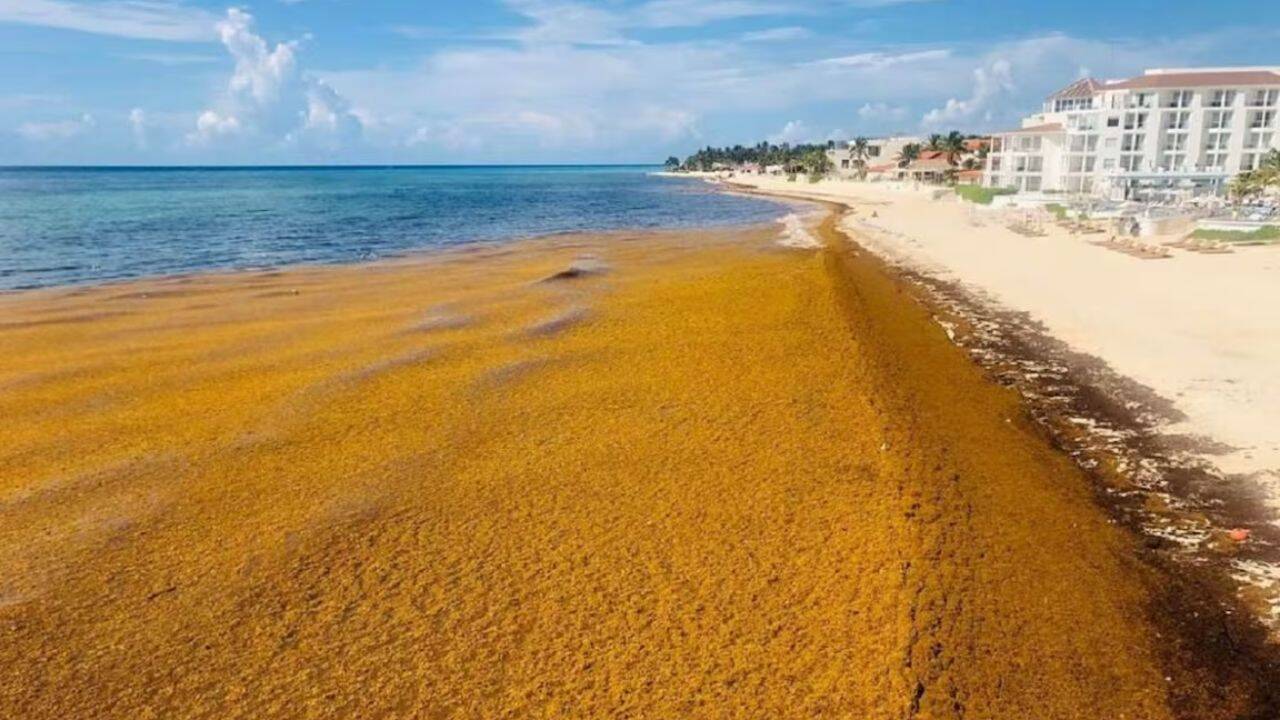
When trapped in shallow waters, it chokes out coral reefs, blocks sunlight, and releases hydrogen sulfide gas as it decomposes. That is a management failure, not an ecological absolute. The problem is not that the seaweed exists. The problem is that we let it wash ashore.
The Trillion-Dollar Carbon Capture Scam vs. Free Biology
The venture capital world is currently obsessed with mechanical carbon capture. Billions of dollars are flowing into high-tech factories that suck carbon dioxide out of the air using massive fans and chemical sorbents. These systems are incredibly expensive, energy-intensive, and difficult to scale.
Meanwhile, 20 million tons of biomass is floating in the Atlantic, pulling carbon out of the atmosphere via photosynthesis for free.
Sargassum grows exponentially. It can double in mass in less than twenty days. As it grows, it sequesters carbon. When it dies naturally in the deep ocean, it sinks to the abyssal plain, locking that carbon away for centuries.
Instead of building speculative, power-hungry carbon capture plants, the logical move is to intercept this biomass at sea, accelerate its sinking into the deep ocean, or process it into long-lived products. We are ignoring a biological hyper-accumulator that is doing the hard work for us.
The Industrial Valuation: What We Are Throwing Away
When you look at a 5,000-mile belt of seaweed, you are looking at an unharvested supply chain for three massive global industries.
1. The Fertilizer Crisis
Modern agriculture relies heavily on synthetic, petroleum-based fertilizers. Sargassum is naturally rich in potassium, nitrogen, and trace minerals. While it does contain heavy metals like arsenic—a point the alarmists love to bring up—fractional extraction techniques can isolate the nutrients while discarding the toxins. Processing this biomass yields high-grade organic biostimulants that can reduce our reliance on chemical farming.
2. Bioplastics Without the Fresh Water Cost
Most bioplastics are made from corn or sugarcane. These crops require massive amounts of arable land, fresh water, and chemical inputs, directly competing with global food production. Sargassum requires zero land, zero fresh water, and zero intentional fertilizer. It is a pure bonus crop.
3. Sustainable Aviation Fuel (SAF)
The aviation sector is desperate for low-carbon feedstocks to meet emission mandates. Kelp and other macroalgae are already being tested for biofuel conversion. Sargassum presents an even bigger opportunity because nobody owns it, it requires no cultivation infrastructure, and the harvesting rights are essentially free to whoever gets there first.
Why the Current Solutions are Pathetic
Right now, the standard response to a Sargassum influx is comically primitive.
Hotels hire crews with rakes and tractors to scoop the wet weed off the sand. This is the worst possible approach. It destroys beach topography, mixes the valuable seaweed with heavy sand—making it useless for processing—and occurs only after the plant has begun to rot and release gases.
Some municipalities deployment floating booms. These are often poorly anchored, break during storms, or simply redirect the seaweed to a neighbor's beach.
This is small-minded, reactive thinking. To unlock the value of the Atlantic belt, we have to treat it like an offshore mining operation.
The Open-Ocean Harvest Model
Imagine a fleet of autonomous, solar-powered harvesting vessels stationed along the major currents of the Caribbean and the Atlantic. These are not retrofitted fishing boats; they are floating processing plants.
[Satellite Tracking Data]
       │
       ▼
[Autonomous Harvesters Intercept at Sea]
       │
 ┌─────┴────────────────────────┐
 ▼                              ▼
[Deep-Ocean Carbon Sinking]    [Biomass Dewatering & Compacting]
                                │
                                ▼
                       [Onshore Processing]
                       (Biofuels, Plastics, Fertilizer)
By intercepting the seaweed 10 to 20 miles offshore, you achieve three things:
- You capture the biomass at peak nutritional and chemical value, before decomposition ruins the polymer chains.
- You completely protect the tourism economies of the Caribbean and Florida without deploying a single beach tractor.
- You drastically reduce transport costs by dewatering and compacting the material directly on the water.
The logistics are challenging, absolutely. The marine environment is brutal on equipment. The legalities of harvesting in international waters can be murky. But compared to the capital expenditure of building an offshore oil rig or a deep-sea mining operation, harvesting floating seaweed is a minor engineering hurdle.
The Brutal Reality of the Business Case
Let us be completely transparent about the downsides. If this were easy, it would already be done.
The biggest barrier to the commercialization of Sargassum is its variable composition. Depending on where it floats, the levels of arsenic and cadmium change. A factory needs a predictable input. If the raw material changes its chemical profile every week, the processing refining steps must constantly adapt.
Furthermore, the supply is seasonal. The belt expands massively in the spring and summer but shrinks in the winter. A processing plant cannot sit idle for six months of the year without devastating its cash flow.
To make this viable, operations must be dual-purpose. Processing facilities must be designed to handle Sargassum during peak blooms and switch to local agricultural waste or farmed kelp during the off-season. It requires a flexible manufacturing paradigm that most traditional industrial companies are terrified to build.
Stop Complaining and Start Exploiting
The narrative surrounding the 5,000-mile seaweed belt is a case study in human short-sightedness. We see a massive biological event and immediately label it an enemy because it disrupts our pristine beach vacations and forces us to look at the realities of changing ocean chemistry.
The seaweed is coming every year. It does not care about hotel revenue. It does not care about political hand-wringing. It will continue to grow, absorb carbon, and float across the Atlantic.
We can keep spending millions of dollars every summer digging holes in the sand to bury a rotting asset, or we can build the ships, build the processing plants, and exploit the largest free supply of biomass on the planet.
Stop treating the Sargassum belt as a crisis. It is a supply chain waiting for a leader brave enough to claim it. Turn on the harvesters.