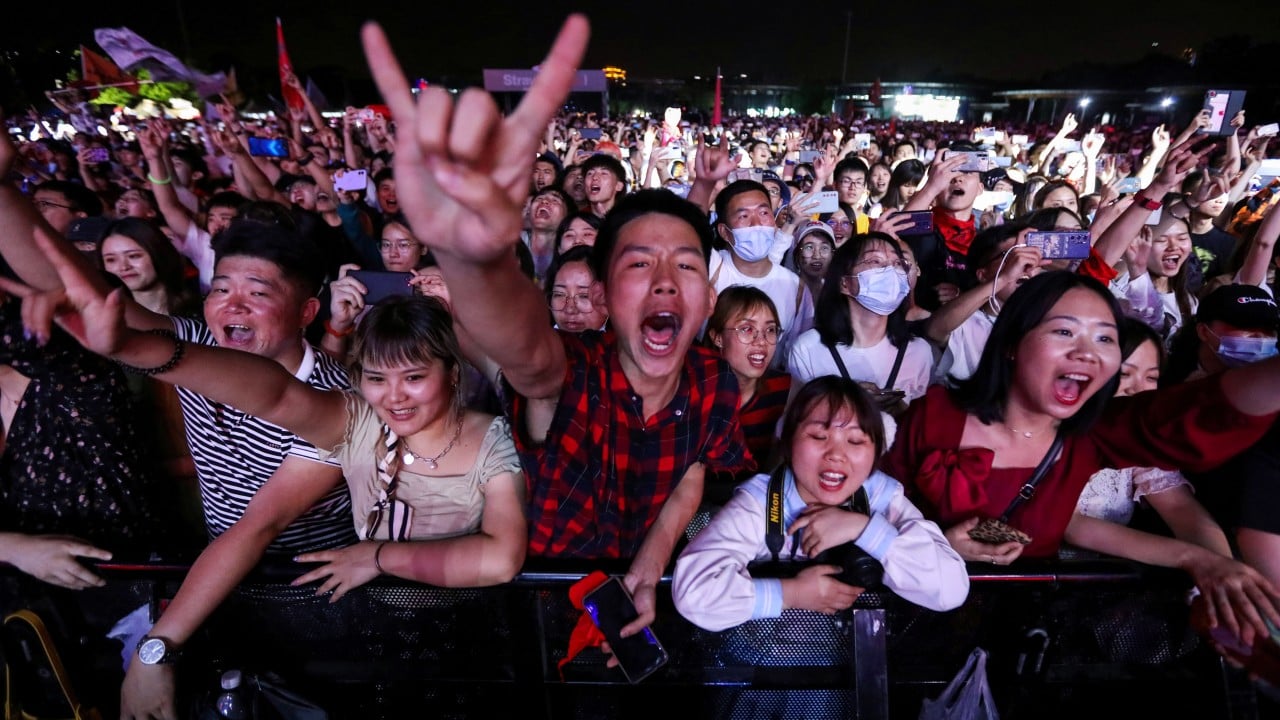
China is currently witnessing a massive geographic shift in where money is spent on live music. For decades, the industry was a predictable duopoly of Beijing and Shanghai, but the skyrocketing costs of living in "Tier 1" cities have pushed the mosh pit into the hinterlands. While the national government frames this as a "consumption drive" to boost domestic spending, the reality on the ground reveals a desperate scramble by provincial officials and real estate developers to replace falling land sales with the fleeting adrenaline of the "festival economy."
The numbers tell a story of rapid decentralization. In the first half of 2024, the number of commercial performances in China increased by nearly 25% year-on-year, but the most aggressive growth wasn't in the capital. It was in cities like Shijiazhuang, Nanchang, and Changzhou. These are places where a three-day outdoor festival can now attract 60,000 people, many of whom are traveling from larger metropolises because they can no longer afford the ticket prices, hotel rates, and logistical friction of seeing a show in Shanghai.
The Provincial Subsidy War
The sudden abundance of live music in smaller cities isn't just a natural outgrowth of fan demand. It is being heavily engineered through local government subsidies. After the collapse of the traditional property-driven growth model, municipal leaders are looking for any "green" industry that can fill hotel beds and restaurants. A music festival is the perfect temporary fix.
In many "Tier 3" and "Tier 4" cities, the local government provides the land for free, covers security costs, and sometimes offers direct cash rebates to promoters. This creates a distorted market. A promoter who might lose money in a high-rent venue in Beijing can turn a profit in a dusty field in Hebei simply because the local bureau of tourism is footng the bill for the police presence and the stage power.
This trend has turned music into a commodity used for "city branding." Local officials aren't necessarily music fans; they are spreadsheet managers. They want the "Z-generation" to post photos on social media that make their industrial city look like a lifestyle destination. However, this creates a precarious ecosystem. If the subsidies vanish because a local budget hits a deficit, the "live music boom" in that city usually evaporates overnight. There is no grassroots infrastructure—just a temporary stage on a plot of land that was supposed to be an apartment complex.
The Death of the Small Venue
While outdoor festivals are exploding, the actual "soul" of the music scene—the small, independent live houses—is struggling. It is a paradox of the current boom. More people are buying tickets to see music, but fewer people are supporting the clubs that develop new talent.
In a Tier 1 city, a 300-capacity venue might pay $15,000 a month in rent. To break even, they have to charge ticket prices that the average student or young worker can’t afford regularly. When a major festival comes to a nearby smaller city, fans save their money for that one "big event" rather than going to five club shows. This is hollowing out the middle class of the music industry. We are seeing a "winner-takes-all" dynamic where a few superstars and massive festivals capture 80% of the revenue, while the clubs that give local bands their start are quietly shuttering.
The cost of touring has also become a logistical nightmare. China is vast. Moving a four-piece band with gear from Chengdu to Shenyang requires flights, hotels, and local transport that have all increased in price. Without the anchor of a profitable club circuit, bands are becoming reliant on the "festival lottery." They wait for a call from a provincial organizer to play a 40-minute set in a city they've never heard of, rather than building a loyal fanbase through consistent touring.
Youth Anxiety and the Escapism Economy
To understand why thousands of young people are flocking to these remote festivals, you have to look at the psychological state of the Chinese worker. The "996" work culture (9 am to 9 pm, six days a week) has left a generation burnt out. With youth unemployment remaining a sensitive and persistent issue, many young people have adopted a "lying flat" or "letting it rot" mentality.
In this context, a music festival isn't just entertainment. It is a temporary autonomous zone. For three days, they can escape the pressures of a cooling economy and a hyper-competitive job market. They spend their dwindling disposable income on "experience" because the traditional milestones—buying a house or starting a family—feel increasingly out of reach.
This shift from "saving for the future" to "spending for the moment" is what is truly driving the provincial boom. It is a form of aggressive hedonism fueled by a lack of long-term financial confidence. Promoters know this. They market festivals not just on the lineup, but on the "vibe"—the camping, the craft beer stalls, and the Instagrammable installations. The music is often secondary to the atmosphere of collective release.
The Infrastructure Trap
There is a technical reason why smaller cities are suddenly viable venues. China's high-speed rail network has effectively shrunk the country. You can now live in a Tier 2 city like Hangzhou and be in a Tier 3 city for a festival in under an hour. This "one-hour economic circle" allows festivals to draw from a massive population base without needing that population to live in the host city.
However, the infrastructure of the music industry hasn't kept pace with the concrete infrastructure of the trains. Most smaller cities lack professional sound engineers, lighting technicians, and stage managers. Promoters have to "import" entire crews from the major cities, which adds a layer of hidden cost.
Furthermore, the regulatory environment in provincial China is a patchwork of uncertainty. A permit that is easy to get in Shenzhen might be impossible to secure in a conservative interior province. We have seen numerous instances of festivals being canceled with 24 hours' notice due to "technical reasons"—a common euphemism for a local official getting cold feet or a last-minute change in security protocols. This volatility makes the "smaller city boom" a high-stakes gamble for investors.
The Content Crisis
As the volume of performances grows, the quality of content is hitting a ceiling. There are only so many headliners in China that can move 20,000 tickets. Because every provincial city now wants its own festival, the same twenty bands are being rotated across the country.
This "musical musical-chairs" leads to audience fatigue. A fan in Nanjing might see the same indie-rock band three times in a single summer because that band is the only "safe" and "proven" act available for booking. The censorship process also plays a role here. Every lyric must be vetted, and every setlist approved weeks in advance. This naturally favors established, "safe" acts over experimental or rebellious newcomers.
The result is a homogenization of the live experience. Whether you are in the deserts of Ningxia or the mountains of Yunnan, the festival starts to look and sound the same. The local culture of the host city is rarely integrated into the event. It is a "pop-up" experience that leaves no lasting impact on the local community once the stage is dismantled.
Reforming the Model
If this boom is to be more than a bubble, the industry needs to move away from the "event-only" mindset. The current reliance on government handouts and one-off spectacles is unsustainable.
A healthier model would involve "music clusters"—small-scale, permanent venues built into the urban planning of these emerging cities. Instead of spending $2 million on a single weekend, local governments could spend that money on low-interest loans for venue owners or tax breaks for local rehearsal spaces.
Investors also need to recognize that the "Tier 1" market is saturated and overpriced. The real opportunity lies in creating "destination venues" in smaller cities that offer high-quality sound and consistent programming, rather than relying on the circus-like atmosphere of a mega-festival. This requires a longer time horizon and a deeper understanding of local subcultures, something that most "lifestyle" developers currently lack.
The Hidden Cost of the Boom
The environmental and social impact of these provincial festivals is often ignored. These events produce massive amounts of waste in areas that may not have the waste management capacity to handle it. Moreover, the sudden influx of thousands of outsiders can drive up local prices for residents who aren't participating in the festival economy.
There is also the risk of "cultural gentrification." When a big-city promoter brings a massive event to a rural or industrial town, they often overlook local artists and vendors. The profits are siphoned back to headquarters in Beijing, leaving the host city with little more than a pile of trash and some temporary social media buzz.
The industry is at a crossroads. It can continue to chase the easy money of provincial subsidies and the "escapism" of a stressed-out youth, or it can build a durable, decentralized network of live music that survives after the government incentives dry up. The current "boom" is a sign of a shifting economy, but without a foundation of local venues and new talent, it remains a fragile theater of consumption.
The real test will come when the next economic cooling cycle hits. When local governments are forced to choose between funding a music festival and funding a hospital, the music will stop. Promoters who haven't built a real connection with the local audience will find themselves with nowhere to plug in their amps.
Stop looking for the next "big thing" in the Tier 1 capitals. The future of Chinese music is being decided in the 1,000-seat halls and dusty fields of the interior, but only if the industry learns that a scene is built on sweat and local loyalty, not just a municipal subsidy.