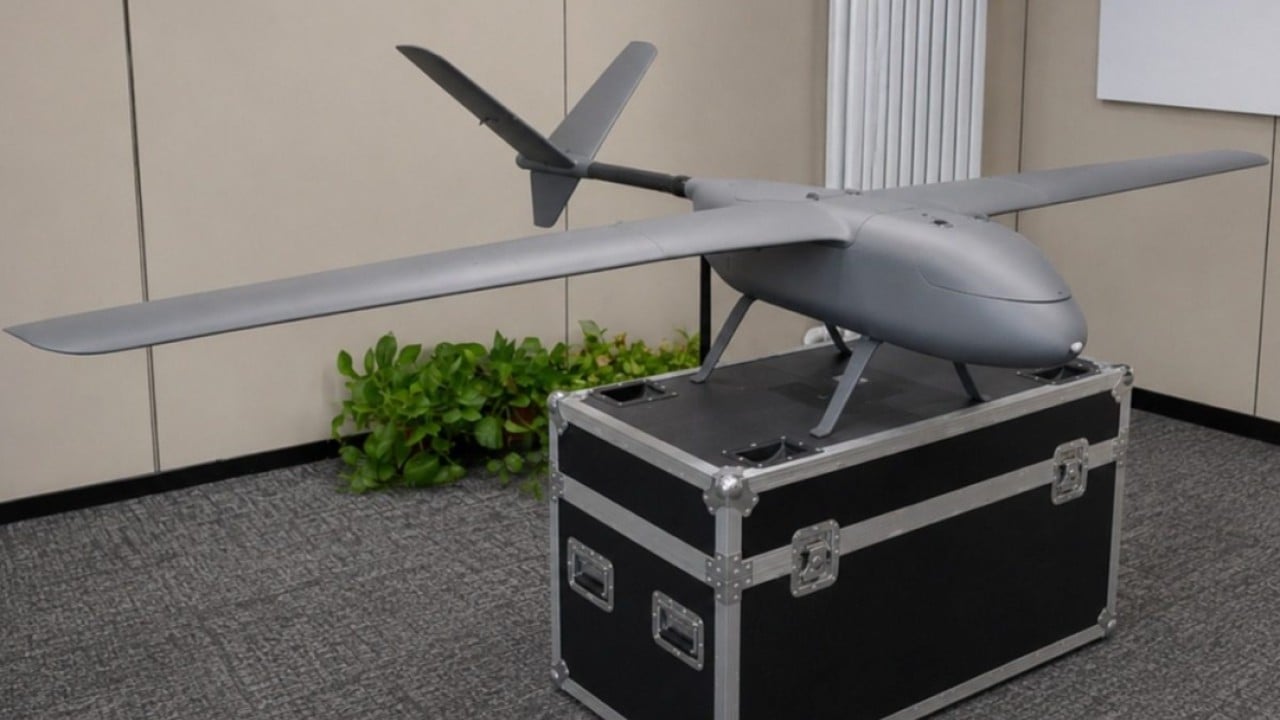
The air inside the small garage in Shenzhen smells of standard hardware store projects: aerosol propellants, curing resin, and the sharp bite of industrial cleaner. A technician, wearing a simple respirator mask and a stained pair of overalls, lifts a pneumatic spray gun. He isn't painting a custom motorcycle or a kitchen cabinet. He is coating a carbon-fiber drone frame that cost less than an iPad.
The liquid flowing from the nozzle is dark, matte, and thick. To the untrained eye, it looks exactly like the rubberized undercoating you would spray on a truck bed to prevent rust.
It costs less than a decent bottle of scotch per kilogram. But when it dries, it does something that, until very recently, required the treasury of a superpower to achieve. It swallows radar waves.
For decades, military stealth was defined by a specific number: two point one billion dollars. That was the staggering cost of a single B-2 Spirit bomber. To make a machine invisible to the electronic eyes of the world, governments had to build climate-controlled hangars, employ teams of material scientists, and apply proprietary, fragile coatings that required meticulous reapplication after nearly every flight. Stealth was a high church. Only a few nations could afford to enter.
That gate is now wide open.
A quiet shift in the global supply chain has turned a state secret into a commodity. Star-Navi, a technology firm operating out of China's manufacturing heartland, has begun selling its XRAM-C Series coating in standard industrial tubs. You don't need a military contract to buy it. You don't need a security clearance. You need a credit card.
The Math of the Disappearing Target
To understand exactly how the equation of modern conflict has changed, we have to look at how radar senses the world. Imagine standing in a pitch-black gym with a flashlight, trying to find a silver coin thrown into the air. The beam hits the metal, bounces straight back to your eyes, and you see a glint.
Radar does the same thing with microwaves. It throws energy into the sky. If that energy hits a piece of metal, it bounces back to a receiver.
Traditional radar-absorbing materials work like a heavy velvet blanket thrown over that silver coin. They don't make the object physically disappear; they change the nature of the reflection. When the microwave energy hits the coating, the tiny magnetic particles inside the paint—often carbonyl iron or sophisticated nanocomposites—vibrate. This physical motion turns the incoming radar energy into heat. The energy is dissolved. The glint never travels back to the flashlight.
Serious military-grade stealth materials aim to reduce that reflection by 20 to 30 decibels, turning a fighter jet into the radar profile of a small bird. The commercial paint flowing out of Shenzhen doesn't do that. Its official performance metrics claim a reduction of roughly 3 decibels.
Three decibels sounds small. It isn't.
In the logarithmic language of physics, a 3-decibel reduction means exactly half of the reflected radar power is gone. Consider what happens next when that paint is applied to a cheap, off-the-shelf plastic drone. The drone was already small. Now, half of its electronic footprint is erased. It doesn't become completely invisible, but it becomes a phantom. It blurs.
The End of the High Gate
The real crisis here isn't a breakthrough in laboratory physics. The crisis is logistics.
Historically, the American approach to stealth has been an exercise in extreme perfectionism. The radar-absorbent skin of an F-22 or an F-35 is notoriously temperamental. It cracks under intense aerodynamic heat. It degrades in high humidity or during simple maneuvers in salt fog. Maintaining that skin costs millions of dollars annually per aircraft, requiring specialized diagnostic tools and technicians working in immaculate conditions.
The strategy behind this new wave of commercial coatings is completely different. It embraces the imperfect.
Instead of demanding a pristine surface on a multi-million-dollar fighter jet, this material is designed to be sprayed onto a throwaway plastic quadcopter by an operator sitting in the back of a muddy pickup truck. If the paint chips, you don't ground the aircraft for three weeks of laboratory repairs. You grab a fresh can and spray it again. It takes thirty minutes.
This democratization of low-visibility technology completely upends the logic of modern defense systems. For the past decade, airspace security has been built on the assumption that threat-detection radar only needs to look for distinct, high-signature targets. Cheap drones were supposed to be noisy, bright, and easily spotted by sensor fusion algorithms.
But when the ability to halve a radar signature is sold by the kilogram, that assumption shatters. Air defense networks suddenly face a tracking problem that has grown exponentially. The sky becomes crowded with thousands of tiny, low-signature objects, each one demanding computational energy to verify, track, and target.
The Expanding Surface Area
This is no longer a localized problem confined to airspace. Autonomous machines are colonizing every corner of our environment.
Look toward the oceans. Small, unmanned surface vessels and underwater drones are being deployed to monitor shipping lanes or sit silently on the seabed to watch submarine transits. When these small craft are coated with a layer of cheap, wideband radar-absorbing material, they don't just disappear from sight—they blend seamlessly into the chaotic clutter of ocean waves and whitecap reflections.
We are moving rapidly toward a world where the defining trait of machinery is its silence.
It is easy to view this through a lens of pure anxiety, to see the collapse of the high-tech wall as an unmitigated threat. But there is a deeper, more human truth to face. Technology has a persistent habit of escaping its creators. The tools that once required empires to build inevitably find their way into the global marketplace, packed into plastic buckets, ready to be shipped anywhere in the world.
The technician in Shenzhen sets down his spray gun. The matte-black drone sits under the fluorescent lights, completely still, its surface dry to the touch. It looks ordinary. It looks like a toy. But the energy of the room seems to pass right through it, leaving nothing but an empty space where a machine used to be.