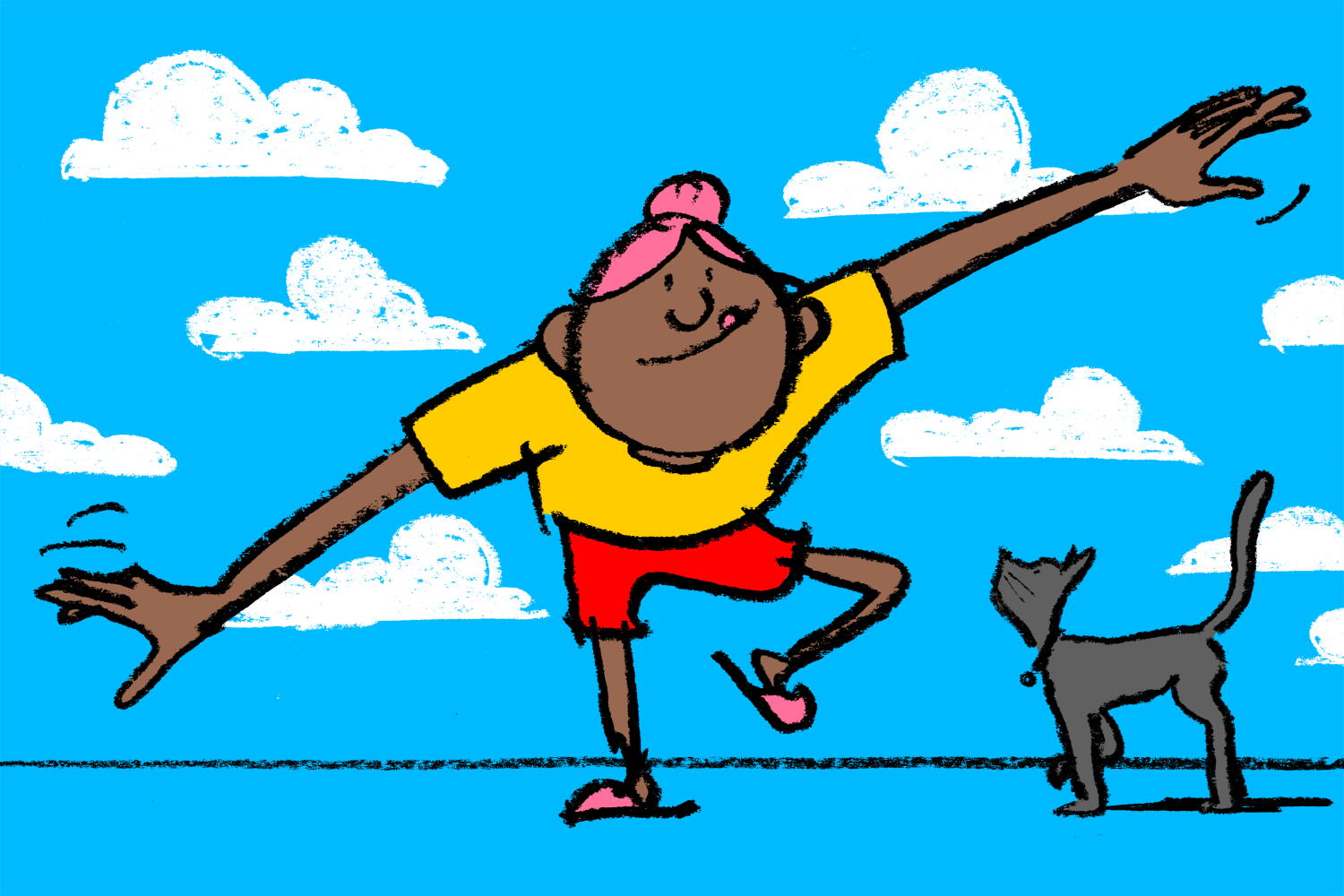
We spend decades obsessing over our cholesterol, our blood pressure, and our caloric intake. We monitor the chemical markers of our internal organs while ignoring the mechanical reality of our existence. You are currently fighting a constant, invisible war against gravity. Most people are losing, and they have no idea why their vitality is bleeding out until they take a bad fall in their sixties or seventies. The decline is not merely a matter of fading muscle or brittle bones. It is a catastrophic failure of the brain to compute its position in space. Your balance is not just a skill for standing still. It is the literal foundation of biological longevity.
When your equilibrium falters, your body enters a state of chronic defensive tension. Every step you take becomes a calculated risk. Your muscles tighten to compensate for perceived instability, consuming energy that should be used for cellular repair and metabolic maintenance. This is the gravity deficit. It forces the body to prioritize immediate survival over long-term durability. If you do not actively maintain the pathways between your inner ear, your eyes, and your feet, the neural maps governing your movement begin to degrade. You do not wake up one day and suddenly lose your balance. You lose it in silent, incremental slivers every time you stop challenging your proprioception.
The Neurological Tax of Stability
The human body is essentially a complex series of levers and pulleys managed by a central processor that relies on a constant stream of data. Balance requires an instantaneous integration of vestibular input from the inner ear, visual tracking, and sensory feedback from the soles of the feet. This is a high-bandwidth task. In youth, this processing happens beneath the level of conscious thought. We sprint across uneven ground and jump off ledges without a second thought. But as we age, we often retreat into predictable, flat environments. We walk on sidewalks, sit in ergonomic chairs, and drive smooth cars. We effectively lobotomize our balance systems by removing the requirement for them to function.
The brain is a miser. It discards what it does not use. If you avoid uneven terrain or tasks that require fine-tuned stabilization, the neural circuits dedicated to those actions atrophy. This is why a person can be physically strong—capable of lifting heavy weights—but still possess the balance of a toddler. Strength is the engine, but balance is the steering system. You can have a powerful engine, but if your steering is loose, you are eventually going to drive off the road.
Consider a hypothetical example: a retired office worker who spends four days a week in the gym lifting dumbbells. He is objectively strong. However, he refuses to walk on trails or participate in any movement that requires him to rotate his torso while his feet are moving. His brain has forgotten how to handle dynamic weight distribution. The moment he encounters an uneven curb in a parking lot, he lacks the reflexive correction time to keep from toppling. His muscles were ready to work, but his nervous system was asleep.
Beyond the Strength Training Myth
The fitness industry loves to push resistance training as the single answer to aging. Resistance training is excellent for bone density and muscle mass, but it is incomplete. If your training regimen consists solely of fixed-motion machines where the machine does the stabilizing for you, you are doing nothing for your longevity. You are just making your muscles stronger in an artificial, restricted range. To truly combat the gravity deficit, you must introduce unpredictability.
You need to train your body to recover from deviations. This means moving in ways that force your center of gravity to shift continuously. It is not about standing on one leg while you brush your teeth, which is a low-level drill that eventually offers diminishing returns. It is about loading your movement with variety. Walking on sand, navigating rocky paths, or practicing movements that require rotation and balance simultaneously will provide the nervous system with the stimulus it needs to stay sharp.
The goal is to maintain what physiologists call compensatory postural control. This is the body’s ability to react to a sudden trip or a shift in the ground surface before the conscious mind can even process the danger. If you wait until you feel yourself falling to fix the problem, you are already behind the curve. You must build the reflex, not the reaction.
The Hidden Cost of Sedentary Comfort
Comfort is the enemy of physical endurance. We have designed a society that minimizes the need for balance. Shoes with thick, cushioned heels and rigid soles act as sensory dampeners. They disconnect your feet from the ground, blocking the millions of nerve endings that tell your brain exactly how you are situated. Wearing these shoes day in and day out is the equivalent of wearing mittens while trying to play a piano. You are losing the tactile feedback necessary to maintain optimal alignment.
Then there is the chair. We spend the majority of our waking hours in chairs that support our backs, our thighs, and our arms. The chair does the work of sitting for us. In a natural, un-engineered environment, sitting on the ground or a low stool requires active engagement of the core and the hip stabilizers. A chair allows your muscles to go slack, contributing to the "dead butt" syndrome and shortening the hip flexors. These shortened muscles pull the pelvis forward, altering your posture and shifting your center of gravity. You are walking around in a state of constant, slight imbalance because your structure has been deformed by the very objects meant to make you comfortable.
If you want to reverse this, start by diversifying your movement floor. Spend time on the ground. Get up without using your hands. These are not merely exercises; they are tests of your mechanical integrity. If you find these movements difficult, you have identified exactly where your gravity deficit is manifesting. Do not reach for a brace or a supplement. Reach for the floor. Reclaim the range of motion that your furniture has stolen from you.
Why Symmetry is a Trap
Many standard exercise programs force bilateral movement—doing the same thing on both sides simultaneously. Squats, presses, and rows are vital, but they ignore the reality that life is rarely perfectly symmetrical. You reach for a heavy bag with one hand. You step off a curb with one foot while carrying groceries in the other. Your body must know how to stabilize itself under asymmetrical loads.
If you only train with two feet firmly planted, you are missing half the equation. Integrate unilateral training—split squats, single-leg deadlifts, and offset carries. When you hold a weight in one hand and walk, your core must work at a much higher intensity to prevent your torso from tilting. This is where balance is forged. It teaches the nervous system to handle load when the body is not perfectly aligned. It creates a robust structure that does not crumble when life presents an uneven challenge.
The obsession with perfect form in the gym often leads people to avoid any movement that looks or feels awkward. But the awkward movements are the ones that save your life. If you are afraid of looking foolish while practicing a difficult balancing drill, you are prioritizing social image over your biological survival. There is a profound difference between training for aesthetic performance and training for physical autonomy. One looks good in a mirror, the other keeps you independent when you are eighty.
Reclaiming the Reflexive Self
You can measure your own decline with brutal honesty. Time how long you can stand on one leg with your eyes closed. If you cannot hit thirty seconds without wobbling, your proprioception is failing. This has nothing to do with your strength and everything to do with the neural pathways that monitor your spatial orientation. The good news is that these pathways are plastic. They can be rewired at any age, provided you give them the right stimulus.
Stop treating your body like a car that needs regular maintenance at a shop. Start treating it like a complex organism that requires constant, varied challenges to maintain its resilience. Seek out terrain that requires attention. Walk on uneven surfaces. Stop relying on your shoes to be your interface with the earth. The most effective way to slow the aging process is to keep your brain actively engaged in the process of keeping you upright.
The moment you concede to the comfort of the couch or the stability of the machine is the moment you begin to decline. You are either training for stability or you are training for the fall. There is no middle ground in the physics of aging. The gravity deficit is real, and it is indifferent to your intentions. It only respects the effort you put into maintaining your connection to the physical world. Your longevity is earned in the seconds you spend correcting your posture, adjusting your balance, and forcing your nervous system to navigate the unpredictable terrain of life. Do not wait for a stumble to realize that your foundation has cracked. Start today by making your movement as intentional as your breathing.


/saur-energy/media/post_attachments/2023/02/green_funding.jpg)