The morning air in the Penedès region usually smells of wet stone, sleep, and the sharp, clean bite of coming autumn. By mid-August, the grapes should still be dreaming on the vine, soaking in the slow descent of the Mediterranean sun, fattening themselves on patience and morning dew. They should be weeks away from the frantic choreography of the vintage.
Instead, the shears are clicking in July.
Mateu stands between rows of old Macabeo vines, holding a cluster that looks entirely wrong for the date on his watch. The berries are small, dense, and unnaturally sweet, baked by weeks of relentless atmospheric pressure that has rewritten the rural rhythm of Catalonia. He pinches a skin between thumb and forefinger. It yields too easily. Inside, the juice is already heavy with sugar, panicking toward an alcohol level that belongs to a different climate entirely.
"We are chasing the shadows," he says, though there is no one nearby to hear him except the cicadas.
Across Europe, the heatwaves are no longer weather events. They are metronomes. They dictate the speed of life, shortening the childhood of fruit and forcing harvests into calendars that look like misprints. What is happening in Spain is a glimpse into a broader restructuring of the earth, told through the medium of agriculture, sweat, and fermented juice.
The Arithmetic of Thermal Shock
To understand why a Catalan winery is pulling its crop off the wire in the middle of summer, you have to abandon the romantic notion of the vintage. Wine is not just poetry; it is chemistry under duress.
For generations, winemaking relied on a predictable arc. Spring brings budburst, summer brings steady warmth, and autumn delivers the long, cool nights that allow sugars and acidity to find a delicate, fragile balance. Acid is the spine of wine. Without it, the beverage collapses into a heavy, flabby syrup.
Heat is the enemy of acid. When temperatures refuse to drop below thirty degrees Celsius for weeks on end—night after night, offering no physiological relief to the plant—the vine goes into a state of biological triage. It shuts down its metabolism to survive, burning off its malic acid just to keep its cellular machinery intact.
Consider what happens next: the sugar accumulates because the sun keeps pounding down, but the acidity plummets. The grower is trapped in a cruel mathematical paradox. Wait another week for optimal phenolic maturity, and the acid disappears entirely, leaving a juice that will ferment into something hot, unbalanced, and unrecognizable. Harvest early, and you risk green tannins and raw flavors.
Mateu chose early. He had to. By late July, his fields were registering parameters that historically belonged to late September.
This is the invisible cost of climate velocity. It is not just that it is getting hotter; it is that the seasonal transitions are being compressed into nothingness. Spring bleeds into a furnace, and autumn arrives as an afterthought.
The Human Cost in the Rows
The physical reality of an early harvest is brutal.
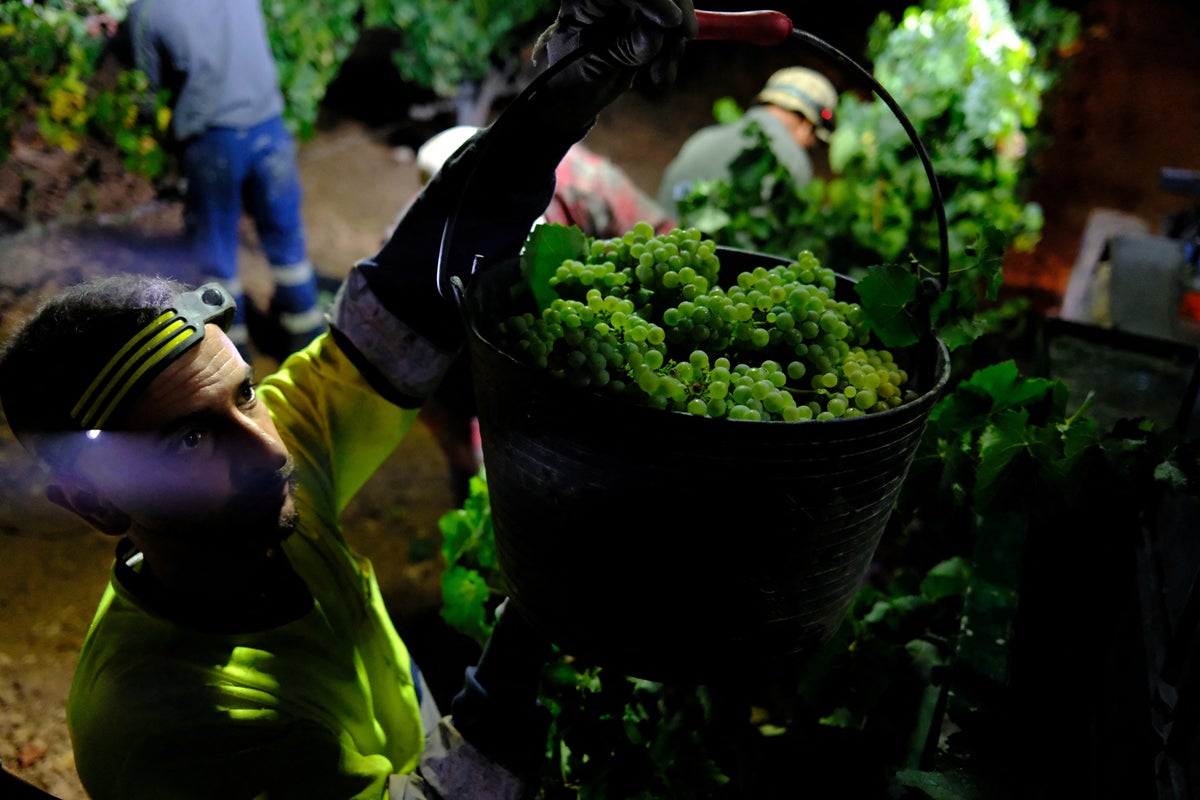
When picking moves from the crisp dawns of September to the searing afternoons of mid-summer, human bodies bear the brunt. Crew leaders shift schedules backward, demanding that workers report to the fields by four in the morning, racing against the sun to get the fruit into the cellar before the temperature climbs past twenty-five degrees.
By seven in the morning, the light is already hard and white, casting sharp shadows between the rows. Hands move with mechanical precision. Snip, drop, toss. Snip, drop, toss. The wooden lugs fill up with dust and warm fruit.
(Note: While the daily routines of specific vineyard crews vary by estate, the shift toward pre-dawn picking across southern European wine regions is a verified, widespread adaptation to extreme summer temperatures.)
There is a quiet grief in this work. Older harvesters talk about vintages from thirty years ago the way people talk about a country they left in their youth. They remember mists that lingered until noon. They remember wearing flannel shirts while tossing the last baskets onto the truck. Now, they strip down to t-shirts before the sun clears the horizon, wiping salt from their eyes while the fruit shrivels on the vine behind them.
It changes the culture of the land. Agriculture is supposed to teach patience, but the modern climate teaches triage. You do not plan for decades; you plan for the next forty-eight hours. If a heat dome settles over the Iberian Peninsula, you drop everything and pick. The winery must adapt or perish.
The Cellular Rebellion
Why do the vines respond this way? Because they are ancient organisms trapped in a modern script.
A grapevine is remarkably stubborn. It remembers every drought, every frost, and every heatwave through epigenetic memory, adjusting its behavior year over year. When the soil moisture drops below critical thresholds and the air turns into a convection oven, the vine's stomata—the microscopic pores on the leaves—seal shut to prevent water loss.
With its breath cut off, photosynthesis sputters. The plant diverts all its remaining energy into the fruit, attempting to ripen the seeds so that birds might eat them and scatter the species before the mother plant dies of thirst. It is a desperate, evolutionary gamble.
The wine that emerges from this panic-harvest is different, too. It carries a higher alcohol potential because of the concentrated sugars, and it lacks the nervous, electric tension of a cooler year. Winemakers are forced to become interventionists, using cold-soaking techniques, acidification, and careful yeast selection to piece together a semblance of balance from grapes that were forced to grow up too fast.
Some estates are fighting back by planting new vineyards at higher altitudes, clawing their way up the mountain slopes where the air is thinner and cooler. Others are experimenting with forgotten, heat-tolerant varietals that were abandoned centuries ago because they ripened too late for the old climate.
They are hunting for time.
The End of the Old Calendar
We are standing at the edge of a great rearrangement.
When a Catalan winery brings in its harvest weeks ahead of schedule, it is not an isolated anomaly. It is a bellwether. It signals that the traditional markers of human life—the harvest festivals, the vintage charts, the seasonal expectations passed down through five hundred years of trial and error—are dissolving.
The earth is speaking a new language, and we are still struggling to conjugate the verbs.
Back in the rows, Mateu wipes his forehead with the back of a calloused hand and looks toward the horizon, where a pale haze hangs over the Mediterranean. The sun is climbing. The temperature is already touching thirty-four degrees, and it is only eight in the morning. He reaches for his shears, snaps another cluster from the wire, and lets it drop into the box with a dull, heavy thud.
The season is over before it had a chance to begin.
:max_bytes(150000):strip_icc()/ar-American-Cheese-taste-test-horizon-4x3-54cc339550cd44b9a818c17bdfd5428d.jpg)