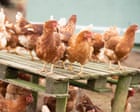
The British government thinks it has found an easy win for national security. Eat more homegrown chicken, fix the food supply, and keep voters happy with cheap protein. Earlier this month at the Groundswell agriculture festival, Emma Reynolds, the environment secretary, made the case plain. She argued that the path to robust food security lies in consuming more homegrown produce. To make that happen, the newly minted Farming and Food Partnership Board is fast-tracking a sector growth plan specifically targeting poultry.
On paper, it sounds like common sense. Why import meat when you can grow it in Shropshire or Norfolk? But look a little closer and the logic completely falls apart.
Campaign groups are sounding the alarm, warning that pushing for an intensive poultry boom will actually sabotage UK national security rather than protect it. The strategy relies on a massive blind spot. Our industrial chicken farms don't exist in a vacuum. They are entirely dependent on a fragile, thousands-of-miles-long supply chain just to keep the birds alive.
The South American Lifeline
Here is the reality of the British chicken industry that politicians conveniently ignore. A factory-farmed chicken is basically a machine that converts imported soy into cheap meat.
The government’s own national security assessments reveal a glaring vulnerability. Animal farming at current levels is utterly unsustainable without massive foreign imports. Specifically, soy grown in South America makes up a staggering 18% of all produced animal feed in the UK.
"Besides destroying the Amazon rainforest to feed factory-farmed chickens, heavy reliance on imports of animal feed also leaves us vulnerable to supply chain shocks and ecosystem collapse, which is a national security issue." — Maya Pardo, Communities Against Factory Farming (CAFF).
If a geopolitical crisis or a climate-driven crop failure hits South American soy producers, the UK poultry sector collapses within weeks. You aren't building a self-sufficient food fortress. You are just outsourcing your vulnerability to the other side of the planet.
Planning Rules and Environmental Collateral Damage
To achieve the growth the government wants, ministers are looking to rewrite planning laws. The National Farmers' Union (NFU) complains that aging infrastructure is holding back production. They claim the average British broiler house is 31 years old and that the industry needs to build more than 1,000 new poultry sheds to keep pace with public demand.
The government seems all too eager to oblige them by cutting red tape. But those planning constraints exist for a reason. Intensive poultry units produce mountains of toxic manure. This waste washes into local river systems, choking rivers like the Wye with phosphate pollution and triggering catastrophic ecological dead zones.
True security isn't just about counting the number of carcasses moving through a processing plant. Long-term food production relies entirely on healthy soils, clean water systems, and biodiversity. If you poison the local environment to build mega-farms, you ruin the foundational resources needed to grow food in the future.
What Genuine Food Security Looks Like
If the goal is genuine resilience against a volatile world, doubling down on resource-intensive, import-dependent poultry is the wrong move.
Campaign groups like Sustain are urging the government to scrap the poultry expansion plan entirely. Instead, the focus should shift toward scaling up homegrown protein sources that don't rely on imported inputs—think pulses, legumes, nuts, and beans. These crops improve soil health naturally, require a fraction of the water and energy, and can actually be grown fully within British borders.
We live in an era where climate degradation, ecosystem collapse, and geopolitical instability threaten severe food price shocks. We can no longer rely on a risk register that treats emergencies as isolated, predictable events. Shocks are happening constantly.
If you want to protect the food supply, stop trying to grease the wheels for industrial chicken factories. True national security requires breaking our dependence on global supply lines and restoring the health of our own land.
The government needs to audit the true, input-to-output resource dependency of any agricultural sector before granting fast-track planning perks. Diversify your own plate by sourcing protein from local, nature-friendly farms. Vote with your wallet and support agricultural systems that build resilience from the soil up, rather than those relying on a fragile trans-Atlantic supply chain.