Walk ten paces off the logging roads outside Bathurst, New Brunswick, and the forest suddenly forgets how to grow.
The black spruce stops. The wild blueberries vanish. In their place rises a strange, flat-topped plateau of gray-brown dust that crunches like stale snow beneath your boots. When the wind blows off Chaleur Bay, it kicks up a fine, metallic grit that tastes faintly of copper pennies and sour rain.
For decades, the people of northern New Brunswick walked past these sprawling mounds of mine tailings without looking twice. They were the price of doing business. The leftover crumbs from the glory days of the Brunswick No. 12 mine, once one of the largest underground zinc and lead operations on Earth. When the shafts finally closed in 2013, the jobs left, the trucks stopped rumbling down Route 430, and the gray mountains stayed behind.
Silent. Heavy. Waiting.
Most people saw an environmental headache—a toxic bill waiting to come due for future generations. But in Fredericton, inside quiet boardrooms and cramped geology labs, a very different realization was taking hold. Those lifeless hills of crushed rock aren't garbage at all. They are vaults. And New Brunswick just struck a landmark deal to crack them open.
The Alchemy of Leftovers
To understand why a provincial government would suddenly get excited about decades-old mining waste, you have to picture how we used to dig things out of the ground.
Consider a hypothetical scenario to make the chemistry clear. Imagine baking a massive chocolate chip cookie using a recipe from 1965. Your oven is imprecise, your sifter is too wide, and you only care about pulling out the biggest chunks of chocolate. You toss the rest of the dough—crushed nuts, melted sugar, tiny shavings of cocoa—into the backyard. Fifty years later, you realize you are starving, and someone tells you that the pile of crumbs in your yard actually contains enough calories to feed your family for a decade.
That is the exact reality of historical mining in eastern Canada.
When companies blasted rock out of the Bathurst Mining Camp in the mid-twentieth century, they had tunnel vision. They wanted zinc. They wanted lead. They wanted silver and copper. Their crushing mills and chemical flotation tanks were engineered exclusively to grab those four metals. Everything else in the rock—elements that had no commercial value in 1972—was pulverized into sand, mixed with water, and pumped out into massive holding ponds.
Today, those "worthless" elements have a different name. We call them critical minerals.
Indium. Germanium. Bismuth. Antimony. Cobalt.
Without them, the modern world simply stops spinning. Indium makes your smartphone screen respond to the touch of your thumb. Germanium keeps fiber-optic cables humming and allows infrared night-vision goggles to see in the dark. Antimony hardens the lead in industrial batteries and serves as an essential fire retardant in aircraft cabins.
For the last twenty years, North America has largely outsourced the messy business of extracting and refining these elements to the other side of the planet, predominantly China. We bought the sleek finished gadgets and ignored the supply chain. Then geopolitical tensions tightened, export controls snapped shut, and western governments woke up in a cold sweat realizing they didn't control the basic ingredients of their own energy grids or defense systems.
Suddenly, the gray dust outside Bathurst didn't look like waste anymore. It looked like sovereignty.
A Bet on the Forgotten
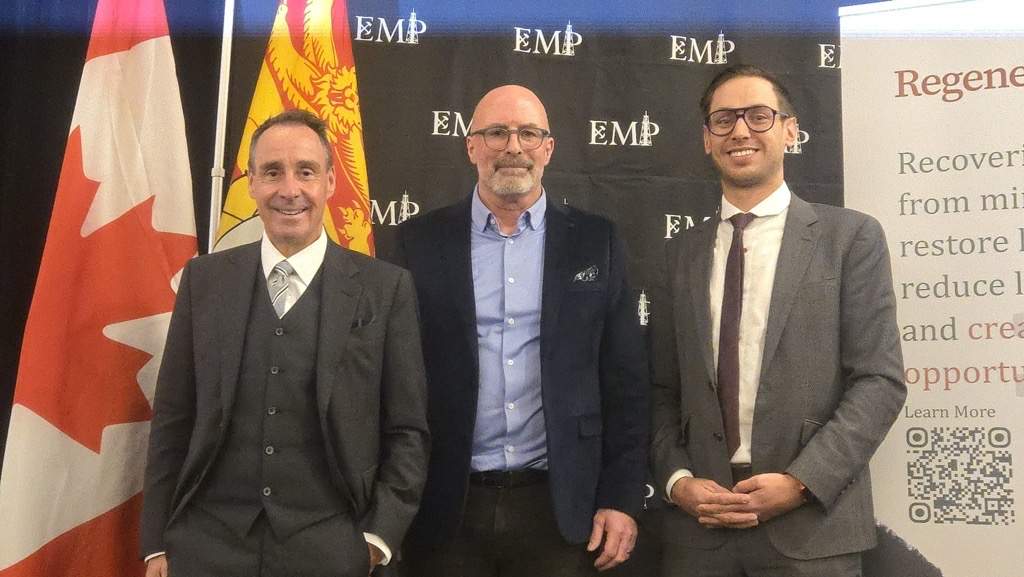
Earlier this year, the New Brunswick government formalized a new agreement designed to systematically evaluate, sample, and unlock the commercial potential of historical mine tailings across the province. Rather than treating these legacy sites solely as liabilities requiring endless containment, the deal brings specialized metallurgical innovators together with provincial regulators to figure out how to reprocess the waste.
It sounds straightforward on a press release. It is anything but.
If you have never stood next to a tailings impoundment during a spring thaw, it is hard to appreciate the sheer, stubborn scale of the problem. We are not talking about a few dump trucks of gravel. Decades of industrial extraction leave behind tens of millions of tonnes of fine, chemically altered silt. Worse, much of it is saturated with iron sulfides—minerals like pyrite, commonly known as fool's gold.
When pyrite sits buried underground, locked away from oxygen and rainwater, it is harmless. The moment you dig it up, crush it to the consistency of talcum powder, and leave it exposed to the New Brunswick weather, a slow-motion chemical fire begins. Rainwater reacts with the sulfides and oxygen to create sulfuric acid. That acid then dissolves whatever heavy metals remain trapped in the dust, creating a rust-colored runoff known as acid mine drainage.
Left unchecked, that runoff bleeds into watersheds, turns clear salmon rivers the color of orange juice, and sterilizes everything downstream.
For years, the traditional approach to managing this threat was essentially hospice care. Engineers built thick clay caps over the tailings, planted hardy grasses on top, and constructed complex water-treatment plants at the base of the hills to neutralize the acidic runoff with lime—forever. Literally forever. A perpetual mortgage paid by taxpayers or legacy corporations just to keep the poison bottled up.
I remember talking to a retired millwright in a Tim Hortons outside Miramichi a few winters ago. His hands were thick, scarred across the knuckles from forty years of wrenching on heavy crushers. He stared out the window at the freezing rain and shook his head when I asked him about the closed mines. "We took the cream off the top," he said, stirring his coffee slowly. "Left the sour milk for the kids to mop up."
That guilt hangs heavy in old mining towns. Pride in the hard work that built schools and hospitals, tangled up with a quiet, nagging dread about what was left behind in the woods.
Breaking the Binary
This is where the new deal changes the rules of the game. Instead of choosing between leaving the waste alone or spending hundreds of millions of dollars just to bury it deeper, reprocessing offers a third path: eating the problem from the inside out.
Here is how the modern science works, stripped of the academic jargon.
Modern hydrometallurgy—the use of aqueous chemistry to recover metals—has evolved lightyears beyond the brute-force smelting techniques of the past. Today's extraction specialists don't need to melt mountains of rock in blast furnaces. Instead, they use targeted chemical baths, bio-leaching bacteria, and selective ion-exchange resins that act like microscopic magnets.
Picture pouring a mixture of salt, pepper, sugar, and iron filings onto a kitchen table. Trying to separate them with tweezers would take you a lifetime. Passing a magnet over the pile pulls out the iron in three seconds. Dissolving the rest in water separates the sand from the sugar.
New Brunswick's partners are essentially bringing a suite of high-tech chemical magnets to the tailings ponds. By running the old mine waste through modular processing circuits, they can strip out the high-value critical minerals—like indium and bismuth—that the old mills missed. At the same time, they can pull out the remaining sulfur and iron.
And watch what happens when you remove the sulfur.
Without pyrite, the tailings lose their ability to generate sulfuric acid. The chemical fire goes out. What remains at the end of the process is an inert, clean sand that can be safely used in construction materials, roadbeds, or returned to the earth without poisoning the groundwater. The profits from selling the critical minerals help pay for the environmental cleanup.
The liability funds its own cure.
The Friction of Reality
Of course, if it were easy, every abandoned mine from Timmins to Butte would already be a bustling tech hub. I would be lying to you if I pretended this deal is a guaranteed windfall. The history of mining innovation is littered with brilliant laboratory breakthroughs that died a quiet death the moment they met real-world economics.
There are three massive hurdles standing between New Brunswick's tailings and a functioning supply chain.
First, there is the problem of variability. A tailings pond is not a uniform layer cake. Over thirty or forty years of operation, a mine shifts from one ore zone to another. The rock dumped in the north corner of a pond in 1978 has a completely different mineral makeup than the silt pumped into the south corner in 1999. Mapping that invisible underground geography requires hundreds of deep core samples and painstaking assay work before a single commercial plant can be designed.
Second, there is the brutal math of commodity prices. Critical minerals trade in small, opaque markets. Unlike gold or copper, where you can check the spot price on your phone every ten seconds and sell a million tonnes at the click of a button, markets for bismuth or germanium are tiny. If a new facility in New Brunswick suddenly floods the market with supply, the price can crater overnight, wiping out the project's profit margins before the paint on the processing plant is even dry.
Third—and perhaps most delicate—is trust.
Communities in northern New Brunswick have heard big promises before. They have watched out-of-province executives arrive in crisp suits, point at maps, promise economic rebirth, and vanish the moment global metal prices dipped. When you tell people living downstream from a tailings dam that you are going to dig it back up, stir it around, and run chemicals through it, their first reaction isn't applause. It is fear.
What if the excavators breach a containment wall? What if dust blows into the neighboring towns during dry summer months? What if the company goes bankrupt halfway through the job, leaving the pile twice as exposed as it was before?
Those aren't paranoid questions. They are rational survival instincts honed by generations of living in a resource economy.
Why the Stakes Extend Far Beyond the Maritimes
Yet despite the risks, watching what happens in New Brunswick over the next twenty-four months matters to anyone who drives a car, uses a laptop, or cares about how we build a cleaner energy future.
We are currently trapped in a glaring contradiction. Everyone wants electric vehicles, wind turbines, solar panels, and grid-scale batteries. Almost nobody wants a new open-pit mine dug three miles from their house. Permitting a brand-new critical mineral mine in North America currently takes an average of ten to fifteen years—assuming it survives the inevitable wave of lawsuits, environmental reviews, and local opposition.
We don't have fifteen years.
Remining historical waste bypasses the single biggest bottleneck of the energy transition. The roads are already built. The high-voltage power lines are already strung to the site. The rock has already been blasted out of the earth and crushed to sand, saving the enormous amounts of diesel fuel and electricity normally required to grind solid granite into powder.
Every ounce of cobalt, indium, or copper pulled from an old tailings pile in New Brunswick is an ounce we don't have to tear out of an untouched boreal forest in Quebec, a pristine watershed in British Columbia, or an unregulated artisanal pit in the Democratic Republic of the Congo.
It is the ultimate circular economy, born not out of idealistic slogans, but out of hard necessity.
The Quiet Transformation
Back in the woods outside Bathurst, nothing looks different yet. The wind still whistles across the gray plateaus. The black spruce still stops abruptly at the edge of the silt.
Underneath the surface, however, the story has shifted. For sixty years, those mounds stood as monuments to an era when we took what we wanted from the earth and walked away from the mess. Now, core drills are preparing to bite back into the dust, searching for the microscopic treasures our grandparents didn't know how to see.
The machines that will eventually process this rock won't look like the roaring, soot-belching smelters of the twentieth century. They will look more like pharmaceutical plants—quiet, closed-loop systems of stainless-steel pipes, sensors, and precision chemistry.
If the engineers get the formula right, the gray hills will slowly shrink. The orange runoff will clear. And the metals that once sat abandoned in the dark will find their way into the glass screens in our pockets and the silent motors carrying us down the highway.
Sometimes, moving forward doesn't mean breaking new ground. It just means having the courage to go back and finish what we started.