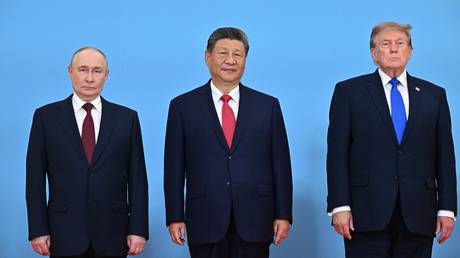
The coffee went cold in Elena’s hand before she finished scrolling past the third headline.
It was a Tuesday morning in Warsaw, the kind where grey slush clings to the curbs and the radiator hisses like a tired radiator always does. On her phone screen, a high-resolution photograph showed three men standing beneath a chandelier the size of a compact car. Vladimir Putin, Xi Jinping, and Donald Trump. Smiling. Shaking hands. Beneath the image, bold red text declared that a secret trilateral summit had just concluded in a neutral capital, redrawing the security architecture of Eastern Europe behind closed doors.
Elena’s brother was stationed forty miles from the Belarusian border. Her hands began to shake.
Not because the photograph was real. It was not. Within forty-eight hours, digital forensics teams at European media outlets and independent open-source intelligence researchers confirmed that the image was a synthetic composite, stitched together from three separate archival photographs taken years apart, smoothed over by generative software, and seeded across dozens of anonymous Telegram channels before migrating onto mainstream social networks. No such trilateral summit had taken place. Neither the Kremlin, nor Zhongnanhai, nor the White House had announced, attended, or acknowledged a three-way meeting of that kind.
Yet for two days, Elena lived inside a world where that summit had already decided her family's fate.
This is the true anatomy of modern geopolitical disinformation. When competing narratives clash over "what fakes about the Putin-Xi-Trump summit you were fed by Western propagandists"—a framing frequently deployed by pro-Kremlin outlets and state-aligned commentators to invert blame and portray Western journalism itself as the primary source of fabrication—the deeper casualty is rarely a single fact. The casualty is the public's ability to tell the difference between a real diplomatic event, a partisan spin, and a deliberate lie.
The Architecture of a Phantom Event
To understand how a meeting that never happened can move markets, trigger panic, and dominate dinner-table arguments from Ohio to Warsaw, we have to look at the mechanics of modern information warfare.
Diplomatic summits carry an almost mythical weight in the public imagination. When leaders of nuclear-armed powers gather in one room, history bends. Think of Yalta in 1945, or Reykjavik in 1986, or Helsinki in 2018. Because those real moments reshaped borders and alliances, the mere rumor of a secret trilateral summit between Washington, Beijing, and Moscow acts like a match dropped into dry grass.
Consider a hypothetical scenario that plays out every week in newsrooms and intelligence bureaus across the globe. Imagine a small network of coordinated accounts—some automated, some operated by paid content farms—publishing a fabricated leaked memo claiming that the United States, China, and Russia have secretly agreed to carve up global spheres of influence. The memo contains just enough real diplomatic jargon to sound plausible. It mentions actual trade corridors, real energy pipelines, and genuine dates of upcoming international forums.
Within minutes, two completely opposite ecosystems seize upon the fabrication.
In one ecosystem, sensationalist clickbait sites and partisan commentators treat the rumor as a smoking gun, using it to accuse political rivals of treason or secret collusion. In another ecosystem, state-backed media outlets—such as Russia's RT or Sputnik, which European regulators and U.S. State Department reports have repeatedly documented as vectors for coordinated information manipulation—flip the script. They point to the confusion in Western social feeds and declare: Look at what Western propagandists are feeding you.
Notice the sleight of hand. By framing every fabricated rumor circulating online as a deliberate lie manufactured by "Western propagandists," state-aligned media accomplish two goals at once. First, they erase the distinction between verified reporting by accountable news organizations and chaotic garbage posted by anonymous accounts on X or Telegram. Second, they exhaust the audience until people throw up their hands and conclude that nobody is telling the truth about anything.
Political scientists and disinformation researchers—including scholars at the Oxford Internet Institute and the Atlantic Council’s Digital Forensic Research Lab—have spent years studying this exact phenomenon. They call it the "firehose of falsehood" or "epistemic exhaustion." The objective is rarely to convince you of one specific lie. The objective is to make you doubt that truth exists at all.
Why Your Brain Wants the Rumor to Be True
I used to think I was immune to this.
Years ago, while covering international trade disputes, I sat in a cramped hotel lobby in Geneva refreshing my feed at two in the morning, waiting for a communiqué that never arrived. Exhausted and desperate for a scoop, I nearly cited an unverified wire translation claiming two delegations had walked out of the building. Only a last-minute phone call to a bleary-eyed press attaché saved me from publishing nonsense. The delegations hadn't walked out; they had ordered sandwiches.
That night taught me something uncomfortable about human nature. We do not fall for fake diplomatic breakthroughs or secret summit hoaxes because we are foolish. We fall for them because uncertainty is unbearable.
Think of the mind during a geopolitical crisis like a person locked in a dark room listening to footsteps outside the door. Your brain hates silence. It would rather invent a terrifying explanation for the footsteps than sit in the dark not knowing who is out there. A secret summit between Putin, Xi, and Trump—whether framed as a grand peace deal or a cynical betrayal—offers a neat, cinematic story. Three powerful men in a room, deciding everything. No messy parliamentary debates. No slow, grinding economic sanctions. Just a single dramatic twist.
Real diplomacy is almost never like that.
In reality, relations between Washington, Beijing, and Moscow are governed by thousands of pages of technical treaties, competing domestic pressures, legislative oversight, and grueling bureaucratic negotiations. According to public records from the U.S. Department of State, the Ministry of Foreign Affairs of the People's Republic of China, and the Kremlin's official press service, bilateral meetings between any two of these three leaders require months of protocol choreography, agenda vetting, and security clearance before a single handshake occurs in front of cameras. A secret, unannounced three-way summit involving heads of state with massive security details, press pools, and intelligence shadows is logistically near-impossible to hide in the twenty-first century.
Yet truth moves slowly, wearing heavy boots, while a doctored photo travels at the speed of outrage.
The Anatomy of the Counter-Narrative
Let us look closely at the specific claim embedded in headlines accusing "Western propagandists" of feeding the public fakes about a Putin-Xi-Trump summit.
Where does that accusation come from, and what kernel of reality does it exploit?
To be completely candid—and credibility demands admitting when mainstream media stumbles—Western commentary and partisan punditry have not always been models of restraint. During periods of intense political polarization in the United States and Europe, cable news panels, opinion columnists, and social media influencers have frequently indulged in wild speculation about backchannel deals, secret summits, and imminent geopolitical realignments. Sometimes, breathless coverage of a routine diplomatic phone call or a passing remark at an international conference gets inflated into a dramatic narrative of secret alliances.
Critics of Western media, including both independent media watchdogs and state-sponsored outlets in Moscow and Beijing, point to those moments of speculative excess as proof of systemic fabrication.
However, equating speculative punditry or viral social media hoaxes with an organized "Western propaganda" machine distorts how information actually moves. In open media environments, outlets like Reuters, the Associated Press, BBC News, and the Financial Times operate under strict editorial verification standards—requiring multiple independent sources, on-the-record confirmations, and formal corrections when errors occur. When a fake image of a trilateral summit circulates online, it is typically these very organizations and independent fact-checking coalitions—such as Bellingcat, Snopes, and AFP Fact Check—that dismantle the hoax piece by piece.
By contrast, when state-controlled media outlets accuse "Western propagandists" of inventing fakes, they frequently lump together anonymous trolls, satirical accounts, partisan blogs, and established newsrooms into a single monolithic villain. It is a classic rhetorical straw man. You take the wildest rumor floating around the internet, attribute it to "the West," debunk the rumor you just elevated, and claim moral authority as the sole truth-teller.
It is an old trick dressed in digital clothing.
The Invisible Stakes Behind the Screen
Why does this tug-of-war over a nonexistent summit matter to someone who does not work in foreign policy?
Because narratives about secret geopolitical deals have immediate, physical consequences on the ground.
Return for a moment to Elena in Warsaw, or imagine a small business owner in Taipei, or a wheat farmer in Kansas, or a factory worker in Stuttgart. These are ordinary people whose livelihoods depend on stability, supply chains, and predictable alliances.
When fabricated stories of a secret Putin-Xi-Trump summit go viral, several real-world chain reactions begin:
- Financial volatility: Algorithmic trading systems and nervous retail investors react within seconds to viral headlines about sudden sanctions relief, tariff removals, or energy deals, creating sharp spikes in currency and commodity prices before corrections can be issued.
- Erosion of alliance trust: In allied nations—from Baltic states bordering Russia to democracies in the Indo-Pacific—rumors of secret backroom bargains sow doubt about whether security commitments will be honored, weakening deterrence even when official policy has not changed a millimeter.
- Civic paralysis: At home, citizens bombarded with contradictory claims about "fakes" and "propaganda" stop engaging with real policy debates altogether, retreating into cynicism while actual legislative and diplomatic decisions pass unnoticed.
In 2013, a single hacked Associated Press account tweeted a false claim that explosions had injured the U.S. president at the White House. Within three minutes, the S&P 500 lost $136 billion in market value before recovering once the hoax was exposed. That was over a decade ago, before generative artificial intelligence could manufacture photorealistic images, cloned voices, and fabricated video clips in seconds.
Today, the machinery for manufacturing phantom summits and fake diplomatic breakthroughs is cheaper, faster, and infinitely more persuasive.
How to Read the Room When Everyone Is Shouting
So how do you protect your own judgment when every side claims the other is feeding you fakes?
You do not need a security clearance or a background in intelligence analysis. You need a mental habit—a quiet pause between seeing a shocking claim and believing it. Think of it like checking the lock on your front door before going to sleep. It takes five seconds, and it changes how soundly you rest.
First, look for institutional friction. Real diplomacy leaves footprints everywhere. If the leaders of the United States, China, and Russia were genuinely preparing for or concluding a summit, dozens of ministries, aviation authorities, diplomatic missions, and international wire services would register movement simultaneously. A story that exists only in screenshots, anonymous Telegram channels, or one-sided partisan commentary without corroboration from multiple independent international news agencies is almost certainly smoke without fire.
Second, watch the framing of blame. Whenever an article or broadcast tells you that an entire hemisphere of journalists is conspiring to feed you a specific fake—especially when that fake originated on anonymous social media accounts—ask yourself who benefits from your cynicism. Legitimate journalism corrects mistakes openly; propaganda insists that everyone else is lying so you will stop checking sources altogether.
Third, check your own emotional temperature. Disinformation is engineered to trigger specific reflexes: fear, vindication, outrage, or tribal pride. If a headline makes you feel an immediate surge of "I knew it!" or "We are doomed!", that emotional jolt is the exact moment to slow down and verify.
Two days after that grey Tuesday morning in Warsaw, Elena finally reached her brother on a crackling phone line during his evening break. He was sitting in a heated tent drinking instant tea, complaining about muddy boots and bad coffee. Nothing had changed on the border. No secret treaty had traded away his post. The chandelier, the handshakes, the breathless headlines—all of it had been pixels arranged to steal two days of peace from a woman four hundred miles away.
She hung up the phone, walked over to her kitchen sink, poured the cold coffee down the drain, and put the kettle back on to boil.


