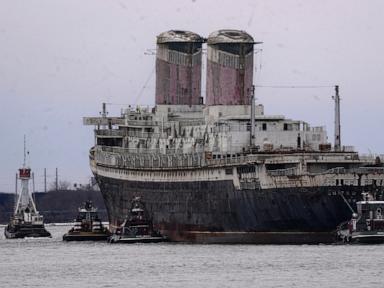
Rust smells like wet pennies and old blood.
Stand on a pier next to a retired ocean liner, and that metallic tang hits the back of your throat before you even look up. When you finally tilt your head back, the sheer scale of the hull makes your knees feel slightly loose. You are looking at nearly a thousand feet of riveted steel, faded paint, and silent portholes—a floating city built for speed, champagne, and transatlantic vanity, now chained to a dock like a retired prize fighter waiting for the torch. Discover more on a related subject: this related article.
For decades, the fate of these maritime giants followed a grim, predictable script. Either they were towed to muddy beaches in South Asia to be dismantled piece by agonizing piece with blowtorches, or they sat rotting in forgotten backwaters until their hulls gave out. Yet off the coast of Florida, a radically different ending is unfolding for the legendary SS United States—the fastest ocean liner ever to cross the Atlantic, a vessel that once carried presidents, Hollywood royalty, and tens of thousands of immigrants toward new lives. Instead of meeting the scrapyard, this 990-foot titan is being prepared for a deliberate, calculated execution. Engineers are stripping her down, cleaning her bones, and towing her out to the Gulf of Mexico to sink her to the seafloor, transforming her into the largest artificial reef on Earth.
Wait. Sinking a massive ship on purpose sounds like environmental vandalism, doesn't it? Further analysis by Al Jazeera delves into similar views on the subject.
When I first heard the proposal years ago, sitting on the sun-bleached gunwale of a dive boat off Key Largo, my stomach knotted. To anyone who loves the ocean, the idea of intentionally dropping tens of thousands of tons of metal into coastal waters feels completely backward. We spend our lives trying to keep human garbage out of the sea. Why on earth would coastal counties spend more than ten million dollars to put an entire ocean liner in it?
The Invisible Collapse Beneath the Waves
To understand why a sunken luxury liner is actually an ecological lifeline, you have to put on a mask, roll backward off a boat, and look at what is happening sixty feet below the surface.
Consider a hypothetical character—let's call her Elena, a third-generation charter captain working out of Destin, Florida. Elena doesn't read climate models in air-conditioned offices; she reads the water through the vibration of her hull and the weight of her clients' fishing lines. Twenty years ago, Elena could take a family three miles offshore and find natural limestone ledges bursting with red snapper, grouper, and amberjack. Today, those same ledges look like bleached bone yards.
Overfishing, warming waters, and nutrient runoff have stripped natural reefs down to bare rock. And here is the biological catch-22 that most people miss: marine life cannot simply float in empty blue water. Larval coral, sponges, and barnacles drift through the currents like microscopic parachutes looking for a place to land. If they hit shifting sand, they suffocate and die. Without hard, complex vertical structure, an ocean floor is essentially an underwater desert—flat, exposed, and empty.
Natural coral reefs take centuries to grow a few feet. We do not have centuries.
When you sink a ship the size of three football fields laid end-to-end, you aren't littering. You are dropping a high-rise apartment complex into the middle of a housing crisis. Within weeks of hitting the bottom, microscopic algae coat the bare steel. Months later, barnacles, oysters, and tube worms anchor themselves to the hull, creating a living carpet. Small baitfish move into the dark, sheltered corridors of the old passenger decks to hide from predators. Then come the snapper. Then the grouper. Then the sharks, rays, and sea turtles.
How You Kill a Ship to Give It Life
Turning a historic vessel into a thriving marine sanctuary is not as simple as pulling a plug and walking away. If you sink a dirty ship, you create an ecological disaster.
Before a single explosive charge is placed, remediation crews spend months performing a brutal, meticulous surgery on the vessel. Imagine stripping a skyscraper down to its bare concrete skeleton using only hand tools and torches. Every drop of fuel, oil, and hydraulic fluid must be pumped out and scrubbed from the bilges. Miles of electrical wiring, thick with plastics and heavy metals, are ripped out of the bulkheads. Asbestos insulation—standard when the SS United States was launched in 1951—has to be painstakingly encapsulated or removed under strict containment protocols.
Even the doors and windows have to go.
To make the wreck safe for recreational scuba divers, crews cut massive access holes through the decks and interior walls. If a diver gets disoriented inside a darkened dining room or engine bay, they need an unobstructed path to open water and light. By the time the cleaning crews finish, the ship is no longer a vessel. She is a hollow, sterile cathedral of steel, inspected down to the last bolt by environmental regulators before she is ever cleared for tow.
I remember diving on the USNS Vandenberg off Key West a few years after she was sunk to create an artificial reef. Descending down the mooring line through hazy green water, the ship didn't appear all at once; she materialized out of the gloom like a mountain range. Swimming through the massive satellite dishes on her deck, watching thousands of silver jack swirl in synchronized clouds through the rusted superstructure, I felt a strange, humbling shift in perspective. Human beings had built that machine for Cold War surveillance, yet the ocean had completely reclaimed it, turning cold military hardware into a vibrant, breathing nursery.
The Economics of Rust and Wonder
There is a hard-nosed financial reality driving these massive reefing projects, too, and it has nothing to do with charity.
Coastal communities live and die by the health of their waters. When natural reefs degrade, commercial fishermen burn more fuel chasing fewer fish, and recreational divers take their vacation dollars elsewhere. Okaloosa County, the Florida panhandle community that stepped up to acquire the SS United States, isn't spending millions of dollars out of sheer nostalgia for maritime history. They are making a calculated investment.
A signature wreck dive—especially one holding the title of the world's largest artificial reef—becomes an instant global magnet. Divers fly in from Europe, Asia, and across North America just to log a descent on a legendary hull. They book local hotels, eat at waterfront restaurants, hire local boat captains, and buy gear at neighborhood dive shops. More importantly, creating a massive, concentrated hub for divers and anglers pulls physical pressure off fragile, struggling natural reefs nearby. Instead of a hundred boats dropping anchors onto delicate living coral every weekend, those boats tie up to mooring buoys above a steel hull built to withstand North Atlantic hurricanes.
Still, watching a legend go under hurts.
For maritime preservationists who fought for decades to save the SS United States and turn her into a stationary museum or hotel, the decision to sink her feels like a funeral. And honestly, it is. You cannot walk her promenade deck again. You cannot stand on her bridge and imagine what it felt like in July 1952 when she shattered the transatlantic speed record, crossing the ocean in three days, ten hours, and forty minutes—a record that still stands for passenger liners today.
The Final Descent
Picture the morning of the sinking.
Out in the Gulf, miles from the white sand beaches, a perimeter of Coast Guard cutters keeps hundreds of spectator boats at a safe distance. On the horizon, the massive red, white, and blue funnels of the liner rise above the swells one last time. Tugboats hold her steady against the current while demolition engineers make their final checks and retreat to a safe blast zone.
A series of sharp, muffled thuds echoes across the water as shaped charges blow precision holes along her waterline.
At first, nothing seems to happen. The giant absorbs the blow with stubborn dignity. Then, slowly, almost imperceptibly, the bow begins to dip. Water pours into the lower holds, pushing trapped air up through the stairwells and ventilation shafts in violent, roaring geysers. The stern rises high into the air, exposing massive bronze propellers that haven't turned in anger for over half a century. With a final, thunderous groan of tearing metal and rushing water, the ocean claims her, sliding ninety stories of American engineering beneath the waves in a matter of minutes.
On the surface, the wake settles into flat, quiet ripples. The skyline is empty.
Below the surface, however, in the cool, blue twilight two hundred feet down, the silence is already ending. As the silt settles onto the sand, the first curious amberjack darts out from the shadows to inspect a rusted porthole, claiming a brand-new world.


