Turn on the kitchen tap in Merrimack, New Hampshire, and the water runs clear. It has no metallic tang. It leaves no rust-colored ring around the porcelain basin. Hold a glass up to the morning light filtering through the white pines, and it looks like the purest thing on earth—the exact promise that draws families to quiet cul-de-sacs in the Granite State, far from the grit of industrial cities.
You fill the kettle. You rinse the strawberries. You run a warm bath for your toddler before bed.
Now, picture a man in a grey suit standing three miles away, decades ago, watching a smokestack vent an invisible mist into the humid New England air. He does not kick down your front door. He does not leave muddy boot prints on your hardwood floors or smash a window in the dead of night. Yet, quietly, persistently, riding the wind and soaking through the sandy soil into the bedrock aquifer beneath your lawn, something he released has just entered your house. It is sitting in your pipes. It is pooling in your bloodstream.
Trespass.
For centuries, the word meant boots on grass. It meant a fence crossed without permission, a boundary violated by something solid you could point to, photograph, and chase off your land. When chemical manufacturers poisoned groundwater, the law historically shrugged at the idea of trespass, forcing sick and frightened families into a grueling, solitary maze of proving specific medical injuries one household at a time.
That legal wall just cracked.
In a landmark ruling that sends a tremor through corporate boardrooms and offers a lifeline to tainted communities across the country, a federal court cleared the way for New Hampshire homeowners to pursue a group trespass claim over chemical water pollution. The decision transforms an invisible, microscopic invasion into a recognized violation of property rights—and allows thousands of neighbors to stand together as a single, formidable force rather than fighting billion-dollar chemical giants alone.
The Invisible Intruder
To understand why this ruling matters, you have to sit at a kitchen table in southern New Hampshire and look at a lab report you do not know how to read.
Consider a hypothetical homeowner—let’s call her Elena—living in a split-level ranch in Litchfield, just across the Merrimack River from the Saint-Gobain Performance Plastics facility. In this hypothetical scenario, Elena bought her house in 2012 because it had a deep private well and half an acre of wooded yard where her golden retriever could run. She paid her property taxes, tested her water for standard bacteria, and believed, as almost all of us do, that the boundary of her deed meant something.
Then came the notices in the mail. State environmental regulators had detected elevated levels of per- and polyfluoroalkyl substances—PFAS—in private wells radiating outward from the industrial plant.
PFAS. Four letters that sound like a bureaucratic yawn until you learn what they actually are. Chemists engineered these synthetic compounds in the mid-twentieth century to make products resist heat, oil, stains, and water. They coated nonstick skillets, waterproofed rain jackets, lined microwave popcorn bags, and formed the backbone of firefighting foams. Because the bond between carbon and fluorine atoms is one of the strongest in organic chemistry, these molecules refuse to break down in nature. They do not rot. They do not evaporate into harmlessness. They earned the name "forever chemicals" because, on a human timescale, they simply do not leave.
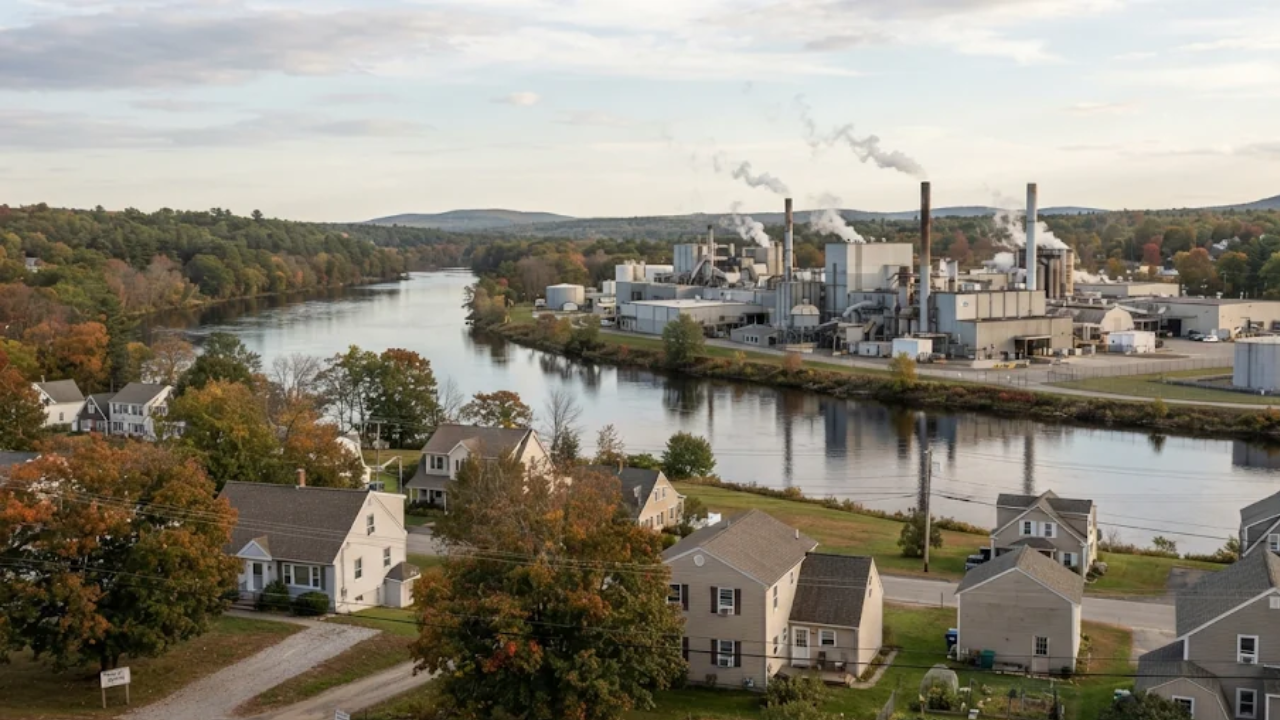
When Saint-Gobain’s smokestacks vented emissions containing perfluorooctanoic acid (PFOA) and related compounds over decades of manufacturing coated fabrics and films, those particles drifted on the prevailing winds. Rain washed them out of the sky. Snowmelt carried them down through the glacial till of southern New Hampshire, straight into the fractured bedrock aquifers that feed private wells across Merrimack, Litchfield, Bedford, and Londonderry.
Look at Elena’s lab report in our hypothetical scenario. The numbers are measured in parts per trillion. One part per trillion is roughly equivalent to a single drop of water diluted into twenty Olympic-sized swimming pools. It sounds absurdly small. Trivial, even.
Except human biology is not built to process synthetic fluorine chains, even at microscopic doses. Decades of peer-reviewed epidemiological research—most notably the massive C8 Science Panel studies in the Ohio River Valley—linked PFOA exposure to kidney cancer, testicular cancer, ulcerative colitis, thyroid disease, pregnancy-induced hypertension, and dangerously high cholesterol. The chemicals bind to proteins in human blood rather than fat, lingering in the human body for years, quietly disrupting endocrine signals and immune responses while the water in the glass still looks pristine.
Suddenly, Elena’s sanctuary feels like a trap. Every glass of water feels like a gamble. Selling the house becomes a nightmare of mandatory disclosures and plummeting property values. Bottled water jugs stack up in the garage like sandbags against an unseen flood.
Why the Law Historically Failed Poisoned Towns
If someone dumps a truckload of gravel onto your driveway without asking, you can sue them for trespass tomorrow. You do not need to prove the gravel gave you a disease. You do not need an oncologist to testify that the rocks shortened your life expectancy. The mere unauthorized physical presence of someone else’s property on your land is enough. The law protects your right to exclusive possession of what you own.
For generations, chemical polluters exploited a loophole in that ancient common-law principle.
When smoke, dust, or dissolved molecules crossed property lines, defense attorneys argued that invisible particles were not "tangible" enough to constitute trespass. They insisted these cases belonged strictly under nuisance or negligence law—legal categories that come loaded with heavy burdens of proof. Under traditional personal injury or negligence claims, homeowners had to prove not only that the company acted carelessly, but that the specific molecules from that specific factory directly caused a specific, already-manifested illness in each individual plaintiff.
Think about what that meant for ordinary families.
If you lived next to a polluting plant, you had two bad choices. You could wait until you or your child developed cancer or thyroid disease, and then spend years in court fighting a team of corporate litigators arguing your illness came from genetics or bad luck. Or, if you were still healthy and simply wanted the company to pay for filtration systems, medical monitoring, and the lost value of your contaminated home, you were largely out of luck.
Worse still, companies fought tooth and nail against class certification—the legal mechanism that allows thousands of people harmed by the same act to sue together as a group. Corporate lawyers argued that every person’s medical history, water consumption, and health risk was too unique to be decided in one trial. Without class-action status, a homeowner whose property value dropped by fifty thousand dollars would have to spend two hundred thousand dollars on expert witnesses, hydrogeologists, and environmental attorneys just to get to a jury.
The math was rigged. Polluters knew it. Homeowners felt it in their bones.
The Shift in the Courtroom
When the New Hampshire federal court ruled that homeowners could move forward with a class-action trespass claim over the chemical contamination of their water, it did not merely tweak a procedural rule. It restored common sense to property law.
Let’s look at the mechanics of what the court recognized, stripped of dense legal Latin.
Imagine a trespasser does not walk across your lawn, but instead aims a high-pressure hose over your fence and saturates your soil with motor oil. Would any reasonable judge say that because the oil seeped underground out of sight, no trespass occurred? Of course not. The physical invasion is real. The substance has weight, mass, and chemical structure. It occupies space on your property that belongs exclusively to you.
The court applied that exact logic to the modern reality of industrial pollution. Whether a chemical enters your groundwater via a leaking underground pipe or falls from an industrial smokestack onto your roof and percolates into your well, the result is identical: a foreign, persistent, physical substance placed onto private property without the owner’s consent.
By allowing this trespass claim to proceed on a group basis—as a class action—the court swept away the divide-and-conquer strategy that has shielded polluters for decades.
In a group trespass case, the central questions are shared by every single homeowner inside the contamination zone. Did the manufacturer release the chemicals? Did those chemicals travel through the air and soil into the community’s groundwater? Did they physically invade the plaintiffs' properties without permission?
You do not need ten thousand separate trials to answer those questions. The plume of contamination underground does not care about property lines, political affiliations, or individual medical charts. It is a single geological reality affecting an entire community at once. By certifying the group claim, the court acknowledged that when a corporation turns an entire town’s aquifer into a chemical storage basin, the town has the right to answer back in one voice.
Anatomy of a Plume
To grasp why a group claim is the only realistic weapon against groundwater contamination, you have to understand how water actually moves beneath New Hampshire’s hills.
Most people picture an underground aquifer as a vast, subterranean lake—a neat blue cavern sitting beneath the dirt. That picture is wrong. In New England, much of the drinking water sits inside fractures, cracks, and fissures in solid granite and metamorphic rock hundreds of feet below the surface.
Hydrogeologists spend years mapping these invisible labyrinths. When industrial emissions settle onto the surface soil over twenty or thirty years, rainwater slowly flushes the soluble PFAS molecules downward until they hit the top of the bedrock. From there, the chemicals follow the ancient fault lines of the earth, migrating along pressure gradients, drawn toward every residential well pump that switches on when someone takes a shower or runs a washing machine.
Every time a family turns on their tap, the pump creates a tiny cone of depression in the water table, pulling groundwater—and whatever dissolved chemicals ride within it—toward their well screen.
I have walked properties near industrial sites in New England where the contrast between the surface beauty and the subterranean reality feels almost dizzying. You stand beside a stone wall built by farmers two hundred years ago, listening to wind rustle through red oaks, breathing crisp autumn air. Everything your eyes and nose tell you is that this land is untouched. Yet eighty feet below your boots, synthetic fluorine chains manufactured during the Reagan and Clinton administrations are migrating through fractures in the granite at a rate of inches per day, arriving at kitchen faucets decades after the decisions that put them in the air were made.
That time lag is what makes chemical trespass so insidious—and why legal accountability has always lagged behind engineering.
When a factory emits a toxic gas that knocks people down in the street, the cause and effect happen in seconds. Sirens wail. Ambulances arrive. Responsibility is undeniable. When a facility emits persistent, water-soluble chemicals at levels measured in parts per trillion, the harm unfolds in slow motion. Ten years pass. Twenty years pass. Plant managers retire. Corporate ownership changes hands. By the time testing technology becomes sensitive enough to detect parts per trillion in residential wells, the contamination has already embedded itself into the daily routines of thousands of families.
What Homeowners Actually Stand to Gain
People often hear "class-action lawsuit" and picture a check for four dollars and twelve cents arriving in the mail three years later while lawyers buy vacation homes. That cynicism is earned in cases about mislabeled shampoo or sluggish smartphone batteries.
Environmental property litigation is a different animal entirely.
When homeowners pursue a group trespass claim over contaminated water, they are not chasing windfall lottery tickets. They are fighting for tangible, survival-level remedies that individual families cannot afford on their own:
- Point-of-Entry Filtration Systems: Whole-house granular activated carbon or reverse-osmosis systems capable of stripping PFAS out of well water before it enters pipes, showers, and appliances. These systems cost thousands of dollars to install and require regular, expensive media replacements to keep from failing.
- Connection to Municipal Water Lines: In heavily contaminated zones, private wells are sometimes beyond reliable treatment. Extending clean municipal water mains down rural roads costs millions of dollars—a bill that should never fall on taxpayers who did not cause the pollution.
- Compensation for Diminished Property Value: Even after a filtration system is installed, a home in a known contamination zone carries a stigma in the real estate market. Buyers hesitate. Lenders ask questions. Appraisals drop. Trespass damages address that stolen equity directly.
- Restitution for Lost Use and Enjoyment: Years of hauling bottled water, worrying over every bath, abandoning backyard vegetable gardens watered from tainted wells, and living with the chronic stress of an invisible hazard inside your own walls.
Without the leverage of a certified group claim, a chemical manufacturer has every financial incentive to stall, appeal, and bleed individual plaintiffs dry until they accept pennies on the dollar. When thousands of homeowners stand together under a single trespass action, the financial exposure on the company’s balance sheet becomes immediate and undeniable. Suddenly, settlement talks stop being a public relations exercise and start becoming a financial necessity.
The Ripple Effect Beyond New Hampshire
Look closely at the map of the United States, and you will realize southern New Hampshire is not an outlier. It is a preview.
According to testing data compiled by the Environmental Working Group and federal regulators under the Safe Drinking Water Act, PFAS contamination has been detected in drinking water systems serving well over one hundred million Americans. From military airfields in Michigan and North Carolina to chemical corridors in West Virginia, Minnesota, and Alabama, communities are waking up to the same cold realization: their water carries a chemical signature they never agreed to ingest.
For years, those communities have watched the courts wrestle with a fundamental question of fairness. Should the burden of scientific complexity fall on the families drinking the water, or on the companies that profited from releasing the chemicals?
The New Hampshire decision tips that scale.
By validating trespass as a viable, group-wide legal claim for chemical water pollution, the court handed environmental attorneys and everyday homeowners across the country a blueprint. You do not need to wait until your neighborhood becomes a cancer cluster to demand accountability. Your property line does not end at the grass. Your right to exclude unwanted intruders from your home applies just as fiercely to microscopic synthetic compounds in your well as it does to a stranger climbing over your back fence.
Consider what changes when that principle takes hold across state and federal courts.
Corporate risk assessments shift overnight. In the past, a manufacturer weighing the cost of installing advanced emissions scrubbers or closed-loop filtration systems against the risk of future lawsuits could bet on legal friction. They could bet that dispersion through air and groundwater would blur responsibility enough to defeat individual claims. When invisible migration across property lines counts as a collective trespass, that bet turns toxic. Prevention becomes cheaper than litigation.
Living With the Water
Even with a legal victory in hand, nothing changes overnight at the kitchen sink.
Court rulings do not scrub fluorine atoms out of New Hampshire granite. Litigation moves at a glacial pace—motions, appeals, discovery battles, expert depositions stretching across years while seasons turn and children grow up. Homeowners in Merrimack, Litchfield, and neighboring towns still check the pressure gauges on their basement filtration tanks. They still keep track of when carbon canisters need swapping. They still pause, for half a second, before filling a pot to boil pasta.
That hesitation is the real cost of chemical pollution—the quiet erosion of trust in the simplest, most necessary substance in human life.
Yet something fundamental has shifted in the balance of power between the smokestack on the riverbank and the houses tucked among the pines. For decades, the contamination moved in only one direction: outward from the factory, downward through the soil, inward through the pipes, uninvited and unanswered.
Now, the homeowners have crossed a boundary of their own—straight into the courtroom, together, holding the deed to their land in one hand and the lab report in the other, demanding that the trespass finally stop.