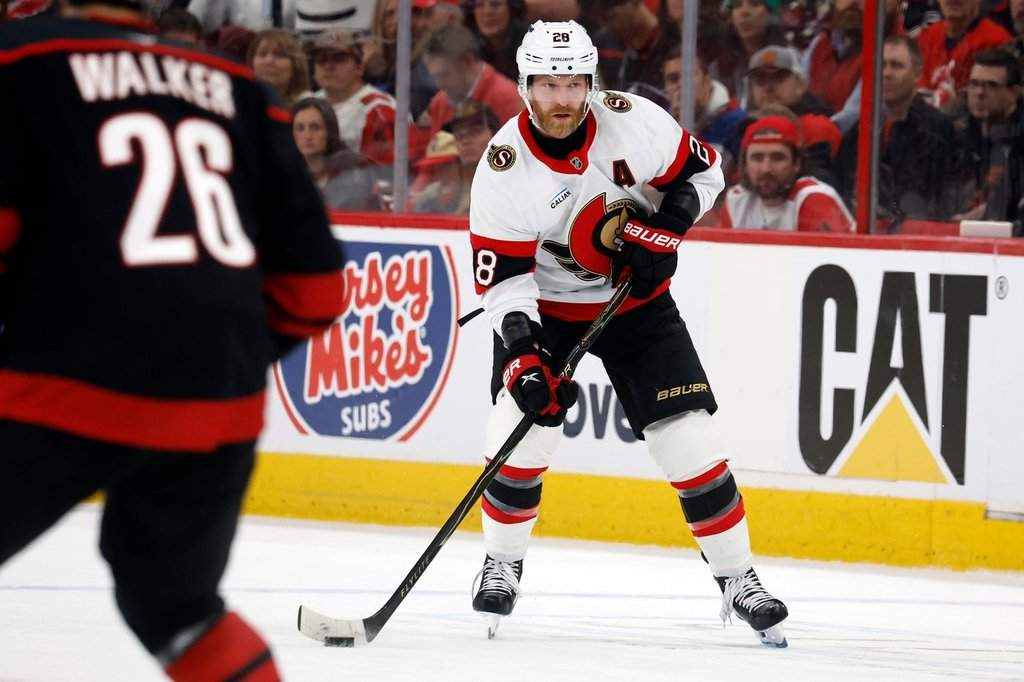
The air inside an empty September arena smells like nothing else on earth. It is a precise chemical cocktail of fresh-cut ice shavings, melting frost, industrial floor wax, and the faint, coppery tang of old sweat baked into rubber mats. At six in the morning, the building is a tomb. The concourses are dark, the concession stands are shuttered, and the only sound is the low, mechanical drone of the refrigeration units humming beneath the concrete floor, keeping the sheet alive against the dying heat of summer.
Then there is the quiet squeak of a skate blade on dry rubber.
In the corner of the home dressing room, a man who has played over a thousand games in the highest-stakes hockey league on the planet sits on a wooden stool, pulling a thick wax-coated lace tight. His fingers are stiff. His breathing is just a fraction too shallow. If you watched him from the hallway, you would see a professional with an extraordinary resume, a player whose name is etched into the collective memory of hockey towns from the mid-Atlantic to the capital of Canada. You would see a veteran.
Look closer. Look at the way his jaw is locked. Look at the slight tremor in his thumb as he knots the lace.
Claude Giroux still gets nervous.
Not a casual, professional butterflies-in-the-stomach kind of nervousness that vanishes the moment you step outside. We are talking about the cold, visceral tightening of the gut. The low-grade panic that whispers in the dark: What if I can't keep up? What if today is the day the legs give out? What if the kids are faster this year?
To the outside world, this makes no sense. Confidence in professional sports is supposed to be armor. We imagine athletes as sleek, unfeeling machines of pure kinetic output, immune to self-doubt because their bank accounts and highlight reels prove their worth daily. We think competence cures anxiety. We think mastery kills fear.
History teaches us the exact opposite. The people who stop feeling nervous are usually the ones who have stopped caring about the outcome. The dread is the price of admission. It is the toll you pay for refusing to coast on reputation.
Consider what happens in the modern National Hockey League every September. Training camp arrives with the ruthless punctuality of a seasonal change. For a rookie, the nerves are frantic and wide-eyed, fueled by the desperate need to prove they belong in the building. For a nineteen-year-old, the anxiety is loud. But for a thirty-something veteran who has captained storied franchises, won international gold, and carried the weight of entire fanbases on his shoulders, the anxiety mutates. It becomes quiet. Heavy. Personal.
It is the burden of the standard.
When you are young, you chase the standard. When you are old, you defend it. Every single day, you are defending your territory against an army of twenty-year-olds who recover from knee surgery in three days and run a mile in four minutes while scrolling on their phones. They do not care about your past trophies. They care about your spot. They are coming for your sweater, your power-play time, your legacy.
Giroux knows this math better than almost anyone. Drafted twenty-second overall by the Philadelphia Flyers back in 2006, he entered a league that played a different style of hockey. Back then, the game was built on violence, slow whistles, and physical intimidation. Skate lanes were clogged with traffic cops who specialized in taking away time and space with cross-checks to the ribs. He survived that era not because he was the biggest man on the ice, but because his brain operated three frames ahead of everyone else's. He saw passing lanes that were mathematically impossible. He turned hockey into geometry.
Seasons bled into one another. The years in Philadelphia turned from a promising youth movement into a crucible of soaring expectations and crushing playoff disappointments. For a decade, the city's heartbeat ran through his skates. When the team won, he was the architect. When the team lost—and in Philadelphia, the margin for error is razor-thin—he was the lightning rod.
Every September during those years brought the same ritual. The medical testing. The grueling VO2 max bike tests that leave players gasping on the floor, tasting blood in the back of their throats. The first skate where the lungs burn like swallowed fire because no amount of summer training on dry land can replicate the specific, oxygen-starved anaerobic agony of hockey shifts.
You would think a man with a hundred career playoff points and an All-Star MVP trophy would walk into the practice facility with a swagger, a cigar in his mouth, laughing with the rookies. You would think he would feel bulletproof.
He doesn't.
In interviews, players rarely admit to fear because the culture of the sport demands stoicism. To show vulnerability is to invite a shark attack. Competitors watch for cracks in your armor. Media members twist a moment of honest reflection into a narrative about decline. So, veterans learn to mask the internal weather behind polite, monosyllabic clichés: Just trying to get better every day. Feeling good. Ready to work.
Behind closed doors, the human reality is far messier. The body remembers every surgical scar, every separated shoulder, every concussion, every morning where getting out of bed requires a deliberate, cautious negotiation with your lower back. When you reach your mid-thirties in a sport governed by speed and collisions, gravity is no longer a theory; it is a daily opponent.
Think about what it takes to maintain elite status over two decades. It is not just about showing up for the games. The games are the reward. The real work happens in the unglamorous months of July and August, lifting heavy iron in dark gym basements while your peers are on golf courses, skating alone on empty sheets of ice with a coach feeding pucks from the boards, forcing tired legs to explode one more time when every muscle fiber is screaming to stop.
Why do it? Why subject yourself to the grind, the media scrutiny, the physical pain, and—most importantly—the terrifying vulnerability of failure?
Because the alternative is worse. The alternative is irrelevance.
When Giroux packed his bags and moved on from Philadelphia, first to Florida for a brief, magical run toward a Stanley Cup final pursuit, and then north to Ottawa to help anchor a young, chaotic, incredibly talented Senators team, he wasn't doing it for a paycheck. He had already secured his financial future. He didn't do it to pad his stats.
He did it because the addiction to competition does not fade just because your birth certificate says you are older than the guys guarding you. If anything, the addiction deepens. The window is closing, and you know it. Every autumn brings fewer opportunities. Every training camp might be your last one.
That realization changes the nature of the nerves.
Early in a career, you are nervous because you might fail. Later in a career, you are nervous because you know exactly what is at stake. You know how much work it took to get here, and you know how fast it can all be stripped away by a pulled groin, a blown coverage, or simply the brutal, unyielding march of time.
Step onto the ice with a veteran during the first day of camp. Watch the way he communicates. He doesn't yell much. He doesn't need to. He uses a sharp, concise vocabulary honed by fifteen years of reading defensive coverages in milliseconds. He points his stick. He corrects a young winger's positioning without breaking stride.
To the rookie, Giroux looks like an immovable monument. He looks like someone who was born with a stick in his hands and ice water in his veins.
The rookie doesn't see the stomach knots. He doesn't see the hours spent lying awake the night before, staring at the ceiling hotel room light, running through faceoff scenarios in his head. He doesn't see the quiet discipline required to keep the engine running when the chassis is starting to rattle.
This is the hidden mechanics of excellence. We celebrate the goals, the overtime winners, the majestic cross-ice passes that thread a needle through three defenders. We build highlight reels around the triumph. But the triumph is only the public half of the equation. The private half is the doubt.
Without the doubt, there is no edge. If you don't care enough to be nervous, you don't care enough to win. The butterflies are not a sign of weakness; they are the internal alarm system confirming that you are still fully alive in the arena, fully invested in the outcome, and unwilling to let your standard drop.
When the whistle blows to start the first drill of camp, the noise in the arena changes. The echoes bounce off the glass. The heavy smell of vulcanized rubber fills the air as a dozen pucks slam against the boards at once.
For a split second, the nerves peak. The chest tightens.
Then his skates dig into the ice. His weight shifts. The muscle memory—forged through twenty-five years of winter mornings, frozen rinks, broken sticks, and relentless, obsessive repetition—takes over. The brain stops chattering. The ice opens up.
He receives a pass on his backhand, never breaking stride, and slides a backhand feed right onto the tape of a streaking teammate's stick. The puck makes a crisp, satisfying thwack.
The butterflies vanish. Not because the pressure is gone, but because he has met it, absorbed it, and turned it into speed.
He is nervous. He is ready. The season has begun.