The diner in Scranton doesn’t care about the Federal Reserve’s overnight lending rate. They care about the price of the eggs.
For the past few years, the American economy has functioned like a high-performance engine that makes a terrifying rattling sound every time you hit sixty miles per hour. On paper, the machine is a marvel. GDP is up. Unemployment remains at historic lows. The stock market reaches for the heavens with a desperate, almost religious fervor. But when you step inside the grocery store, the numbers on the receipt feel like a personal insult. This is the paradox that defines the current political moment: the economy is doing great, but the people living in it feel like they are drowning in shallow water.
Donald Trump built his political identity on the image of the master builder, the man who could tune that engine until it purred. But as he eyes a return to the Oval Office, he isn’t just running against a political opponent. He is running against the very ghost he helped summon. He is running against an economy that has become his most formidable, unpredictable adversary.
Consider a hypothetical voter named Elena. She lives in a suburb of Phoenix. She’s not an activist. She’s a dental hygienist who likes to garden. In 2019, she felt the wind at her back. Gas was cheap. Her mortgage was locked in at a rate that felt like a gift. Today, she looks at the price of a gallon of milk and feels a low-simmering resentment. It isn't just about the money. It’s about the loss of control. When the price of basic survival fluctuates wildly, the future feels like a threat rather than a promise.
The Weight of the Invisible Dollar
The central struggle for any incumbent or challenger is the gap between "The Economy" and "My Economy."
Economists love to talk about the Consumer Price Index. They chart the fluctuations of the dollar against the yen. They discuss the nuances of quantitative easing as if they were explaining the mechanics of a clock. But for the average family, the economy is not a chart. It is a feeling. It is the anxiety of seeing the "Low Balance" alert on a smartphone screen. It is the decision to skip a vacation because the tires on the SUV finally gave out.
Trump’s previous term was defined by a specific kind of economic theater. He used the Dow Jones Industrial Average as a scoreboard, tweeting out its gains as proof of his personal prowess. It worked because, for a significant portion of his tenure, inflation was a sleeping giant. The cost of living was a steady, predictable hum in the background.
Then the world broke.
The pandemic didn't just stop the gears; it rusted them. When the world reopened, demand surged like a tidal wave hitting a crumbling levee. Supply chains snapped. Stimulus checks, meant to be a lifeline, became fuel for an inflationary fire that no one seemed able to extinguish. By the time the dust settled, the price floor of American life had shifted upward by twenty percent.
That floor isn't coming back down. Prices might stop rising as fast—a phenomenon the suits call disinflation—but they aren't going to retreat to 2019 levels. That is the fundamental betrayal of the modern era. The "new normal" feels like a permanent tax on existence.
The Architect’s Dilemma
When Trump argues that he can "fix" this, he runs into a mathematical wall. The tools he used last time—tax cuts and pressure on the Fed to keep interest rates in the basement—are the exact opposite of what a high-inflation environment requires.
Tax cuts put more money in the system. Lower interest rates make borrowing easier. Both of these actions are like throwing gasoline on a kitchen fire when the goal is to cool the room down. If he returns to power and insists on the same playbook, he risks a secondary surge of inflation that could turn a difficult situation into a catastrophic one.
This is the invisible stake of the 2024 election. It isn't just about who sits in the chair; it’s about whether the person in the chair understands that the rules of the game have changed. You cannot build your way out of a debt crisis by borrowing more. You cannot deregulate your way out of a global supply shortage.
Trump’s rhetoric often treats the economy as something that can be bullied into submission. He speaks of tariffs as a magic wand that will force manufacturing back to American shores and punish rivals. But tariffs are, at their core, a tax on the person buying the goods. If you put a twenty percent tariff on steel, the guy building the apartment complex in Ohio doesn't just eat that cost. He passes it on to the renter. The renter is Elena. The renter is the person in the Scranton diner.
The ghost in the ledger doesn't care about campaign slogans. It only cares about the balance.
The Psychology of the Supermarket
We have to talk about the "vibecession." This is the term coined to describe the period where every economic indicator says "thriving" while every social indicator says "miserable."
Why do we feel this way?
Humans are hardwired to notice loss more acutely than gain. If you get a five percent raise but your rent goes up by eight percent, you don't feel three percent poorer. You feel cheated. You feel like the system is rigged. The psychological toll of inflation is a sense of powerlessness. It erodes the social contract. It makes people cynical, and cynical people are drawn to candidates who promise to break things.
Trump’s greatest strength has always been his ability to channel that cynicism. He points at the wreckage and says, "I didn't do this." He points at the current administration and says, "They did this." It is a powerful narrative because it has the benefit of being partially true—every government in the world struggled to handle the post-COVID transition.
But the tragedy of the master builder is that eventually, he has to actually build.
If he wins, he inherits the rattle in the engine. He inherits a national debt that is no longer a theoretical problem but a concrete weight on the currency. He inherits a workforce that is aging and a housing market that has become a fortress, impenetrable to the young.
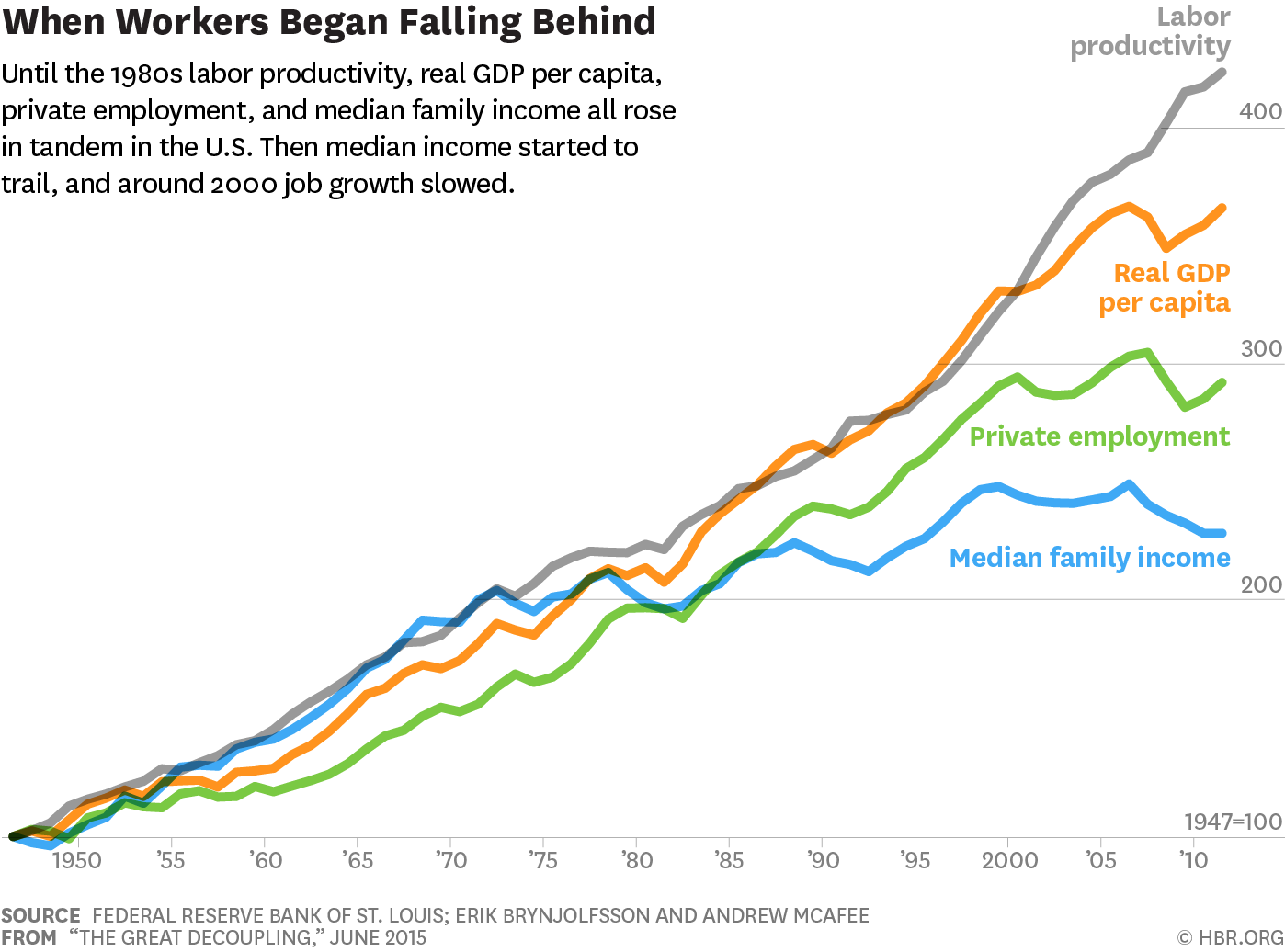
The disconnect shown above is the real battlefield. The blue line of productivity and the red line of happiness have stopped following each other. They are moving in opposite directions. Any leader who ignores the red line in favor of the blue one is destined to fail.
The Trap of the Strongman
There is a specific danger in the "strongman" approach to economics. It relies on the idea that the market is a person you can negotiate with, a rival you can outmaneuver in a board room.
But the market is not a person. It is a weather system. It is the cumulative result of millions of tiny decisions made by people like Elena every single day. If Elena decides she can’t afford that garden fence this year, and a million other Elenas make the same choice, the economy shifts. No amount of shouting from a podium can change the aggregate reality of a million empty bank accounts.
Trump’s toughest opponent isn't a Democrat. It isn't a judge. It isn't a prosecutor.
It is the fact that his preferred economic medicines—cheap money and protectionism—are the very things that could make the current sickness terminal. He is caught in a trap of his own making. To satisfy his base, he must promise a return to the "golden age" of 2018. But the 2018 economy was built on a foundation of low interest rates and global stability that no longer exists.
Trying to recreate that era now is like trying to drive a car into a lake because you remember how good it felt to go for a swim.
The Price of the Promise
Politics is the art of promising a better tomorrow. Economics is the science of explaining why you can’t have it for free.
The tension between these two forces is reaching a breaking point. We are living through a period of profound transition. The era of "easy" growth is over. The cost of energy, the cost of labor, and the cost of capital are all rising simultaneously. This is the "Great Reset" that no one asked for and no one seems to know how to manage.
If you listen closely to the campaign trail, you hear a lot about "winning." You hear about "making things great again." You hear about "crushing" inflation.
What you don't hear about is the sacrifice.
No one wants to tell the voter in Scranton that their eggs will never be $1.50 a dozen again. No one wants to tell the dental hygienist in Phoenix that her home value might actually need to stagnate so her children can afford to live in the same zip code. To tell the truth is to lose the election. To lie is to ensure a crisis once you win.
Trump’s toughest opponent is the reality that the tools he loves most are now broken. He is a carpenter who only owns a hammer, standing in a room made of glass. Every swing he takes to fix the structure risks bringing the whole ceiling down on his head.
The ledger doesn't lie. It doesn't have a political affiliation. It doesn't care about rallies or red hats. It only records the cold, hard fact that you cannot spend what you do not have, and you cannot fix a broken heart with a change in the interest rate.
The ghost is in the machine now. It's waiting for him. It's waiting for all of us. And when the music stops and the lights come up, we will find that the price of the dream was much higher than we were ever told.
The bill is on the table.