The brass key in Sofia’s pocket weighs less than an ounce, yet it feels like a brick dragging her coat to the left.
Consider Sofia—a hypothetical composite of thousands of young professionals in Lisbon today, though her story is drawn directly from the statistical reality crushing a generation. She is thirty-two. She holds a master’s degree in architecture, works fifty hours a week at a respected firm near the Tagus River, and earns €1,350 a month after taxes. Until last Tuesday, that key opened the heavy wooden door to a third-floor walk-up in the Arroios neighborhood. She shared the two-bedroom apartment with a nurse and a graphic designer. Their collective rent was €1,400. For another look, see: this related article.
Then came the registered letter. The landlord was not renewing the lease. The building had been sold to an investment fund registered in Luxembourg, and the new asking price for her modest, damp-walled flat—once renovated with grey laminate flooring and minimalist light fixtures—would be €2,600.
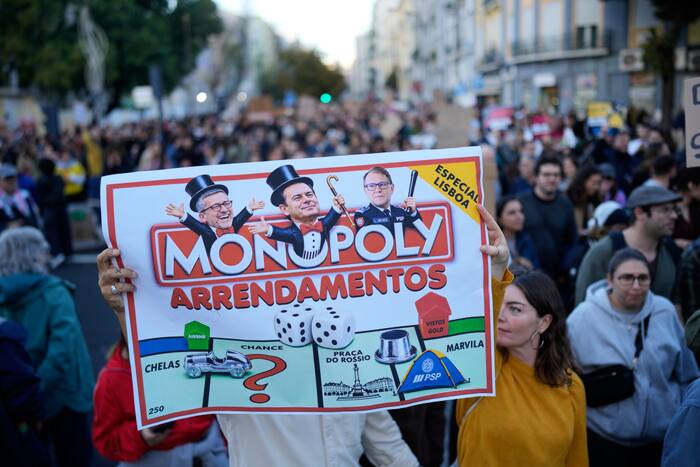
Sofia did not pack her boxes quietly. On a crisp Saturday afternoon, she joined tens of thousands of her neighbors marching down Avenida da Liberdade in Lisbon, while parallel rivers of frustration flooded the streets of Porto, Braga, Coimbra, and Faro. They carried house keys held aloft like tiny metal torches, cardboard signs painted with slogans like Houses to Live In, Not to Speculate On, and a palpable, boiling grief that has been simmering across the Iberian Peninsula for nearly a decade. Similar analysis regarding this has been shared by BBC News.
To understand why Portugal—a country long celebrated for its warm hospitality, sun-drenched coastlines, and laid-back rhythm—has erupted into massive civil demonstrations, you have to look past the postcard. You have to look at the math that no longer adds up.
The Arithmetic of Exile
Numbers can feel cold until you try to buy groceries with them.
Between 2015 and 2024, house prices in Portugal more than doubled, surging by over 100 percent according to Eurostat data—one of the sharpest increases anywhere in the European Union. In Lisbon alone, average rental prices jumped roughly 90 percent over the same period, pushing the median cost of a modest one-bedroom apartment well past €1,300 or €1,500 a month.
Now place that figure beside the Portuguese paycheck.
Portugal consistently ranks among Western Europe’s lowest-wage economies. The national minimum wage hovers around €820 per month (paid fourteen times a year, factoring in holiday and Christmas bonuses), while the average net salary sits barely above €1,100. Even young doctors, teachers, and engineers routinely take home between €1,200 and €1,600.
Do the subtraction. An ordinary worker in Lisbon or Porto must hand over 100 percent—and often 120 percent—of their entire monthly income just to secure a roof over their head, before buying a single loaf of bread, paying an electric bill, or boarding a metro train.
Economists use a clinical phrase for this: housing cost overburden. When you live it, it feels much simpler. It feels like exile in your own hometown.
I remember walking through the Alfama district ten years ago. The air smelled of grilled sardines, damp limestone, and laundry detergent drying on wrought-iron balconies. Elderly women leaned out of windows to trade gossip across narrow cobblestone alleys. Local tascas served soup and wine for five euros. Today, walking those same alleys feels like wandering through a meticulously curated theme park after closing hours. The laundry lines are gone. In their place hang black lockboxes bolted to the stone beside front doors—hundreds of them, waiting for rolling suitcases to clatter across the cobbles at midnight.
How a Country Sold Its Front Door
How did a nation of homeowners become a nation of tenants priced out of their own neighborhoods? The answer lies in a policy born out of desperation that mutated into an addiction.
Cast your mind back to 2011. Portugal was on its knees, battered by the Eurozone sovereign debt crisis and forced to accept a €78 billion international bailout. Unemployment soared past 17 percent. Historic city centers in Lisbon and Porto were crumbling, filled with vacant, decaying buildings whose rents had been frozen for decades. The government needed foreign capital immediately.
So, in 2012, Portugal opened the floodgates.
It launched the Golden Visa program, granting residency permits—and a golden ticket to visa-free travel across Europe’s Schengen Area—to non-EU citizens who bought real estate worth at least €500,000. Alongside it came the Non-Habitual Resident (NHR) tax regime, offering foreign retirees and high-earning professionals a flat 20 percent income tax rate and massive exemptions on foreign pensions. Later, as remote work exploded during the pandemic, a dedicated Digital Nomad Visa invited salaried workers from San Francisco, London, and Berlin to bring their Silicon Valley and Northern European incomes to a country where the local economy ran on Southern European wages.
Think of a local housing market like a neighborhood farmers' market where everyone earns ten dollars a day, and apples cost one dollar. Suddenly, busloads of visitors arrive carrying thousands of dollars, eager to buy up the entire orchard at ten dollars an apple. The farmers are thrilled. The local residents starve.
That is precisely what happened to Portuguese real estate.
Between 2012 and 2023, the Golden Visa scheme alone poured over €7 billion into Portugal, with roughly 90 percent of that capital funneled directly into property. Global institutional investors, short-term rental operators, and wealthy expatriates saw Lisbon and Porto as undervalued gems—cheaper than Paris, safer than London, sunnier than Amsterdam.
In historic parishes like Santa Maria Maior in Lisbon, more than half of all residential properties were converted into short-term tourist rentals, known locally as Alojamento Local. Traditional families were evicted to make way for boutique apartments. Corner hardware stores and neighborhood bakeries shuttered, replaced by brunch cafes selling €14 avocado toast in English.
The Invisible Casualties
When protesters march under banners reading Casa Para Viver (Home to Live In), the media often frames the story around twenty-somethings forced to live with their parents until age thirty-five. That part is true—Eurostat notes that the average young Portuguese adult does not leave the parental home until nearly thirty—but the crisis cuts much deeper into the social fabric.
Consider what happens next when an entire city becomes unaffordable for the people who keep it running.
Public schools in Lisbon and the coastal Algarve region now face severe teacher shortages, not because there are no teachers in Portugal, but because a public school instructor earning €1,400 cannot pay €1,200 in rent. Hospitals struggle to retain nurses and support staff. Police officers, bus drivers, restaurant cooks, and municipal sanitation workers are pushed to distant, poorly connected suburbs—places like Sintra, Loures, or across the river in Almada—enduring two- and three-hour daily commutes just to serve tourists staying in the city centers they can no longer afford.
And then there are the elderly.
Across Lisbon and Porto, thousands of seniors in their seventies and eighties have lived in the same rent-controlled apartments for forty or fifty years. Following a 2012 liberalization of rental laws designed to stimulate the market, many of those protections began expiring. Imagine surviving on a €550 monthly pension and receiving an eviction notice because your building was purchased for luxury redevelopment. For many older residents, losing their apartment does not mean moving across town; it means losing their doctors, their neighbors, their grocery store, and their will to keep going.
There is a quiet, psychological violence in watching your entire life become a line item on an international spreadsheet. You begin to feel like an inconvenience in the place where you were born.
Why Band-Aids Haven't Stopped the Bleeding
To be fair, the Portuguese government has not ignored the sirens blaring in the streets. Over the last few years, politicians have scrambled to prove they are listening, passing waves of legislation that swing wildly depending on who holds power in São Bento.
In 2023, the former Socialist government unveiled the Mais Habitação (More Housing) package. It halted new Golden Visas tied to real estate purchases, slapped extra taxes on short-term holiday rentals, capped rent increases on existing contracts, and even floated a controversial proposal to force owners of long-vacant properties to rent them out.
Then the political pendulum swung. A center-right coalition took office in 2024 and rolled back several of those restrictions, arguing that heavy-handed state intervention scares away investors and chokes off new construction. Instead, the newer strategy leaned toward tax exemptions for young first-time homebuyers under thirty-five, state guarantees on mortgage down payments, and incentives to build more supply.
Yet tens of thousands still marched. Why?
Because anyone who has stood in line to view a cramped basement studio alongside forty desperate strangers knows that tax breaks for down payments do not magic affordable apartments out of thin air. When you subsidize demand without radically expanding supply or curbing speculative hoarding, prices simply rise to swallow the subsidy. If the government gives young buyers a €15,000 tax break, sellers raise asking prices by €15,000.
Meanwhile, Portugal suffers from a staggering structural deficit in public housing. Unlike Vienna, where roughly 60 percent of residents live in municipal or subsidized housing, or the Netherlands, where social housing accounts for nearly 30 percent of the total stock, public housing in Portugal makes up a dismal 2 percent of all homes.
Two percent.
There is virtually no safety net. When the private market goes feral, citizens fall straight onto the concrete.
And another unsettling truth haunts the debate: over 700,000 homes across Portugal sit vacant or underused, tangled in sluggish inheritance disputes, dilapidated beyond habitability, or held purely as appreciating assets by owners who have no financial need to rent them out. The bricks and mortar already exist. They are simply locked behind legal paralysis and tax structures that reward sitting on empty property.
A Reckoning in the Streets
Standing amid the crowd in Porto or Lisbon during these demonstrations, you notice something remarkable. This is not a fringe gathering of ideological activists.
Walking shoulder-to-shoulder are grandmothers gripping aluminum walkers, university students carrying drums, middle-aged factory workers, nurses coming off night shifts, and young parents pushing strollers. Their anger is unusually focused because the grievance is universal. Everyone in Portugal either cannot afford a home, knows someone facing eviction, or watches their children pack bags for emigration to France, Switzerland, Germany, or the UK.
Since 2011, hundreds of thousands of Portuguese citizens—a disproportionate share of them young and university-educated—have left the country. Portugal spends billions educating its doctors, engineers, and architects, only to export them abroad because the domestic economy cannot offer them a living wage or an affordable apartment.
What makes these marches so electric is the realization that the crisis is not a natural disaster. It was not caused by an earthquake or a drought. It was engineered through policy choices—and what policy created, policy can dismantle.
What Real Repair Actually Looks Like
If Portugal—and the dozens of global cities watching Lisbon like a canary in a coal mine, from Barcelona to Dublin to Vancouver—wants to stop the bleeding, half-measures will not suffice. Solving a structural housing emergency requires treating shelter first as a fundamental human right, and only secondarily as an investment vehicle.
That begins with three hard, unglamorous shifts:
- Massive public and cooperative housing construction. Relying solely on private developers to build luxury condominiums will never house teachers or nurses. Portugal must aggressively expand its 2 percent public housing share toward the European average, using public land and European Union recovery funds to build permanent, non-profit rental stock that can never be sold off to private equity.
- Strict enforcement on short-term rentals and vacant properties. Historic residential zones cannot function as unregulated hotel districts. Cities need hard caps on tourist apartments paired with meaningful vacancy taxes that make hoarding empty buildings more expensive than renting them to local families.
- Linking rent stability to local wages. In an economy where median take-home pay barely crosses €1,100, unregulated market rents are a recipe for social collapse. Long-term lease security and transparent rent ceilings tied to local income indices give families the predictability required to build a life, raise children, and invest in their communities.
None of these fixes are quick. Concrete takes time to pour, zoning laws take months to rewrite, and powerful real estate lobbies fight every inch of regulation.
Back in Lisbon, as twilight settled over the river and the chants echoed off the Pombaline facades of Baixa, Sofia stood near the edge of the square, her fingers wrapped tightly around that heavy brass key in her coat pocket. Tomorrow, she would hand it back to a property manager who had never stepped foot in the building, pack her drafting tubes into the back of a borrowed van, and move forty kilometers north to a room in her cousin’s house.
Behind her, thousands of keys rattled in the evening air—a metallic chorus echoing down the avenues of a country trying to buy back its own front door.

