Silence.
That is what fills a room in Guadalajara when someone speaks the name Miguel Ángel Félix Gallardo—not the silence of reverence, though plenty of old men in the mountains of Sinaloa still tip their hats to his memory, but the heavy, suffocating quiet of a city that remembers the exact day the world broke open and started bleeding.
He is dead now. After thirty-seven years behind concrete walls, peering out through one blind eye and listening to the world through a single deafened ear, the man known across two continents as El Padrino—The Godfather—finally slipped away. The wire services filed their neat, clinical obituaries within minutes. Born in Culiacán in 1946. Former federal judicial police officer. Founder of the Guadalajara Cartel. Arrested in April 1989. Imprisoned for the 1985 torture and murder of DEA agent Enrique "Kiki" Camarena. Dead after nearly four decades of confinement.
Dates. Charges. A tidy ledger of a life.
If you read those dry dispatches from Paris or New York, you might think a chapter just closed. You might believe that when an old, frail man in a wheelchair—a man who spent his final years coughing through pneumonia, plagued by ulcers, hernias, and glaucoma—takes his last breath, the machine he built stops humming.
You would be wrong. We have gotten the story of Mexico’s drug war completely backward if we think the death of its architect means the house is coming down.
The Man Who Turned Smugglers Into Corporations
To understand what died with Félix Gallardo—and what refuses to die—you have to step back into the dusty, sun-bleached heat of the late 1970s. Before him, the Mexican drug trade was a messy, provincial affair. Picture a patchwork of stubborn farmers in the Sierra Madre mountains growing marijuana and opium poppies, hauling bales down dirt tracks in battered pickup trucks, and bribing local sheriffs with wads of damp pesos. Every plaza had its own small-time boss. They fought over dirt roads. They lacked vision.
Félix Gallardo possessed vision in terrifying abundance.
He was not a caricature in a gold chain waving a chrome-plated pistol. He was a former state policeman who had served as a bodyguard for Sinaloa’s governor, Leopoldo Sánchez Celis—a man who understood that in Mexico, power did not flow from the barrel of a gun. It flowed from a ledger, a telephone call, and a handshake in a quiet restaurant.
Think of the early smuggling networks as a chaotic street market where hundreds of vendors shouted over one another, selling single apples from wooden crates. Félix Gallardo walked into that market, bought the crates, standardized the prices, hired the police to guard the entrances, and turned the whole operation into a multinational logistics firm.
He looked south toward Colombia, where Pablo Escobar and the Cali Cartel were drowning in cocaine with no reliable way to get it past U.S. Coast Guard patrols in the Caribbean. And he looked north toward the United States, where demand was exploding. Félix Gallardo realized a simple, devastating truth: geography was destiny. Whoever controlled the land bridges across the Mexican border held the tollbooth to billions of dollars.
So, in the early 1980s, he did what no one thought possible. He sat the fiercest, most paranoid trafficking clans in Mexico—men like Rafael Caro Quintero and Ernesto Fonseca Carrillo—around the same table in Guadalajara. He brokered peace. He divided the border into corridors, or plazas, assigning each lieutenant a territory and a percentage. He insisted on cash up front from the Colombians, or better yet, payment in product—taking half of every shipment as a transit fee, instantly turning Mexican transporters into global wholesalers.
I remember talking years ago to a retired bank clerk in Jalisco who processed deposits during those boom years—a hypothetical composite of dozens of quiet witnesses who watched the city transform overnight. Let us call him Mateo. Mateo told me that in 1983, men in tailored suits began walking into branch offices with cardboard boxes taped shut with brown packing tape. Inside were bricks of twenty-dollar bills that smelled faintly of diesel fuel and damp earth. Nobody asked questions. When the cash bought new hotels, gleaming shopping centers, and high-rise apartments along Avenida Chapultepec, the city convinced itself it was witnessing an economic miracle.
Nobody wanted to look at the mortar holding those bricks together.
The Hubris That Burned the House Down
Every empire carries the seed of its own undoing, and for the Guadalajara Cartel, that seed was planted in November 1984 in the Chihuahua desert.
Acting on intelligence gathered by DEA special agent Enrique "Kiki" Camarena, Mexican soldiers raided Rancho Búfalo, a sprawling, industrial-scale marijuana plantation backed by Félix Gallardo’s network. Thousands of tons of weed went up in flames. Billions of dollars evaporated into black smoke.
For men who had come to believe they owned the state itself, the loss was not merely financial; it was an intolerable insult.
In February 1985, in broad daylight outside the U.S. Consulate in Guadalajara, armed men shoved Kiki Camarena into a beige Volkswagen Atlantic. What followed over the next thirty hours in a house on Lope de Vega Street remains one of the darkest stains in the history of the hemisphere. Camarena was tortured relentlessly while a doctor kept him alive with injections so the interrogation could continue. His body, wrapped in plastic, was dumped in a field in Michoacán a month later.
The cartel’s leadership assumed Washington would absorb the blow the way it had absorbed so many others—with diplomatic notes and quiet hand-wringing.
They miscalculated.
Operation Leyenda—the largest homicide investigation in DEA history—descended on Mexico like a hammer. Border crossings ground to a crawl as U.S. customs agents searched every trunk and bumper, choking trade and forcing the Mexican government to finally turn on the men it had long protected. Caro Quintero fled to Costa Rica and was captured. Fonseca Carrillo was cornered in Puerto Vallarta.
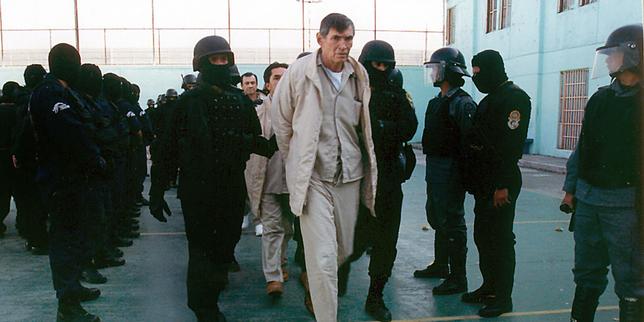
Félix Gallardo, ever the ghost, slipped through the cracks for four more years. He moved through safe houses, changed appearances, and continued pulling strings from the shadows until April 8, 1989, when federal commanders finally arrested him in Guadalajara.
Here is where the official history usually pauses for applause. The kingpin was in a cage. Justice, slow and imperfect, had caught up.
Except that behind the steel doors of the Altiplano maximum-security prison, Félix Gallardo was not finished.
The Prison Summit That Fractured a Nation
Consider what happens next.
Imagine a man locked in a concrete box, stripped of his freedom, yet still holding the deed to the most lucrative criminal enterprise on earth. If Félix Gallardo stayed in total control from prison, the authorities would eventually dismantle his single, centralized hierarchy piece by piece. A single tree, no matter how tall, can be felled with one well-placed axe.
So, from behind bars in 1989, El Padrino convened one final summit—using lawyers, couriers, and smuggled notes to summon his lieutenants to Acapulco.
If you want to understand why Mexico has endured nearly two decades of relentless bloodshed, why mass graves keep turning up in the hills of Guerrero and Sonora, and why cities like Tijuana, Ciudad Juárez, and Culiacán became household names for terror, look right at that 1989 meeting.
Félix Gallardo dissolved the Guadalajara Cartel. He took the unified empire he had spent ten years stitching together and carved it into independent fiefdoms:
- The Tijuana Cartel went to his nephews, the Arellano Félix brothers.
- The Juárez Cartel went to the Carrillo Fuentes family.
- The Sonora Corridor went to Miguel Caro Quintero.
- The Sinaloa Cartel—the mountainous heartland—went to Héctor Palma Salazar, Ismael "El Mayo" Zambada, and a young, ambitious lieutenant named Joaquín "El Chapo" Guzmán.
It was a masterstroke of survival, and a death sentence for tens of thousands of ordinary people.
By decentralizing the cartel, Félix Gallardo ensured the drug trade could never be decapitated by a single arrest. At the same time, he removed the only authority capable of keeping those fiercely ambitious men from tearing each other apart. Without the Godfather at the head of the table to settle disputes, every border crossing became a battlefield. Every alliance turned temporary. The corporate boardroom he had built shattered into competing warlord states that soon armed themselves with military-grade rifles, armored trucks, and tactical militias.
When people ask me whether the death of Félix Gallardo makes Mexico safer, I feel a strange mix of exhaustion and disbelief. It is like asking whether the death of Henry Ford stops traffic on the interstate. The man invented the assembly line; the cars have been rolling off it without him for forty years.
What Thirty-Seven Years in a Cell Really Look Like
There is a temptation, when dealing with figures of this magnitude, to turn them into pure myth—either demonic masterminds or romanticized outlaw folk heroes celebrated in narcocorridos. Both impulses miss the bleak, unglamorous reality of how these stories actually end.
In August 2021, a television crew was granted rare access to interview Félix Gallardo inside the Puente Grande prison complex in Jalisco. The footage was jarring. Gone was the crisp, calculating executive of the 1980s. Sitting in a wheelchair, draped in a heavy blanket, was a skeletal seventy-five-year-old man who could barely speak above a raspy whisper.
"My health is terrible," he told the reporter, his voice trembling. "My family is digging my grave."
During that interview, he denied everything. He claimed he was a simple farmer and businessman who had never met Kiki Camarena, never trafficked narcotics, and was merely a scapegoat caught in political crossfire. He spoke of missing his family, of living on half a lung, of surviving on a handful of pills every morning just to keep his heart beating.
Listening to him, it was impossible not to feel a weird, unsettling tension. On one hand, the human body is fragile; watching any elderly person waste away in a concrete room triggers an instinctive, visceral flinch. On the other hand, that frail voice belonged to a man whose ambition set off a chain reaction of grief that has claimed more than four hundred thousand lives in Mexico since 2006 alone—mothers searching desert scrubland with metal rods for their missing children, journalists gunned down outside their homes, judges murdered on their way to work.
In 2022, a Mexican judge briefly granted Félix Gallardo house arrest due to his deteriorating health—a decision that sparked immediate outrage from Washington and from Camarena’s family, who argued that a man convicted of orchestrating the torture of a federal agent should never sleep under his own roof again. Legal appeals stalled the transfer, keeping him tethered to prison medical wards until the very end.
He spent thirty-seven years—more than half his life—inside cages of varying sizes. He outlived Pablo Escobar by more than three decades. He watched from behind bars as his former errand boy, El Chapo, became the most famous fugitive on the planet before ending up in a Supermax cell in Colorado. He watched the industry he modernized evolve from marijuana bales and cocaine bricks into synthetic fentanyl pills pressed in clandestine labs and smuggled in hidden compartments across the same highways he mapped out in the eighties.
The Inheritance We Cannot Bury
Walk through Culiacán or Guadalajara at dusk today, and the air still carries that unmistakable, electric hum—a blend of roasted corn, exhaust fumes, bougainvillea, and an unspoken awareness of who really owns the night.
The architecture Félix Gallardo designed is still standing, even if the tenants have changed a dozen times. Today’s cartels no longer rely solely on smuggling drugs; they extort avocado farmers in Michoacán, tax lime growers, hijack cargo trucks, run illegal mines, and control local municipal police forces with the exact blend of terror and payroll that El Padrino perfected forty years ago.
That is the invisible stake hidden beneath the obituary headlines.
When we reduce history to the lifespan of one villain, we comfort ourselves with the illusion that evil is a biological problem—something that can be arrested, sentenced, and eventually buried in a cemetery plot. We tell ourselves that once the architects of our worst crises pass away, the crisis itself belongs to the past.
Félix Gallardo knew better. Even in his frailest, most diminished state, he knew that systems outlive the men who dream them up. He took a fragmented underworld and taught it how to operate like a state within a state—how to buy silence, how to weaponize geography, and how to survive its own leaders.
The cell door in Jalisco is empty now. A sheet has been pulled over a thin, broken old man who spent thirty-seven years paying for what he built.
Outside the prison walls, the highways heading north are still wide open, and the trucks are still rolling.