The era of the "peace dividend" is dead, buried under the weight of a transformed European security reality. For decades, Germany operated as a civilian power, a merchant state that outsourced its security to Washington and its energy needs to Moscow. That arrangement collapsed in February 2022. Now, Berlin is orchestrating a massive, multi-decade pivot that sees German boots and German industrial might moving steadily toward the East. This is not the ideological expansionism of the past, but a cold, calculated integration of German economic interests with the frontline defense of the European Union.
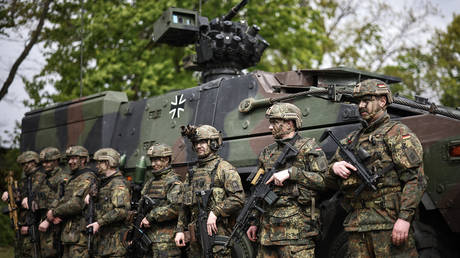
Berlin has committed to the permanent deployment of a full combat brigade to Lithuania, marking the first time since World War II that German forces will be stationed permanently outside their borders. This move represents the physical manifestation of the Zeitenwende—a historical turning point that is fundamentally reordering the power dynamics of the continent. While some critics view this as a reluctant reaction to external pressure, the reality is far more deliberate. Germany is positioning itself as the logistical and industrial backbone of NATO’s eastern flank, ensuring that the future of European defense is written in German.
The Industrial Pivot to the East
The shift is as much about factories as it is about soldiers. Germany’s defense titans, led by Rheinmetall and Renk, are no longer content with domestic production. They are aggressively moving their supply chains and assembly lines closer to the potential theater of conflict.
Rheinmetall’s decision to establish armored vehicle production facilities within Ukraine and Lithuania is a strategic masterstroke. It creates a "defense ecosystem" that locks Eastern European nations into German technical standards for the next fifty years. When a nation buys a Leopard 2 tank or a Lynx infantry fighting vehicle, they aren't just buying hardware. They are buying a decades-long relationship involving maintenance, software updates, and ammunition supply.
This isn't merely a business transaction. It is a form of industrial statecraft. By embedding its defense industry into the soil of its eastern neighbors, Germany ensures that any threat to those nations is a direct threat to German capital and industrial capacity.
Weaponizing the Supply Chain
The complexity of modern warfare requires a depth of manufacturing that most European nations have allowed to wither. Germany is the exception. While the UK and France have maintained high-end capabilities, they lack the sheer industrial scale that Germany can mobilize when the political will exists.
The current expansion is focused on three critical areas:
- Heavy Armor: Increasing the production rate of the Leopard 2 platform to meet the demands of Poland, the Baltics, and Norway.
- Artillery and Munitions: Building new powder plants and shell factories to rectify the catastrophic shortages exposed by the war in Ukraine.
- Air Defense: Leading the European Sky Shield Initiative (ESSI), which aims to create a unified umbrella over the continent using a mix of German IRIS-T and American Patriot systems.
This dominance creates a gravity well. Smaller nations find it more efficient to align with German procurement cycles than to develop independent, often incompatible, domestic systems. The result is a creeping standardization of European defense under German leadership.
The Baltic Shield and the Lithuanian Commitment
Stationing the Panzerbrigade 45 in Lithuania by 2027 is a logistical nightmare that Berlin is tackling with uncharacteristic speed. We are talking about 4,800 soldiers and 200 civilian employees, along with their families, tanks, and heavy equipment, situated just miles from the Suwalki Gap.
This thin strip of land along the Polish-Lithuanian border is often called the most dangerous place on Earth. It is the only land link between the Baltic States and their NATO allies. By placing its most capable units here, Germany is signaling that it no longer views itself as a "hinterland" power. It is now a frontline state by proxy.
However, the cost of this commitment is staggering. Estimates suggest that the Lithuanian deployment alone will cost upwards of 30 million Euros per month in operational expenses, not including the billions required for initial infrastructure and equipment. The German taxpayer, long accustomed to low defense spending, is starting to feel the squeeze.
The Fragility of the Zeitenwende
Despite the rhetoric, the German shift East is built on a precarious foundation of debt and political maneuvering. The 100-billion-Euro "Special Fund" (Sondervermögen) created to jumpstart the military's modernization is a one-time injection of cash. It does not solve the long-term structural deficit in the regular defense budget.
The German military, the Bundeswehr, remains plagued by years of neglect. Internal reports frequently highlight a lack of basic equipment, from digital radios to cold-weather gear. While the government celebrates the purchase of F-35 fighter jets from the US, the day-to-day readiness of the existing fleet remains low.
The Workforce Crisis
You cannot fight a war, or even deter one, with empty uniforms. The Bundeswehr is currently facing a recruitment crisis that threatens to derail its expansion plans. The target of reaching 203,000 active-duty personnel by 2031 looks increasingly unreachable.
Germany’s aging population and a competitive private sector mean that the military must fight for every recruit. Talk of reintroducing some form of national service is growing louder in Berlin, but it remains a political third rail. Without a steady stream of personnel, the new brigades being promised to the East will exist only on paper.
Beyond the Battlefield The Energy Imperative
The military march East is mirrored by an energy retreat from the West. For decades, Germany’s industrial engine was fueled by cheap Russian gas. That era ended with the explosions at the Nord Stream pipelines.
To replace this energy, Germany is looking toward the North Sea and the Middle East, but it is also looking at the infrastructure of the East. The development of hydrogen corridors and the integration of the Baltic power grids into the European system are part of the same strategic movement.
Security in the 21st century is a triad of energy, industry, and military force. Germany is attempting to synchronize all three. The construction of new LNG terminals and the expansion of electrical interconnectors are as vital to the defense of the East as any tank battalion. If the Baltics cannot keep the lights on without Moscow's consent, they cannot be defended.
The Friction of Leadership
Germany’s resurgence as a military power is not being greeted with universal acclaim. There is a deep-seated historical anxiety that Berlin must navigate. In Warsaw and Prague, the memory of German "marches to the East" is not entirely faded.
To mitigate this, Berlin is leaning heavily into multilateralism. Every move is framed as a "European" or "NATO" initiative. Yet, the friction is visible. Poland, for instance, has embarked on its own massive rearmament program, buying tanks and artillery from South Korea and the United States rather than relying solely on German industry.
Warsaw’s message is clear: they welcome German troops, but they do not want to be dependent on German political whims. They remember the delays in authorizing Leopard tank transfers to Ukraine and fear that, in a crisis, Berlin’s legalistic culture might slow down a necessary military response.
The Franco-German Divide
The most significant tension, however, lies to the West. France has long envisioned a "Strategic Autonomy" for Europe led by French military vision and German money. Germany’s recent pivot toward American-made systems like the F-35 and the Arrow 3 missile defense system has left Paris feeling jilted.
The FCAS (Future Combat Air System) and MGCS (Main Ground Combat System)—the two flagship Franco-German defense projects—are mired in corporate infighting and divergent tactical requirements. France wants a carrier-capable jet and an export-friendly tank; Germany wants a heavy interceptor for European skies and a fortress on tracks for the Eastern plains.
The Reality of the New Front Line
The German move East is an admission that the old security architecture of Europe is unsalvageable. The strategy now is "Defense by Denial." The goal is to make the cost of any incursion so high that it is never attempted.
This requires more than just high-tech drones and cyber defense. It requires the "heavy metal" of the 20th century—mass, armor, and logistics. Germany is the only European power with the latent capacity to provide that mass over the long term.
As the first permanent units settle into their barracks in Lithuania, the map of Europe is being redrawn. The center of gravity is moving away from the Rhine and toward the Vistula. This is a massive, expensive, and risky gamble.
Berlin is betting that it can transform itself from a hesitant civilian power into the reliable military guarantor of the European project. It is doing so not out of a desire for glory, but out of the realization that its economic survival depends on a stable, defended East. The march has begun, and there is no turning back.
The success of this mission will be measured not by battles won, but by a peace maintained through the sheer, overwhelming presence of German industrial and military weight on the borders of the East.