The Iranian national football team began its World Cup campaign with a 2-2 draw against New Zealand at SoFi Stadium in Los Angeles, but the actual contest on the grass was completely overshadowed by an agonizing geopolitical struggle. For Team Melli, neutrality is an impossible luxury. Standing shoulder to shoulder under a heavy cascade of boos, hisses, and howls from their own diaspora during the national anthem, the players occupied a suffocating middle ground. They are viewed by the Islamic Republic as a crucial vehicle for state legitimacy and condemned by anti-government protesters as complicit symbols of a brutal regime.
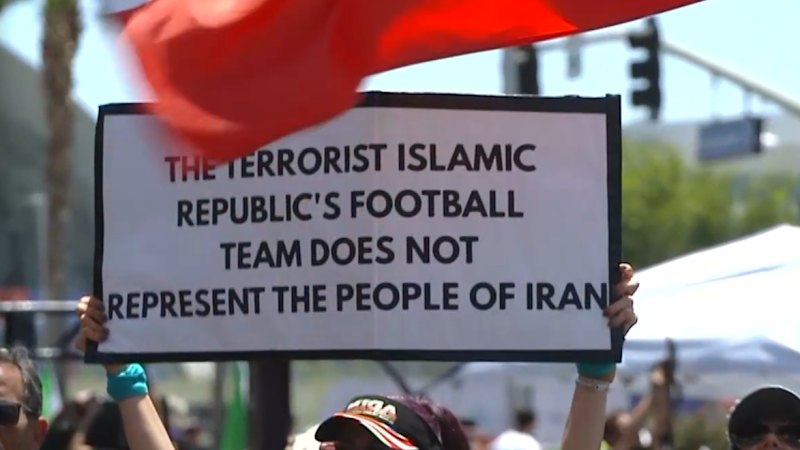
This tension is not a spontaneous byproduct of the tournament, but rather the climax of a deep fracture within the global Iranian community. Outside the turnstiles in Inglewood, California—home to the largest concentration of Iranian ancestry outside Iran—the scene resembled a political battleground rather than a sporting celebration. Several hundred Iranian Americans brandished the pre-revolutionary lion-and-sun flag, spat on official state banners, and openly confronted fans entering the arena in team jerseys.
The primary conflict surrounding Team Melli lies in the complete erosion of the boundary separating sport from state survival. Football cannot be parsed as mere entertainment when an authoritarian apparatus monitors every gesture, and a furious diaspora demands total defiance from athletes who face severe retaliation back home.
The Hostage State of Iranian Football
For decades, international sports federations have clung to the myth that football can remain insulated from geopolitics. FIFA maintains strict regulations prohibiting political symbols inside stadiums, a rule that led to a legal battle in Los Angeles County Superior Court just hours before kickoff. The court upheld FIFA’s ban on the pre-revolutionary flag, forcing fans to resort to smuggling alternative garments and banners into the venue to express dissent.
This institutional insistence on keeping politics out of the game ignores the reality of how authoritarian states operate. The Islamic Republic does not view Team Melli as an autonomous collection of athletic professionals. It treats the team as a branch of national public relations.
When athletes succeed, the state claims the victory as validation of its governance. When athletes dissent, the retribution is swift, calculated, and absolute.
Consider the internal mechanics of the Iranian roster choices for this World Cup cycle. Star striker Sardar Azmoun was entirely excluded from the squad following social media activity that directly criticized the government’s systemic crackdowns. Stripping a premier talent from a World Cup roster is an act of athletic self-sabotage, yet Tehran willingly prioritizes ideological compliance over competitive edge.
This leverage is magnified by what occurred during the 2022 tournament in Qatar. Following the death of 22-year-old Mahsa Amini in the custody of the morality police, the national team initially refused to sing the national anthem during their opening match against England. It was a monumental act of collective courage. By their second and third matches, however, the players fell back into line. Intelligence reports later revealed that families of the players had been explicitly threatened with imprisonment and torture if the team continued its public defiance.
To expect these athletes to act as frontline revolutionary leaders while their relatives remain within reach of the Islamic Revolutionary Guard Corps is a profound miscalculation. The diaspora, operating under the protection of Western civil liberties, frequently demands absolute martyrdom from a squad that operates under total surveillance.
The Fracture of Tehrangeles
The choice of Los Angeles as a host city for Group G created an volatile microclimate. The Westwood corridor, colloquially known as Tehrangeles, is populated largely by families who fled the 1979 Islamic Revolution and subsequent decades of domestic oppression. For this community, the official green, white, and red flag authorized by FIFA is not a symbol of the homeland; it is the insignia of an occupying force.
+-----------------------------------------------------------------------+
|                       THE DIASPORA DILEMMA                            |
+-----------------------------------+-----------------------------------+
|       THE PROTESTER PERSPECTIVE   |       THE REFORMIST PERSPECTIVE   |
+-----------------------------------+-----------------------------------+
| • Team Melli is a state asset     | • Team Melli belongs to the people|
| • Playing legitimizes the regime  | • Athletes are under duress       |
| • Silence equals complicity       | • Sport offers rare national joy  |
+-----------------------------------+-----------------------------------+
This polarization manifested in raw hostility on the concrete outside SoFi Stadium. Protesters set up perimeters where arriving families were jeered for wearing national team shirts. An official flag was snatched from a supporter, thrown to the pavement, scuffed, and systematically destroyed by a crowd chanting anti-regime slogans.
"They are a government team," argued Rameileh Jaffrey, a resident who left Iran ten years ago. Her stance reflects a growing contingent within the diaspora that views any form of athletic celebration as an erasure of the ongoing human rights crisis within Iran’s borders.
Conversely, families who attended the match with children argued that the players represent the geographic and cultural soul of the nation, completely distinct from the current theological leadership. This creates an impossible environment for the squad. If they perform poorly, they are dismissed as a demoralized state asset. If they perform well, they risk providing the regime with a cynical propaganda victory.
The Illusion of the Apopolitical Pitch
Team captain Mehdi Taremi attempted to navigate this minefield during his pre-match press conferences, pleading for a separation of sport and state. "We play for every Iranian, be it in the diaspora or in Iran," Taremi stated. "This kind of tension undermines that joy, and it undermines the message of FIFA and our people, which is that football brings about peace."
It is a diplomatic statement designed to appease Western media while avoiding phrases that could trigger an arrest warrant upon return to Tehran. But as an analytical reality, an apolitical Iranian football match does not exist. Every movement on the field is translated into political currency.
When right-back Ramin Rezaeian scored Iran's opening goal against New Zealand, his immediate reaction was to pull his jersey entirely over his face. It was an eerie, muted celebration. When questioned afterward about the gesture, Rezaeian admitted it was political, stating simply, "I don't want to see the world."
          [ Regime Surveillance & Roster Retaliation ]
                             │
                             ▼
  [ Diaspora Protest ] ──► [ TEAM MELLI ] ◄── [ FIFA Political Bans ]
                             ▲
                             │
            [ Threat of Domestic Family Reprisals ]
This internal torment strips the game of its traditional escapism. The players are acutely aware that their training camp was forced to relocate from Arizona to Mexico after several soccer officials were denied visas by U.S. authorities amidst escalating regional military tensions. They are aware that their head coach, Amir Ghalenoei, openly describes them as "the most oppressed team in the whole World Cup."
The ultimate tragedy of Team Melli is that they are trapped in a system where true authenticity is impossible. Defiance carries the price of state retribution against their families, while compliance guarantees the permanent alienation of the global communities that should be their natural support base. As the tournament progresses through the group stage, the ninety minutes on the pitch will remain the least complicated part of their journey. The unresolved question is not whether Iran can advance through the tournament, but whether the national team can survive the crushing weight of the identity crisis imposed upon them by both their rulers and their people.