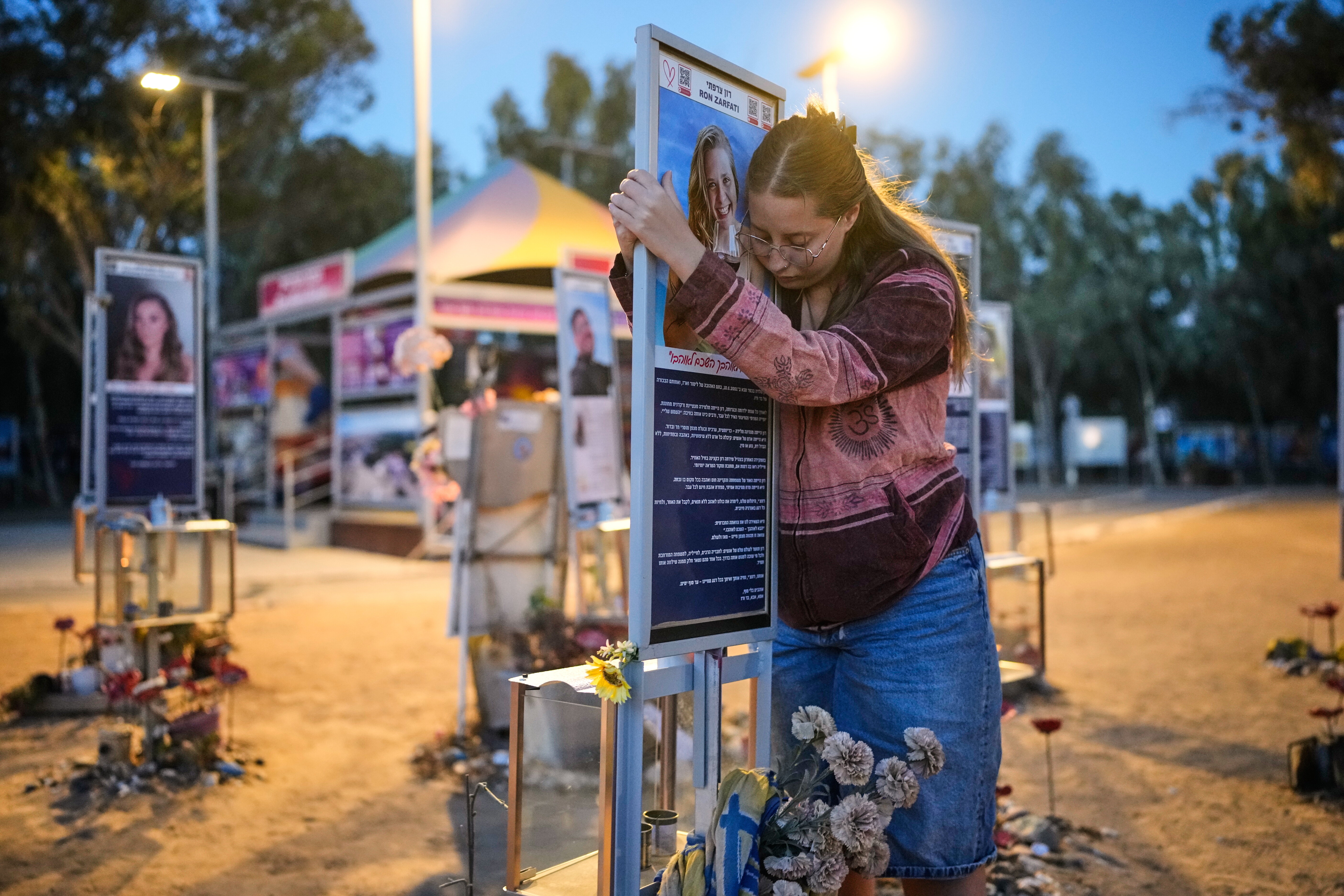
Time does not heal everything. Sometimes, it merely hardens the edges of an open wound until it becomes a monument you are forced to carry.
On a quiet side street in Tel Aviv, the coffee cups are still sitting half-full on wooden tables that have not been wiped down in an hour. People are not talking loudly. They are listening. Listening for sirens, listening for ghosts, listening to the heavy, suffocating silence of an anniversary that arrived too soon and stayed too long. October 7 did not happen once. It repeats in the quiet tremor of a mother’s hand pouring morning tea, in the empty chair at the dinner table that everyone pretends not to see, and in the sharp, sudden intake of breath whenever a motorcycle backfires in the distance.
One year. Twelve months of counting days since the sky tore open, since the borders crumbled, since the illusion of safety vanished into the smoke of burning kibbutzim.
Cross a map, cross a border that exists more in blood and barbed wire than ink, and the landscape changes its face while keeping the same hollow ache. In the battered alleys of Gaza, beneath the skeletal remains of apartment blocks that once echoed with the sound of children playing football, the anniversary sounds different. There are no sirens here because the sky is already falling. There is no quiet coffee shop. There is only the endless, grueling calculus of survival—where finding clean water or a scrap of plastic to patch a leaking tent counts as a minor victory against a winter that is coming too fast.
This is not a story about statistics. Statistics are shields we use to keep the horror at a distance. Let us drop the shields.
Consider a hypothetical father, David, standing in a cemetery in the center of Israel. He is holding a small smooth stone—the traditional Jewish marker left on graves instead of flowers. His son’s name was Omer. Omer loved music festivals, built absurdly complex things out of Lego, and laughed with his entire body. Now, David holds a stone. The weight of it in his palm feels insulting. How can a tiny pebble measure a universe extinguished? David looks around him. Hundreds of others are doing the exact same thing, their shoulders hunched under an invisible gravity. They are mourning not just their dead, but the sudden, brutal theft of their future. They live in a country where grief is now the national architecture. Every citizen is an expert in shiva, every calendar is divided strictly into before and after.
Now shift your gaze a few miles southwest, to a makeshift camp where Fatima sits on the dirt, trying to soothe a coughing toddler wrapped in a dust-stained blanket. Fatima is not thinking about geopolitics or ceasefire resolutions drafted in distant, air-conditioned European halls. She is thinking about the three times her family has been forced to pack their entire lives into a single plastic bag. She is thinking about her sister, who is buried beneath concrete that heavy machinery cannot reach. Fatima’s grief is wrapped in terror and exhaustion. She wants peace, yes, but peace feels like a myth told by people with full stomachs to people who have forgotten what a meal without flour rations tastes like.
Two peoples. Two radically different daily nightmares. Bound together by an unbreakable chain of geography, trauma, and an intractable refusal to disappear.
To understand how we arrived at this grim anniversary, we have to look past the breaking news banners and examine the mechanics of chronic fear. Fear is an architect. When a society is struck by an unprecedented security failure, the collective nervous system rewires itself. The social contract—the silent agreement that the state will protect you while you sleep—shatters. In Israel, the days following October 7 unleashed a fierce, protective mobilization, but also a deep, existential dread. Reservists packed their bags, leaving behind tech startups, university lecture halls, and newborn babies, marching toward a war with no clean exit strategy. They went because they felt they had no choice. If the wall fails, you become the wall.
Yet, inside Gaza, millions found themselves trapped behind that exact same wall, paying the catastrophic price of a war launched by Hamas—a militant leadership that rule through iron and tunnels, treating civilian survival as collateral damage in a grand, ideological theater. The ordinary people of Gaza did not choose this firestorm. They are caught in the gears of a machine far larger than themselves, where every day is an endurance test against hunger, cold, and the relentless roar of jets overhead.
This is the tragedy of mirrored pain. When two populations are locked in a struggle where each side’s survival feels mutually exclusive to the other, empathy becomes a revolutionary act. And right now, revolutionaries are in short supply.
Look closer at the emotional geography of this conflict.
In a Tel Aviv park, a support group gathers in a circle of folding chairs. They are survivors, parents of hostages, siblings of soldiers. No one speaks for the first ten minutes. The air is thick with things left unsaid. A woman named Ilana finally speaks, her voice cracking. "We used to argue about politics," she whispers, looking down at her sneakers. "Left, right, judicial reform, housing prices. It feels like we were arguing about the color of the curtains while the house was burning down. Now, I just want my daughter back. I don’t care about the rest."
That is the stripping away of pretense. War strips a culture down to its rawest, most vulnerable nerves. It exposes the fragility of modern civilization. We like to think we live in an era of advanced technology, where distance is conquered by fiber optics and our lives are insulated by comfort. But October 7 and its aftermath proved something ancient and terrifying: strip away the thin veneer of order, and humans are still vulnerable to the oldest horrors in the book.
Across the fence line, in a makeshift clinic lit by a flickering battery-powered bulb, a young medic named Tariq stitches a wound on a young boy’s leg. There is no anesthesia left. Tariq’s hands do not shake, not because he is unafraid, but because fear is a luxury he exhausted months ago. He has worked for thirty-six hours straight. He thinks of his own children, whom he sent south weeks ago, hoping—praying—they are still breathing.
"People ask me if I have hope," Tariq says quietly, biting his lip as he knots the thread. "Hope is a dangerous word here. Hope gets you killed. Today, I don't need hope. I need tomorrow. If we can reach tomorrow, maybe we can talk about hope."
That is where the entire region stands today. Stranded between a yesterday that cannot be undone and a tomorrow that refuses to promise safety.
The anniversary of October 7 is not a historical milestone tucked neatly into a textbook. It is a living, bleeding nerve. It challenges the world to look beyond the polarized talking points of social media feeds, where complex human suffering is flattened into hashtags and memes. It demands that we witness the human cost of extremism, bad governance, and the failure of imagination.
When the political speeches fade, when the anniversary broadcasts end and the anchors turn off their microphones, the silence returns to the streets of Tel Aviv and the ruins of Gaza.
In that silence, the real question lingers. Not how many rockets were fired, or how many statements were issued by the United Nations, but how two traumatized nations can ever coexist on a strip of earth so small that their shadows overlap.
The sun dips below the Mediterranean, painting the sky in shades of bruised purple and gold. A stray cat picks its way through rubble in the north. A mother in the center of the country checks the locks on her front door for the third time, listening. The horizon remains dark, heavy with the weight of tomorrow, waiting to see if the dawn will bring a different kind of light, or simply more of the same fire.


