The smell hits you first.
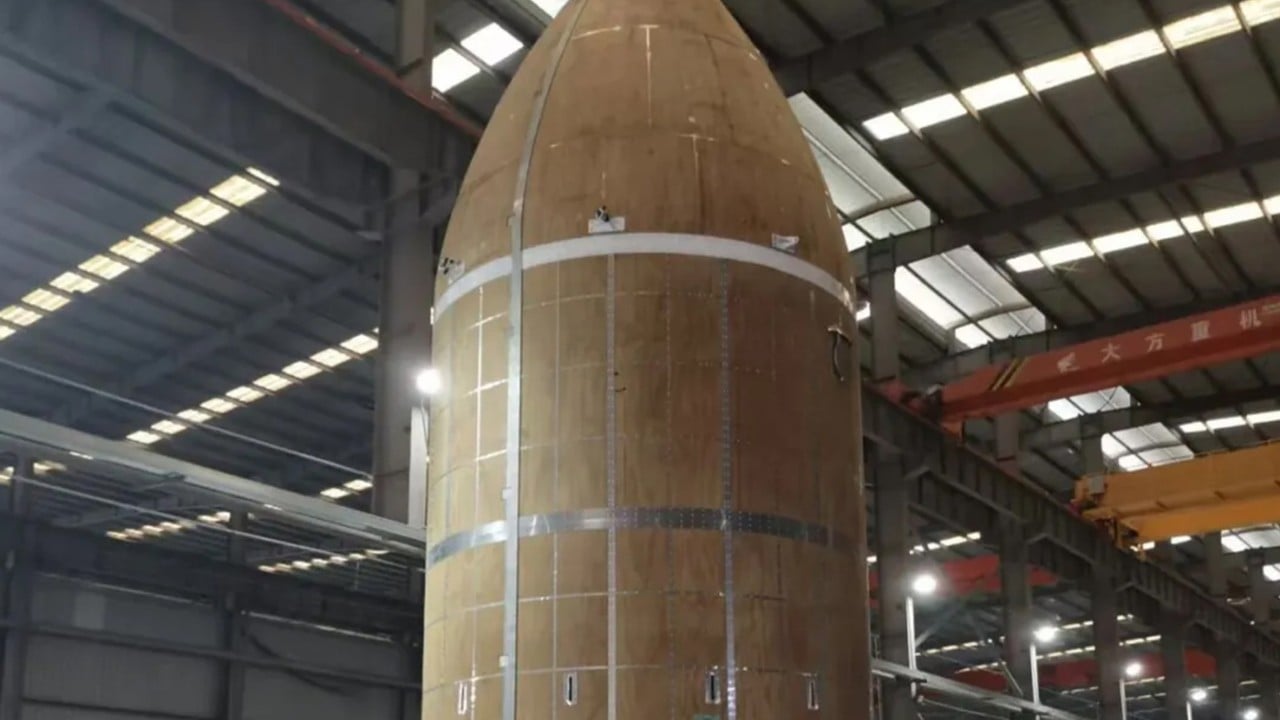
Before you see the CNC routers humming in the cavernous industrial bays of Jiayuguan, before you notice the white-suited technicians measuring aerodynamic tolerances to the fraction of a millimeter, your nose registers the unmistakable, earthy sweetness of freshly cut birch.
It smells like a grandfather’s workshop. It smells like furniture. It smells like everything aerospace engineering spent the last seventy years trying to escape.
For decades, we have been conditioned to believe that reaching orbit requires materials forged in the fires of impossible alchemy. Carbon-fiber composites cured in massive autoclaves. Titanium alloys milled from solid billets at a cost that makes luxury watchmakers weep. Proprietary ceramic tiles baked until they can shrug off the fury of atmospheric reentry. We look at a rocket sitting on a launchpad and see a gleaming monolith of silver and white, a monument to human defiance against gravity.
Then, a commercial Chinese aerospace company looked at the tip of a rocket—the payload fairing, the bulbous nose cone that shields multi-million-dollar satellites from the violent slap of the atmosphere—and asked a question so absurd it bordered on heresy.
Why not make it out of wood?
The Billion-Dollar Trash Problem
To understand why a group of engineers in northwest China decided to wrap orbital hardware in timber, you have to understand the quiet absurdity of modern spaceflight.
Consider a hypothetical engineer—let’s call her Lin—working on a commercial launch team in Jiuquan. For six months, Lin and her team spend millions of dollars and thousands of sleepless hours fabricating a standard carbon-fiber payload fairing. They layer the weaves by hand. They monitor the pressure inside an industrial oven the size of a subway car. They test the acoustic dampening so the roaring vibration of liftoff doesn't rattle a delicate communications satellite into expensive scrap metal.
Then comes launch day.
The engines ignite. The rocket climbs through the troposphere, punching through the sound barrier at Max Q, the moment of peak aerodynamic stress where the air pushes back against the rising metal like a solid wall. Three minutes into the flight, well above the thickest part of the atmosphere, the fairing has done its job. Explosive bolts fire. The clamshell halves split apart, tumbling backward toward Earth.
Unless you are SpaceX operating a dedicated fleet of recovery ships in the Atlantic, that multi-million-dollar masterpiece of composite engineering simply falls into the ocean or smashes into the Gobi Desert. Destroyed. Written off.
Trash.
Spaceflight has always suffered from a chronic addiction to perfection at any price. When governments footed the bill during the Cold War, cost was a rounding error next to geopolitical pride. Today, the orbital economy is a ruthless commercial freight business. Every kilogram counts, yes, but every dollar counts more. If you want to launch small satellites every week—the way cargo planes move packages between Memphis and Tokyo—you cannot spend half a year and a small fortune building a disposable umbrella.
You need something cheap. You need something fast. And, paradoxically, you need something that burns cleanly when its job is done.
The Physics of Char
When news broke that Chinese commercial firm Space Pioneer (Beijing Tianbing Technology) and researchers within China’s aerospace sector were developing and testing wooden payload fairings—specifically utilizing high-density birch laminates—the internet reacted with predictable amusement. Memes of lumberjacks in spacesuits flooded social media. Skeptics scoffed at the idea of trees surviving the brutal physics of hypersonic flight.
I’ll admit, my first reaction wasn't awe. It was confusion.
I grew up thinking of wood as the ultimate fragile material—something that warps in the rain, rots in the dirt, and turns to ash the moment it touches a spark. Putting wood on a rocket felt like taping cardboard to the bumper of a Formula 1 car. It triggered a deep, instinctive doubt that every layperson feels when modern engineering violates common sense.
Yet, when you peel back the aesthetic bias of the Space Age and look at the raw thermodynamics, the joke evaporates.
Think of a campfire log. When you throw a thick piece of hardwood into a blaze, the outside catches fire immediately. Within minutes, a layer of black charcoal forms across the surface. That char isn't a failure of the wood; it is a shield. Charcoal is a remarkably poor conductor of heat. It insulates the raw, unburned wood beneath it, slowing the inward march of the flames so dramatically that a thick log can sit in a roaring fire for hours while its core remains cool enough to touch.
In aerospace engineering, this phenomenon has a clinical, high-tech name: ablation.
During the Apollo missions, NASA protected astronauts returning from the Moon at 25,000 miles per hour not with space-age metals, but with an ablative heat shield made of phenolic resin—a synthetic polymer closely related to the glues used in plywood—packed into a fiberglass honeycomb. As the capsule slammed into the atmosphere, the outer layer charred, melted, and vaporized, carrying the intense heat away with it.
Wood is nature’s original ablative composite.
Long before human beings invented carbon fiber, evolution engineered trees to survive lightning strikes and forest fires. Cellular structures of cellulose and lignin create a lightweight, naturally reinforced matrix with an astonishing strength-to-weight ratio. When subjected to the searing aerodynamic friction of a rocket punching through the lower atmosphere, specialized laminated birch doesn't shatter or melt unpredictably like certain plastics or thin metals. Its outer millimeters char, locking in thermal protection and keeping the satellite payload bays safely cool during the three-minute sprint to space.
And the acoustics? Anyone who has ever stepped inside a timber-framed concert hall knows how wood handles sound. Unlike aluminum-lithium alloys, which ring like a struck bell when bombarded by 140 decibels of rocket exhaust, dense wood naturally absorbs and dampens acoustic vibrations. For a fragile satellite packed with delicate optical lenses and microscopic solder joints, a wooden nose cone isn't a downgrade. It is a padded velvet case.
The Invisible Bottleneck in the Supply Chain
The real story here isn't a quirky material science experiment. It is a brutal lesson in industrial economics.
Across the globe, private space companies are locked in a desperate race to build mega-constellations—networks of thousands of low-Earth orbit satellites designed to beam broadband internet to remote villages, track climate shifts in real time, and connect autonomous shipping fleets. China alone has filed plans for multiple constellations totaling tens of thousands of satellites, including projects like Guowang and Qianfan.
You cannot build a ten-thousand-satellite network if you are waiting in line for carbon fiber.
Carbon fiber is a notoriously finicky, bottlenecked industry. High-grade aerospace prepreg—carbon fibers pre-impregnated with epoxy resin—must be stored in industrial freezers, laid up in temperature-controlled cleanrooms, and baked under extreme pressure. A single flaw in the resin cure can compromise the structural integrity of a fairing, leading to catastrophic mission failure. The global supply chain for these materials is tight, expensive, and heavily regulated.
Now contrast that with engineered wood.
We have spent ten thousand years perfecting the art of working with timber. The supply chain is infinite, renewable, and dirt cheap. By using precision CNC machining on cross-laminated birch panels—essentially an ultra-refined, aerospace-grade cousin of marine plywood—engineers can slash the manufacturing cost of a payload fairing by upwards of 70 to 80 percent.
More importantly, they slash the clock.
Instead of waiting months for a composite shell to move through cleanrooms and autoclaves, a wooden fairing can be milled, bonded, sealed against moisture, and inspected in a matter of days. If a design tweak is needed because a customer’s satellite is slightly wider than expected, technicians don't need to machine a new half-million-dollar titanium mold. They simply adjust the CAD file and let the router blades carve a new curve out of birch.
History has a habit of rewarding the side that masters logistics over elegance. During World War II, the de Havilland Mosquito—affectionately nicknamed the "Wooden Wonder"—became one of the fastest, most versatile aircraft in the skies precisely because it was built out of balsa and birch plywood. While rival factories choked on aluminum shortages, furniture makers and piano builders across Britain quietly assembled warplanes in converted workshops.
The Chinese commercial space sector is pulling the exact same lever for the twenty-first century.
The Ghost of Orbital Debris
There is another, quieter reason why wood makes startling sense at the edge of space, one that rarely makes the splashy headlines about launch costs.
Look up at the night sky long enough, and you aren't just looking at stars anymore; you are looking at a junkyard. Decades of discarded rocket stages, dead satellites, and jettisoned fairings are swirling around Earth at 17,500 miles per hour. Even hardware that falls back early—like first-stage boosters and payload fairings—leaves a footprint.
When an aluminum or carbon-fiber fairing falls back through the atmosphere, chunks of metal and composite frequently survive the fiery plunge, slamming into oceans, farmland, or populated exclusion zones downrange from inland launch sites like Jiuquan and Xichang. Worse, when aluminum vaporizes in the upper atmosphere during reentry, it leaves behind microscopic plumes of aluminum oxide—a chemical compound that atmospheric scientists increasingly warn could deplete the ozone layer and alter Earth's upper-atmospheric heat balance if launch rates scale to thousands of flights per year.
Wood leaves no ghosts.
If a wooden nose cone survives its initial drop and splashes into the ocean, it floats, waterlogs, and eventually biodegrades into harmless organic matter, feeding marine ecosystems rather than leaching synthetic resins. If it reenters from higher velocities and burns up in the mesosphere, it turns into carbon dioxide and water vapor—the exact same compounds a tree absorbs during its life on Earth.
In 2024, researchers at Kyoto University and Sumitomo Forestry launched LignoSat, the world’s first wooden satellite, aboard a SpaceX rocket to test how magnolia wood endures the harsh vacuum and temperature swings of orbit. Their motivation was identical: finding ways to keep the orbital commons from turning into a toxic metallic shroud.
Spaceflight has spent decades treating environmental sustainability as someone else’s problem. By turning to timber for single-use components, engineers are accidentally stumbling into green aerospace—not out of moral idealism, but because nature happens to be the cheapest, cleanest engineer in the room.
Letting Go of What a Rocket Should Look Like
Of course, wood isn't going to replace titanium in rocket engines, nor will we ever see a crewed capsule made of oak returning from Mars. Wood hates moisture, demands rigorous sealing against humidity on coastal launchpads, and lacks the tensile strength required for pressurized propellant tanks holding cryogenic liquid oxygen at minus 297 degrees Fahrenheit.
Every material has its boundary. The genius of this shift lies in recognizing where our obsession with high-tech materials was never actually necessary.
Think about how we get trapped by aesthetics in our own lives and industries. We buy over-engineered tools we never push to their limits. We build needlessly complex software when a spreadsheet would do the job in half the time. We confuse expensive with effective, and futuristic with functional.
Walking past a rocket fairing carved from birch forces a sudden, uncomfortable recalibration of what progress looks like. Progress isn't always a sleeker alloy or a denser microchip. Sometimes, progress is having the intellectual humility to realize that the answer you need has been growing quietly in a forest for three hundred million years.
Imagine standing near a launchpad in the Gobi Desert at dawn. The desert air is crisp, biting at your cheeks. Across the tarmac, illuminated by floodlights against the bruising purple sky, stands a towering white launch vehicle, venting plumes of supercooled vapor into the morning chill.
Inside its nose cone sits a constellation of modern marvels—circuit boards etched at the nanometer scale, laser communication terminals, atomic clocks ticking with cosmic precision. And wrapped tightly around that pinnacle of twenty-first-century human intellect, holding back the fury of the atmosphere until the stars take over, are thin sheets of pale, fragrant birch, bound together with glue and shaped by spinning blades.
Three minutes after ignition, high above the curve of the Earth, the bolts will blow. The wood will peel away into the silence of the upper stratosphere, its brief, violent duty complete, tumbling down toward the sand and sea from which it came.