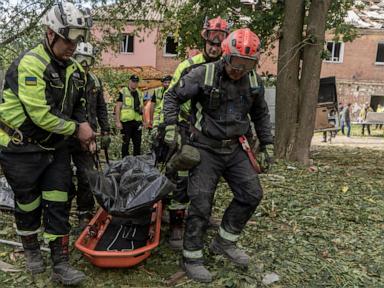
The ongoing bombardment of Ukraine’s border cities cannot be understood merely as a sequence of isolated tragedies, but rather as an exercise in asymmetric attrition. When a Russian guided aerial bomb struck a low-rise residential building in Kharkiv's Kholodnohirskyi district, killing a 76-year-old man and injuring nine others, it highlighted a profound operational challenge for Ukrainian air defense. The incident exposes an fundamental imbalance in the cost, range, and interception dynamics of modern standoff weapons versus localized urban defense.
Understanding this dynamic requires breaking down the mechanics of the weapon systems involved, the geographic vulnerabilities of cities located within the tactical buffer zone, and the strategic calculus of the opposing forces. The current security dilemma for Kharkiv does not stem from a failure of tactical vigilance, but from an economic and kinetic bottleneck that standard Western air defense architectures were not designed to solve.
The Kinematics of Standoff Bombardment
To map the logic of the June 20 strike, one must examine the weapon used: the guided aerial bomb, known locally as the KAB (Kerovana Aviatsiyna Bomba). These systems are conventional high-explosive unguided bombs—frequently from the FAB-250, FAB-500, or FAB-1500 inventories—retrofitted with unified gliding and correction modules (UMPK).
[Russian Airfield] ──(Su-34 Sortie)──> [High-Altitude Release] ──(40-70km Glide)──> [Kharkiv Urban Center]
                                                                                            │
[Expensive Long-Range Interceptor (Patriot/NASAMS)] <──(Unfavorable Intercept Window)───────┘
The retrofitted wings and satellite guidance packages transform cheap iron bombs into precision-guided standoff weapons. The operational mechanics follow a distinct sequence:
- High-Altitude Release: Russian fighter-bombers, typically Su-34s, release the weapons at altitudes exceeding 10,000 meters and at high subsonic speeds. This initial kinetic and potential energy maximizes the glide trajectory.
- Standoff Range: The glide kit allows the bomb to travel between 40 and 70 kilometers to its target. Crucially, this release point occurs well within Russian airspace, safe from short- and medium-range air defense systems deployed near the border.
- Low Radar Cross-Section: Unlike ballistic or cruise missiles, a gliding bomb possesses no hot rocket engine exhaust for infrared tracking, has a small radar cross-section, and spends minimal time in flight—often under four minutes from release to impact.
This creates an acute tactical crisis for a city like Kharkiv, situated roughly 30 kilometers from the Russian border. The time-to-target window is compressed to such an extent that localized early warning systems can offer residents only a few minutes of notice. The target profile of a low-rise residential block in the Kholodnohirskyi district emphasizes that these weapons are not being reserved for high-value military installations; their precision is sufficient to hit specific city coordinates, while their abundance allows them to be expended on civilian infrastructure.
The Economics of Interception
The structural bottleneck for Ukraine lies in the cost function of air defense. The air force reported shooting down 92 out of 99 drones launched overnight across the nation, demonstrating high proficiency in neutralizing low-velocity, long-range threats like the Shahed-136. However, the three guided bombs launched at Kharkiv presented a entirely different defensive equation. One was intercepted, while another struck the two-story building.
The divergence in interception success rates stems from an asymmetry in unit economics and inventory depletion rates.
- The Aggressor's Cost Function: A standard FAB bomb costs virtually nothing to draw from legacy stockpiles, and the UMPK guidance kit costs an estimated $20,000 to $30,000 to manufacture. The marginal cost of launching a glide bomb strike is negligible for the Russian industrial complex.
- The Defender's Cost Function: To intercept a fast-moving, low-signature glide bomb, defensive forces must deploy advanced surface-to-air missile (SAM) systems. A single interceptor missile for a Patriot or NASAMS battery costs between $1 million and $4 million.
This creates a highly unsustainable attrition ratio. Attempting to match every $20,000 glide bomb with a multi-million-dollar interceptor leads to rapid inventory depletion. Furthermore, placing these high-tier air defense assets close enough to the border to protect Kharkiv exposes the batteries themselves to detection and destruction by Russian reconnaissance drones and loitering munitions. Consequently, Ukraine is forced to ration its premium interceptors for strategic targets—such as power grids, major military headquarters, and the capital—leaving frontline and border urban centers vulnerable to low-cost standoff munitions.
Geographic Proximity as a Force Multiplier
Kharkiv's vulnerability is fundamentally a function of geography. The city’s proximity to the border strips the defense of depth, which is the core prerequisite for multi-layered air defense networks.
In a standard defense model, an incoming threat is detected early, tracked across sectors, and engaged sequentially by long-range, medium-range, and short-range point defense systems. In Kharkiv, the sequence collapses. The weapon crosses from sovereign Russian airspace into the urban core within minutes.
Simultaneously, the offensive strategy leverages diversification. While guided bombs target border cities, long-range strike capabilities are directed deeper into the interior. For instance, the concurrent Ukrainian drone strikes on Russian fuel infrastructure—such as the oil refinery in Tyumen and facilities near Moscow—illustrate a reciprocal attempt to impose economic costs. Yet, while Ukraine targets industrial revenue engines to disrupt the Kremlin's war funding, Russia uses its tactical aviation advantages to degrade the habitability of Ukraine's second-largest city.
The damage to eight apartment buildings in the Kholodnohirskyi district and the death of a resident are the direct consequences of this geographic penalty. The structural objective of such strikes is clear: to maintain a constant state of insecurity that prevents economic normalization, discourages the return of displaced populations, and forces Ukraine to tie down valuable defensive assets in a localized theater.
The Border Defense Dilemma
Defending a major metropolitan area 30 kilometers from an adversarial border requires a shift from defensive interception to offensive denial. To neutralize the threat of guided aerial bombs, the target cannot be the bomb itself; it must be the platform launching it.
This operational shift introduces significant strategic constraints. To destroy Su-34 fighter-bombers before they release their payloads, Ukraine requires the authorization and capability to strike deep within Russian territory using Western-supplied long-range munitions, or it must deploy its incoming Western fighter fleets (such as F-16s) into highly contested airspace near the border. Both options carry immense operational risk, including the loss of scarce airframes or political escalation with international partners.
Without these capabilities, the operational reality for cities like Kharkiv remains fixed. The defense must rely on passive measures—such as reinforced concrete shelters, decentralized emergency services, and rapid rubble clearance—alongside a highly calculated, selective use of mid-range anti-aircraft assets. Until the launch platforms themselves can be consistently engaged prior to weapon release, low-cost guided munitions will continue to exploit the physical and economic asymmetries of border-zone warfare.