The metal screams before it yields. In a dim, cavernous workshop hidden somewhere in eastern Ukraine, the sound of an angle grinder cutting through armor plate is deafening. Sparks shower the grease-stained concrete like a cheap firework display.
Here sits an M1A1 Abrams tank. If you liked this piece, you should look at: this related article.
To an American defense contractor, this machine is a masterpiece of late-twentieth-century engineering. It is a seventy-ton apex predator, designed to fight across the sweeping plains of Western Europe against Soviet armor divisions. It is fast. It is heavily armored. It cost millions of dollars to build.
But to the Ukrainian mechanics crawling over its massive chassis, the Abrams is a beautiful, lethal contradiction. It is a weapon built for a war that no longer exists, being forced to fight in a war that changes every single Tuesday. For another perspective on this story, see the recent coverage from The Washington Post.
When the United States delivered thirty-one refurbished Abrams tanks to Ukraine, the move was heralded as a major geopolitical milestone. Yet, on the modern battlefield, these steel giants quickly encountered a terrifying reality. The sky is no longer empty. Thousands of cheap, explosive-laden First-Person View (FPV) drones swarm the front lines, hunting for the tiniest vulnerability. An electronic eye in the sky can spot a seventy-ton tank from miles away, tracking its movements in real-time until a drone worth five hundred dollars hits a soft spot and paralyzes a multi-million-dollar asset.
The Americans built the Abrams to survive direct hits from other tanks. They did not design its thin top armor to withstand a kamikaze drone dropping a shaped-charge warhead directly onto the turret roof.
So, the Ukrainians are rewriting the manual. They have to. Survival demands it.
The Weight of the Sky
Consider a hypothetical crew member. Let us call him Dmytro. He is twenty-four, but his eyes belong to a man three times his age. He sits in the driver’s seat of an Abrams, encased in steel, listening to the high-pitched whine of the gas turbine engine.
Before the full-scale war, Dmytro repaired agricultural equipment in Poltava. Now, his life depends on understanding the exact metallurgical properties of depleted uranium armor and Soviet-era explosive tiles.
When Dmytro takes the Abrams into the tree lines of the Donbas, he isn’t just watching the horizon for enemy tanks. He is listening. He is straining to hear the buzzing of a drone over the roar of his own engine.
"The tank is a fortress," Dmytro might tell you, wiping carbon scoring from his knuckles. "But a fortress without a roof is just a trap."
This is the invisible stake of the conflict. It is a collision of generations. The Abrams represents the pinnacle of industrial-age military might. The drones represent the dawn of the digital, decentralized attrition age. When these two forces meet, the industrial giant often bleeds.
To fix this, Ukrainian maintenance units have become a hybrid of a military depot and a mad scientist's laboratory. They are not waiting for Washington to send upgrade kits. They are scrounging, welding, and inventing on the fly.
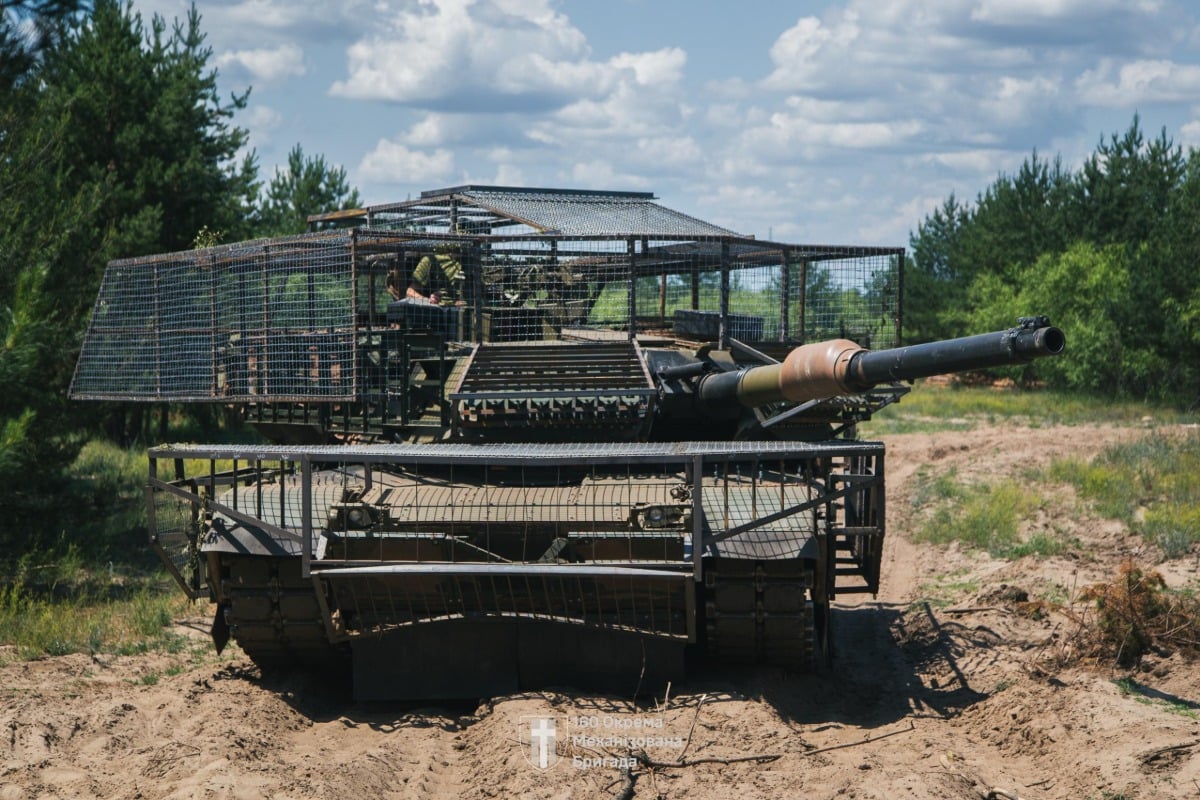
Look closely at the tanks currently operating near the front. They no longer look like the pristine machines that rolled out of Lima, Ohio. They are covered in steel cages, mesh screens, and blocky green bricks of Kontakt-1 reactive armor—salvaged from captured or destroyed Russian tanks.
It is a grotesque, brilliant fusion of Western and Eastern military technology. A Frankenstein tank.
The Alchemy of Iron
The process of rebuilding an Abrams to survive today's war is an exercise in desperate creativity.
First comes the "cope cage." This is a derogatory term coined early in the war for the crude metal structures Russian forces welded to their tanks. But the joke died when the drones multiplied. Today, cage armor is a matter of life and death. Ukrainian engineers construct elaborate slatted steel umbrellas over the turret and engine compartments.
The engineering principle is simple yet vital. The cage acts as spaced armor. When an FPV drone strikes the metal mesh, the warhead detonates inches away from the tank’s actual skin. The molten jet of copper produced by the explosion dissipates in the open air rather than burning through the main armor and incinerating the crew inside.
But adding hundreds of pounds of crude steel cages changes the tank's physics.
The Abrams is already a heavy beast. It bogs down in the thick, black mud of the Ukrainian autumn. Every extra pound of welded rebar strains the suspension and demands more fuel from an already thirsty engine. The mechanics must calculate the exact balance between protection and mobility. If they make the tank invulnerable to drones, they might make it too heavy to move, turning it into a sitting duck for artillery.
Then there is the integration of Soviet dynamic armor.
The American military relies on proprietary, highly classified composite armor matrices. The Ukrainians, raised on Soviet hardware, trust explosive reactive armor (ERA). These are small metal boxes filled with explosives. When a missile hits the box, it detonates outward, disrupting the incoming blast wave.
Bolting Soviet ERA onto American composite armor is an engineering heresy. It requires welding mounting brackets directly onto the exterior of the tank, a practice that would give an American depot manager a stroke. Yet, out in the mud, it works. The blocks of Kontakt-1 are meticulously arranged around the vulnerable tracks and the sides of the hull.
It is an admission of vulnerability that feels deeply human. The crews know the machine is not invincible. By covering it in makeshift armor, they are acknowledging their own fragility.
The Supply Chain of Shadows
The transformation of these tanks happens in a shadow economy of grease and ingenuity.
Western logistics are notoriously rigid. If a component breaks on an American tank in a standard theater of operations, a request is logged, a supply chain is activated, and a replacement part is shipped from a central hub.
Ukraine does not have the luxury of time. The front line is eating metal at an unprecedented rate.
Instead, the mechanics rely on a network of volunteer organizations, local machine shops, and 3D printers. If a specific bracket for a drone-jamming antenna is missing, a volunteer in Kyiv prints it from reinforced polymer and sends it to the front via a civilian courier service. If a steel plate needs bending, a local civilian factory pauses its production of agricultural parts to assist the military.
This creates a strange, jarring contrast. The high-tech components of the Abrams—its thermal sights, its laser rangefinders, its fire control computers—are maintained using secure digital links with NATO experts based outside the country. Meanwhile, the physical protection of those same high-tech components is handled by a man named Vasyl using an oxy-acetylene torch and a pile of scrap metal from a ruined warehouse.
It is easy to get lost in the technical specifications of these modifications. But the technical details are merely a reflection of a psychological reality.
The men who repair these tanks are fighting a war against despair. They see the losses. They see the charred hulls of armor dragged back from the gray zone. Every weld they make, every scrap of steel they attach to a turret, is a physical manifestation of their refusal to surrender to the arithmetic of the battlefield.
The Iron Law of Adaptability
Military analysts will spend decades studying this conflict. They will write thick, academic papers on the obsolescence of heavy armor and the democratization of precision strike capabilities. They will use sterile words like vulnerability matrices and asymmetric vectors.
But those papers will miss the point.
The tank is not dead. It is merely undergoing a violent, unmedicated evolution.
The lesson of the Ukrainian Abrams crews is that technology is only as good as the culture of the people using it. A rigid system breaks under the pressure of unexpected conditions. An adaptable system bends, welds, and reinvents itself.
The Americans built a magnificent machine for a clean, doctrinal war. The Ukrainians took that machine and dragged it into the mud, the chaos, and the terrifying sky of the modern world. They stripped away its mystique and replaced it with practical, ugly resilience.
Back in the hidden workshop, the grinder stops. The shower of sparks dies away. The mechanic steps back, lifting his welding mask to reveal a face covered in black dust. He taps the newly welded steel cage with the handle of his hammer.
The sound is dull, heavy, and solid.
The modified Abrams sits in the shadows, looking less like a symbol of Western military aid and more like a scarred, dangerous animal ready to return to the brush. It is unpolished. It is unauthorized. It is exactly what is needed to survive until tomorrow morning.


