Proposals by French lawmakers to prohibit commercial exchanges with Israeli settlements in the occupied territories bring together international legal obligations, European Union trade law, and complex supply-chain realities. While supporters of the legislation argue that France must align its domestic trade rules with international court rulings, legal scholars and trade economists point out that unilateral national bans collide directly with the exclusive trade competences of the European Union.
The Legislative Push and International Law Arguments
In the French National Assembly, a group of deputies has introduced bills and resolutions aimed at banning the import and sale of goods originating from Israeli settlements in the West Bank, East Jerusalem, and the Golan Heights. Proponents of these measures—including lawmakers from left-wing coalitions and human rights organizations such as Amnesty International and Human Rights Watch—argue that continued economic activity with settlements sustains situations deemed illegal under international law.
Supporters frequently cite United Nations Security Council Resolution 2334 (2016), which reaffirmed that settlements have no legal validity, as well as the July 2024 Advisory Opinion of the International Court of Justice (ICJ). In that opinion, the ICJ stated that states are under an obligation not to render aid or assistance in maintaining the situation created by Israel's presence in the Occupied Palestinian Territory, and to abstain from entering into economic or trade dealings that may entrench its unlawful presence. For French advocates of a ban, national legislation is presented as a direct application of France's stated diplomatic position supporting a two-state solution and opposing settlement expansion.
The European Union Competence Barrier
The primary legal obstacle to a purely French trade ban lies in the constitutional architecture of the European Union. Under Article 3 and Article 207 of the Treaty on the Functioning of the European Union (TFEU), the Common Commercial Policy is an exclusive competence of the EU. Individual member states, including France, are legally barred from unilaterally restricting imports or imposing customs barriers on specific territories without authorization from Brussels.
Trade law specialists and European Commission officials have repeatedly noted that commercial policy—including tariffs, trade agreements, and import prohibitions—must be decided at the EU level, generally requiring a qualified majority or unanimity depending on the specific legal instrument, such as Common Foreign and Security Policy (CFSP) sanctions. When Ireland debated similar legislation (the Control of Economic Activity Bill) in previous years, legal advisers to the Irish government warned that unilateral national restrictions risked infringement proceedings by the European Commission before the Court of Justice of the European Union (CJEU).
Currently, the EU applies a policy of differentiation rather than a total ban:
- Exclusion from preferential tariffs: Under the EU-Israel Association Agreement and the 2005 technical arrangement, products originating from settlements beyond Israel's pre-1967 borders do not qualify for preferential tariff treatment.
- Mandatory origin labeling: Following a 2015 European Commission interpretative notice and the 2019 CJEU ruling in the Psagot case, food and consumer goods produced in Israeli settlements must carry explicit labeling indicating their origin from a settlement rather than "Israel."
Economic Scope and Supply-Chain Realities
Evaluating the practical impact of a trade ban also requires examining the scale and nature of the commerce involved. According to European Commission trade data and independent economic assessments, total trade between the EU and Israeli settlements represents a tiny fraction—estimated at well under 1%—of overall EU-Israel bilateral trade, which exceeds €40 billion annually.
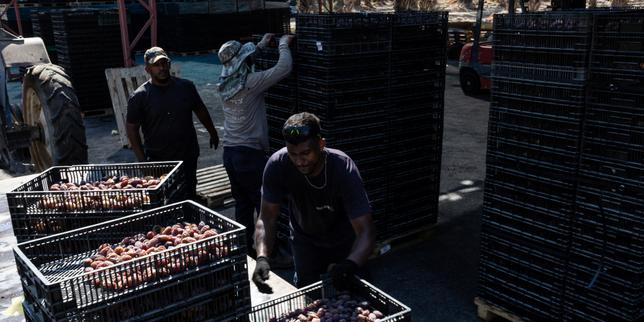
The goods exported from settlements to Europe primarily consist of agricultural produce (such as dates, citrus fruits, herbs, and wine), cosmetics, and certain manufactured plastics or textiles. However, trade analysts highlight several structural complexities that complicate enforcement:
- Services and financial flows: Physical goods are traceable through customs codes, whereas digital services, software development, and financial investments cross borders without physical inspection. Critics of narrow goods-only bans argue they leave major economic sectors untouched, while opponents of broader restrictions warn that policing financial transactions creates severe compliance burdens for European banks and corporations.
- Mixed supply chains: Products assembled inside internationally recognized Israeli territory may incorporate raw materials, agricultural inputs, or components sourced from the West Bank. Verifying the exact geographic origin of every sub-component poses significant auditing challenges for customs authorities.
- Impact on Palestinian workers: Economists and business groups in the region offer differing assessments of how trade restrictions affect local populations. Some Israeli business associations and certain economic researchers argue that boycotts or bans on settlement factories could lead to job losses among the tens of thousands of Palestinians employed in industrial zones in the West Bank, who often earn higher wages than in the local Palestinian economy. Conversely, Palestinian trade unions and civil society groups have stated that long-term economic viability depends on ending settlement expansion and lifting restrictions on the Palestinian economy rather than relying on employment within settlements.
Diplomatic and Political Counterarguments
Opponents of the French legislative proposal—including members of the French government, centrist and right-wing lawmakers, and Franco-Israeli business chambers—raise both diplomatic and legal objections.
From a diplomatic standpoint, French diplomatic officials have historically favored coordinated European action over unilateral national measures, arguing that isolated bans carry limited economic weight while reducing France's diplomatic leverage as a mediator in the Middle East. Opponents also point out that French law (specifically the Lellouche Law and provisions of the Penal Code regarding discrimination) strictly prohibits calls to boycott products based on national origin, though French courts and the European Court of Human Rights (in the 2020 Baldassi ruling) have distinguished between discriminatory boycotts and political expression calling for the boycott of products from occupied territories.
Furthermore, critics of the bill question the consistency of targeting a single territorial dispute through unilateral trade legislation when similar measures are not applied to other contested territories globally, arguing that trade policy should remain governed by multilateral rules under the World Trade Organization (WTO) and unified EU foreign policy decisions.
Where the Debate Stands
The debate in Paris illustrates a persistent tension in modern trade policy: how national parliaments seek to respond to international court rulings when actual regulatory power over trade sits with supranational institutions. Whether France's role remains limited to enforcing existing EU labeling and tariff rules, or whether growing political pressure in Paris and other European capitals pushes the European Commission toward a unified EU-wide import restriction, remains a central question for both European lawmakers and international businesses operating in the region.