Ink dries on official municipal decrees faster than tears dry on a mother’s face. In the seaside town of Deauville, famous for its grand boardwalk, its historic grand hotel, and the lingering ghosts of cinematic romance, the sea air usually carries the scent of salt, damp wood, and old money. But lately, it carries something heavier. It carries the weight of a court ruling that stripped the town’s administration of its chosen authority, exposing the raw nerve where local governance meets global catastrophe.
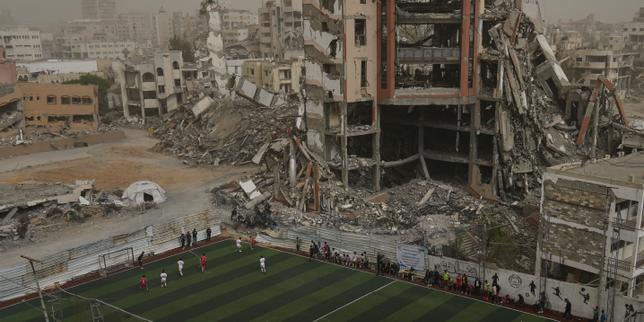
Consider the quiet hum of a festival gallery. The lights are soft. The prints are pinned to the panels with careful, professional precision. Visitors walk past with coats buttoned against the Norman chill, murmuring polite appreciations. Among those prints hung a photograph from Gaza. It did not shout. It simply documented the stark, unyielding reality of a landscape fractured by relentless conflict. A fragment of a ruined street. The dust hanging suspended in amber light. The profound absence of what once was.
Then came the red pen.
Without warning, the municipal leadership reached out and pulled the image down. A swift, quiet administrative hook, executed behind closed doors. The official reasoning was draped in the language of neutrality, the comfortable diplomatic blanket that institutions wrap themselves in when things get too hot to hold. They claimed the space must remain apolitical. They suggested that art in a public festival should soothe rather than sear. They hoped the gap on the wall would simply be filled by something safer, something easier to digest over a glass of Sancerre.
They miscalculated the durability of truth.
To understand why the court eventually struck down this act of censorship, you have to look beyond the cold legal briefs filed in administrative tribunals. You have to look at what happens when an institution tries to curate human empathy. Empathy is not a thermostat. You cannot simply dial it down when the room gets uncomfortable. When the local court ultimately ruled that the mayor's office had overstepped its bounds, that it had violated the delicate balance of fundamental freedoms, it was not merely a victory for a single photographer or a aggrieved collective. It was a reaffirmation of an ancient principle: you cannot legislate away the sight of suffering just because it ruins the view.
Imagine standing in that gallery space hours after the removal. The wall bears a faint rectangular ghost where the frame used to hang, the paint slightly cleaner underneath, untouched by the dust of the exhibition. That shadow is a monument to cowardice. It represents the urge of those in power to sanitize the world, to edit out the jagged edges of history so that the tourists can stroll down the Planches without stumbling over their own conscience.
Courts do not often speak in poetry. Their language is dense, laced with procedural citations, references to administrative jurisprudence, and dry interpretations of municipal codes. Yet, read between the lines of the justice system's rebuke of Deauville, and you hear a sharp, clean chime. The judges reminded the town hall that a cultural festival is not a corporate brochure. It is a mirror. And when you don't like what the mirror shows, breaking the glass does not change your face.
We live in an age terrified of friction. Every algorithm is tuned to smooth our path, to feed us content that flatters our worldview, to protect our sensibilities from the rough, abrasive edges of human reality. When municipal authorities censor art under the banner of neutrality, they are bowing to that same digital panic. They assume that if we do not see it, we will not have to feel it. If we do not feel it, we will not have to act.
But distance is a luxury of geography, not morality.
The photographer whose work was hauled off the wall did not capture the image to make local politicians uncomfortable during cocktail hour. They captured it because the shutter clicks when history demands a witness. To suppress that witness is to participate in a quiet, insidious form of erasure. It says to the people living through the ruins: your survival is inconvenient to our tourism campaign.
When the administrative tribunal overturned the removal, it restored more than just a photograph to a gallery wall. It restored a crack in the veneer. It proved that even in places dedicated to leisure and escapism, the wider world has a right to knock on the door.
The frame is back up now. The dust in the photograph is still suspended in that eternal, tragic amber. Walk past it, and you will hear the faint echo of a judicial rebuke, whispering that freedom of expression is not a decorative accessory to be hung when it matches the drapes and taken down when it clashes with the mood. It is the foundation under our feet. And when the ground gives way, no amount of municipal varnish can hide the abyss.