History is rarely written by those who bleed in the dust. It is drafted behind polished mahogany desks by men who never heard the whistling shriek of an Ottoman artillery shell or smelled the terrified sweat of a thousand charging warhorses. For nearly a century, the textbooks in London and Istanbul glossed over the autumn morning of September 23, 1918. They preferred grand strategies of empires collapsing over distant maps, ignoring the sheer, brutal mechanics of a cavalry charge across the Mediterranean coast.
Yet, on the dusty outskirts of Haifa, something extraordinary happened. It was an act of tactical audacity executed by men who had sailed thousands of miles from the Indian subcontinent to fight in a war that was not theirs, for a crown that did not value them as equals. At the center of this forgotten storm was Major Dalpat Singh, a man whose name still commands quiet reverence in Israeli military academies, even as it slips from the collective memory of his homeland.
The Strategic Nightmare of Mount Carmel
To understand why a handful of Indian lancers succeeded where mechanized divisions might have hesitated, you have to look at the ground. Haifa in 1918 was not the sprawling high-tech metropolis of modern Israel. It was a tightly clustered strategic choke point wedged between the blue expanse of the Mediterranean Sea and the steep, rugged slopes of Mount Carmel.
The Ottoman forces, supported by German machine-gun detachments, understood this geography intimately. They had fortified the heights with Krupp field guns and entrenched infantry. Any conventional infantry advance along the narrow coastal strip meant walking directly into a meat grinder. The Allied high command needed a breakthrough, and they needed it before Ottoman reinforcements could reorganize along the Syrian frontier.
Enter the 15th Imperial Service Cavalry Brigade. Comprising units from the Jodhpur, Mysore, and Hyderabad princely states, these horsemen brought something entirely unexpected to the dusty theater of Palestine: exceptional horsemanship, tactical mobility, and an absolute disregard for conventional military ratios.
The Logistics of Valor
War is an exercise in brutal arithmetic. On paper, the Ottoman defenders held every conceivable advantage. They had elevation, heavy artillery zeroed in on every potential approach, and fixed machine-gun positions. The Indian cavalry had lances, swords, and Lee-Enfield rifles. Against entrenched artillery, cavalry charges are textbook military suicide.
Military analysts often debate whether Major Dalpat Singh’s assault was a stroke of strategic brilliance or sheer desperation. The truth lies in the speed of execution. Singh, commanding the Jodhpur Lancers, realized that hesitation meant total destruction. If they moved slowly, the artillery would tear them apart. If they stopped, they became stationary targets.
He ordered a direct cavalry charge across open salt flats and marshy ground toward the German and Ottoman machine-gun nests stationed on the slopes.
Think about the physical reality of that moment. A horse does not charge into gunfire by instinct; it requires rigorous training and absolute rider discipline. As the squadron broke into a full gallop, the ground trembled under hundreds of pounding hooves. Artillery shells tore craters into the earth, throwing up geysers of dust and shrapnel. Men and horses went down in the chaotic seconds of the initial approach, yet the line did not break.
Breaking the Line
The brilliance of the charge was its kinetic momentum. Ottoman gunners, trained to sweep horizontal fields of fire against advancing infantry or slow-moving armored cars, found themselves facing a rapidly closing wave of mounted targets moving at breakneck speed. The angle of the steep slopes prevented their heavy guns from depressing far enough to target the horsemen once they closed the distance.
Major Dalpat Singh led from the front, a flashing silhouette against the dust and smoke. When the lancers reached the enemy positions, the fight devolved into brutal, close-quarters combat. Swords and lances proved devastatingly effective against startled infantrymen who had no time to establish defensive perimeters.
Singh fell in the final moments of the engagement, struck down just as the objective was secured. He did not live to see the liberation of Haifa, nor did he live to witness the geopolitical tectonic shifts that would follow the collapse of the Ottoman Empire. He died in the dirt of foreign soil, his life traded for a strategic victory that opened the port of Haifa for Allied supplies.
The Resonance of Memory
Why does this particular skirmish—out of thousands in a global conflict that consumed millions of lives—retain such magnetic cultural gravity today?
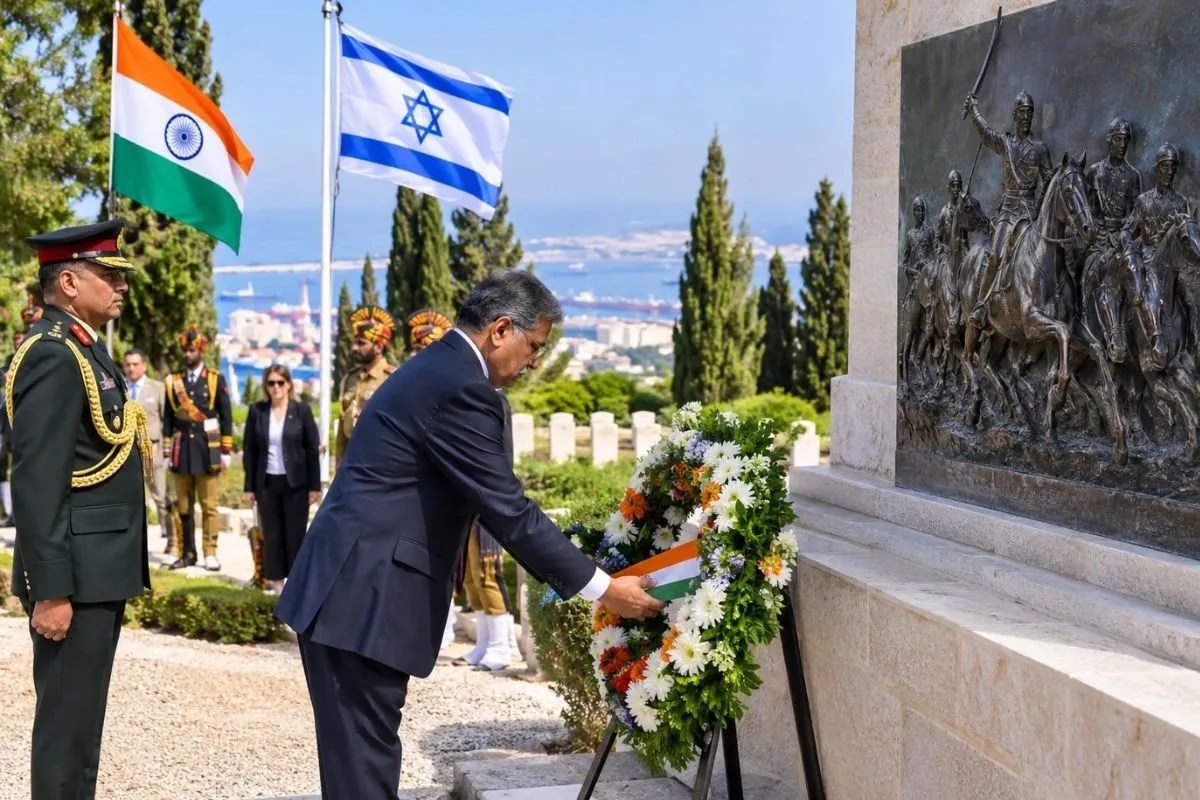
In Israel, the Battle of Haifa is remembered not merely as an Allied victory, but as a pivotal turning point that liberated the city from centuries of Ottoman rule. Every year, civic leaders, military officials, and descendants gather at the Indian Cemetery in Haifa to pay homage. School children learn about the Indian soldiers who rode out of the East to break a stalemate. It is a rare cross-cultural historical anchor where modern geopolitical alliances find deep, organic roots in shared blood and sacrifice.
In India, however, the narrative is more complicated. For decades, the collective historical gaze remained fixed on the domestic freedom struggle. Soldiers who fought under the British Indian Army were frequently viewed through the complicated lens of colonial service, their individual heroism overshadowed by the larger, uncomfortable reality of imperial exploitation.
Yet, men like Dalpat Singh were soldiers bound by a code of professional honor, regimental loyalty, and personal valor that transcended the political machinery of the British Empire. They were Rajputs, Marathas, Deccanis, and Muslims who carried centuries of martial tradition onto foreign sands. Their courage was authentic, regardless of who signed their commission papers.
Stripping Away the Myth
It is easy to romanticize such episodes into cinematic mythology, stripping away the grit and horror to leave only a shiny monument of bronze and memory. True history demands that we look at the cost.
The horses that died on the salt flats of Haifa suffered the same terror as the men. The families back in Rajasthan and the Deccan waited months for telegrams that brought devastating news across oceans. The geopolitical map carved out by the victorious powers in the wake of 1918 would eventually plunge the Middle East into a century of conflict, proving that military victories often plant the seeds of future wars.
Major Dalpat Singh did not charge up the slopes of Mount Carmel to solve the intricate puzzles of Middle Eastern statecraft. He charged because orders were given, because a regiment's honor was on the line, and because in the crucible of combat, men fall back on their training and their brothers-in-arms.
As the sun sets over the Haifa coastline today, casting long shadows across the neat, white-marbled headstones of the Commonwealth war cemetery, the city hums with modern life. Traffic crawls along coastal highways, and cargo ships sit on the horizon. But beneath the asphalt and the progress lies the dust of a September morning in 1918, undisturbed by time, where horses thundered into legend and a major from Rajasthan carved his name into history with a sword.


