The crisp air of the American heartland usually smells of harvested soil and distant diesel exhaust by late summer. But this season, a different kind of energy hangs over the horizon. It is the heavy, unmistakable scent of political gravity.
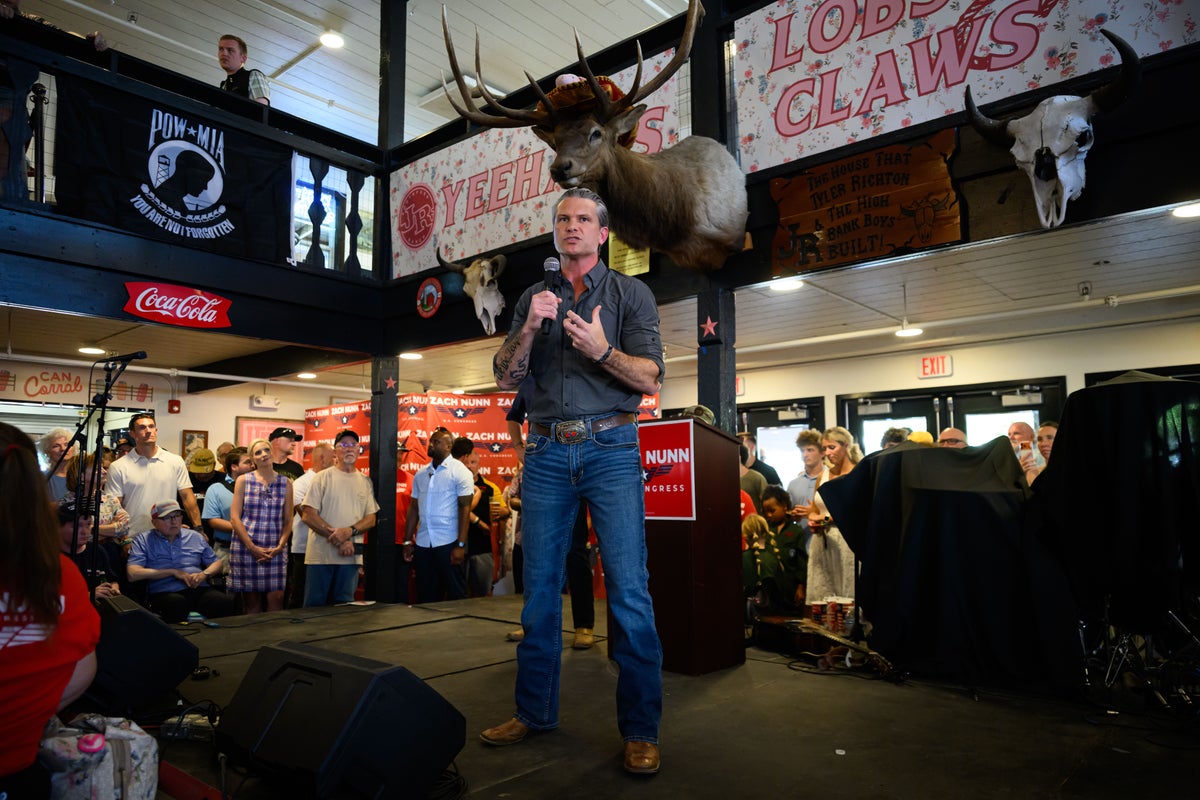
Consider what happens when a cabinet secretary steps off a plane in a midwestern battleground. It is rarely a casual journey. Defense Secretary Pete Hegseth’s recent arrival in Iowa was ostensibly framed around official duties, veteran outreach, and public remarks. Yet, beneath the scheduled handshakes at the county fairgrounds and the quiet nods inside packed Legion halls, a louder narrative echoes across the state lines. High-ranking administration figures are descending on local districts with a single, urgent mission: holding the line.
For months, political analysts have treated the map like a static chessboard. Red states stay red; blue states stay blue. But local reality is always messier, far more human, and infinitely more fragile. In districts where congressional margins are measured by a handful of ballots, every visit carries the weight of an anchor dropped in shallow water.
Imagine a local grocery store owner in a competitive central district, someone who has watched congressional majorities shift back and forth across cable news tickers for decades. To that store owner, abstract talk of political momentum means very little. What matters is the motorcade blocking traffic outside, the sudden influx of national media vans, and the sharp realization that their local representative's seat has become a national flashpoint.
The electoral terrain here is razor-thin. Incumbents like Republican Representative Zach Nunn—an Air Force Reserve colonel defending a district clinched by narrow margins in previous cycles—find themselves flanked by executive branch heavyweights. Alongside Hegseth, a parade of administration officials has crisscrossed the state. Treasury Secretary Scott Bessent, Small Business Administrator Kelly Loeffler, and VA Secretary Doug Collins have all carved out time for the Midwest. This is not routine governance. It is a calculated mobilization.
Why Iowa? Because the midterms do not swing on national averages. They turn on kitchen tables in suburbs outside Des Moines and quiet street corners in the agricultural counties. When a defense secretary steps off an aircraft to campaign for a congressional candidate, it breaks historical protocol. Traditionally, cabinet secretaries maintained a polite distance from hyper-local legislative battles, guarding the illusion of institutional neutrality.
That boundary has dissolved.
The underlying friction is palpable. On one side, an administration determined to protect its legislative flank and cement its governing mandate. On the other, energized local challengers and independent voices sensing vulnerability in districts historically taken for granted. Voters are caught in the crossfire of this high-stakes alignment, listening to speeches about national security while worrying about grocery prices, community healthcare, and the eroding middle ground of local politics.
The private charter planes will eventually leave the tarmac. The motorcades will vanish. But the quiet anxiety of a community realizing it holds the legislative balance of the entire country remains long after the last camera crew packs its lenses. The midwestern soil has absorbed the footsteps of Washington's elite, and the harvest is yet to come.