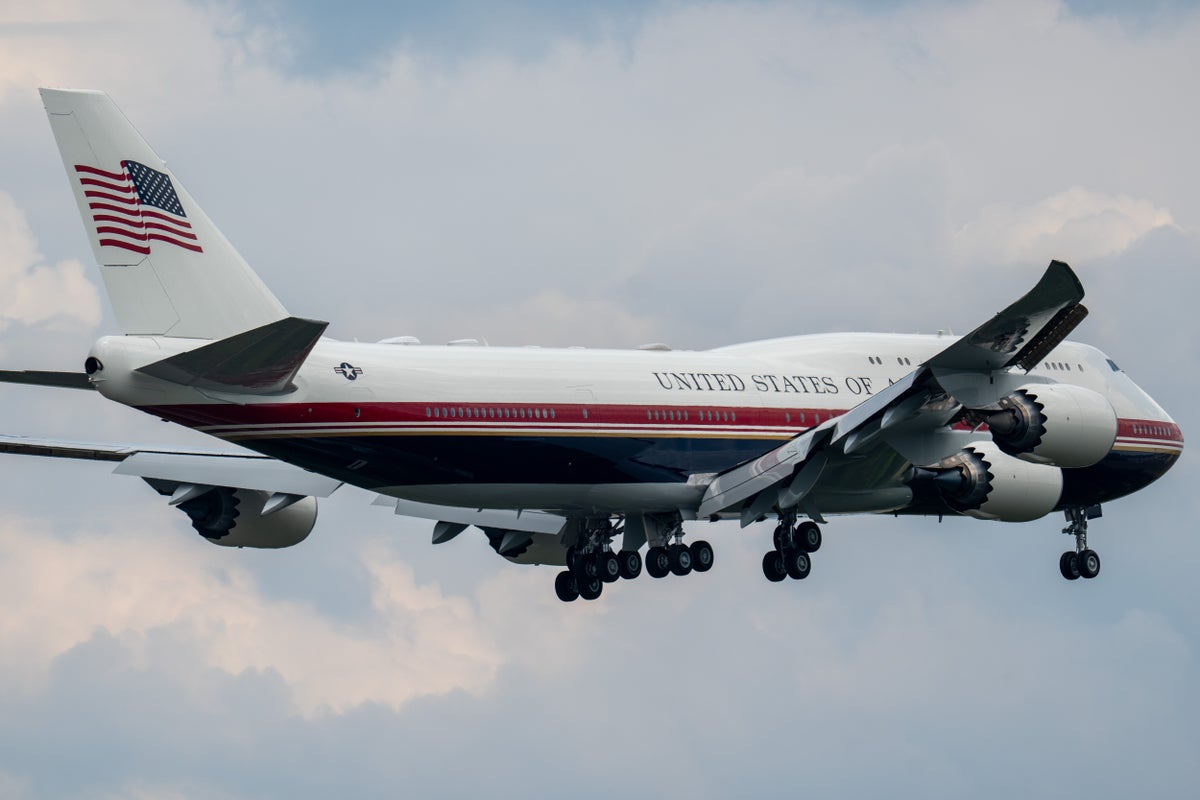
You don't send a half-shielded luxury liner into a geopolitical hot zone. Yet, that is exactly what happened when Donald Trump flew his new, Qatari-gifted Boeing 747-8 to the NATO summit in Ankara, Turkey.
If you've been following the recent drama, the Secret Service pulled a last-minute bait-and-switch. They basically forced the president to ditch his shiny new toy and board the aging, baby-blue VC-25A to fly out of Turkey. The reason? The newly retrofitted plane lacks the advanced military defenses needed to survive in volatile international airspace.
The administration tried to spin this as a casual public relations move. Trump claimed on Truth Social that the plane went ahead to RAF Mildenhall in the United Kingdom just to show it off to ecstatic service members. Nobody bought it. You don't alter presidential flight paths during an active military escalation with nearby Iran for a quick photo op.
The reality is simple. The bridge aircraft is a flying luxury palace, but it isn't a battlefield commander.
The Billion Dollar Rush Job
The Boeing 747-8 was accepted last year from Qatar as a temporary fix. Boeing is plagued with manufacturing delays, pushing the delivery of the official next-generation VC-25B models to 2028. Trump wanted a replacement for the 1990s-era current fleet immediately. Defense contractor L3Harris Technologies scrambled to retrofit the Qatari plane in under a year.
An estimated $1 billion went into this transformation. It sports Trump's preferred navy blue, white, and red livery, ditching the classic Kennedy-era styling. Inside, it boasts unprecedented executive luxury.
But you can't build a flawless military fortress in twelve months.
Former Air Force officials involved in previous presidential aircraft acquisitions expressed absolute shock that the jet was cleared for an overseas trip. Standard engineering and defense outfitting for a presidential aircraft takes years. By rushing the timeline to get the plane operational by July 2026, massive compromises were made.
What the New Jet Is Missing
The Air Force openly admitted that this plane doesn't carry all the equipment found on a standard Air Force One. They claim they made trades on less commonly used mission sets.
Intelligence sources tell a different story. The glaring omissions center around advanced countermeasure systems designed to keep the plane safe outside of domestic U.S. airspace.
Direct Infrared Countermeasures
The standard Air Force One uses directional laser technology to blind incoming heat-seeking missiles. If a shoulder-fired missile or surface-to-air munition locks onto the plane, these lasers fire directly into the missile's seeker head, throwing it completely off course. The Qatari bridge plane lacks this operational system.
Advanced Diversion Technologies
The old VC-25A models are packed with classified electronic warfare suites capable of jamming radar, spoofing tracking systems, and dispensing highly sophisticated chaff and flares. The accelerated timeline for the new plane meant skipping the deep structural integrations required for these heavy military systems.
Airborne Command Capabilities
With the U.S. executing fresh strikes against Iran, the president must be capable of managing a full-scale war from the air. The older aircraft features heavily hardened, EMP-resistant communications that allow seamless control over the nuclear triad. The Qatari jet's secure communications are upgraded, but they don't match the hardened military infrastructure of the older model.
A High Stakes Warning From the Secret Service
Turkey shares a border with Iran. Iranian missiles can easily reach Turkish airspace. When threats escalated during the summit, the Secret Service looked at the defensive gaps on the new plane and drew a hard line.
White House communications director Steven Cheung defended the aircraft by stating it features high-level security protocols. He noted that the administration uses distraction and misdirection to address threats. That's a diplomatic way of admitting the plane had to fly empty to the U.K. because it couldn't risk flying the president near a war zone.
When reporters aboard the older plane asked Trump directly if there was a security concern, he shrugged it off. "No, no, why would there be?" he said. Yet, minutes later, he acknowledged to the press corps that they were on a dangerous flight because of the geopolitical adversaries involved. The window blinds were ordered down for nighttime tactical invisibility. The tension was real.
The Cost of Prioritizing Style Over Security
Accepting a $400 million luxury gift from a foreign government already raised massive ethical and legal red flags. Relying on it as a primary transport before it is battle-ready is a different level of risk.
The Air Force and the Presidential Airlift Group now face a logistics nightmare. They have three planes available, but they have to choose the right tool for the job.
Expect to see a major shift in how these planes are deployed moving forward. The Qatari bridge plane will likely be restricted to domestic flights within the United States, where North American Aerospace Defense Command (NORAD) can provide a continuous fighter escort. For any high-risk international travel, the older, battle-tested baby-blue workhorses will have to stay in service. Relying on an incomplete defensive suite in international airspace is a gamble the Secret Service won't let the administration take twice.
Trump advised not to use Qatari-gifted Air Force One amid security concerns
This brief report outlines the law enforcement and internal discussions that prompted the Secret Service to switch the president's aircraft for his safety.