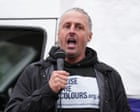
Street furniture in England became a battleground over identity, public safety, and local governance. When Thames Valley Police slapped fourteen criminal charges onto Ryan Bridge, the founder of the "Raise the Colours" campaign, the simmering tension around unauthorized patriotic displays boiled over.
Bridge, a 45-year-old activist from Bromsgrove, found himself at the center of a massive legal storm just days after receiving public praise from Reform UK leader Nigel Farage at the party's annual conference. Farage told him from the stage that if the party could help legally, they would. Hours later, the reality of the courts caught up. Thames Valley Police confirmed charges spanning a two-month window in Oxfordshire early this year.
The list of charges reads like a worst-case scenario for any grassroots organizer. Bridge faces seven counts of using threatening words or behaviour to cause harassment, alarm, or distress, alongside three counts of using threatening or insulting behavior to provoke unlawful violence. Worse still for his legal defense team, the charges include two counts of racially aggravated intentional harassment, one count of racially aggravated fear of violence, and a single count of common assault.
The High Stakes of Lamppost Politics
For months, members of Raise the Colours marched through towns and cities across the Midlands and southern England, strapping hundreds of Union Jacks and St George's Cross flags to roundabouts, traffic lights, and lampposts. To supporters, it looked like harmless patriotism. To local authorities and minority residents, it felt entirely different.
Local councils quickly realized that removing the flags manually wasn't enough. Oxfordshire County Council secured a High Court injunction in July to stop unauthorized installations near highways, citing safety hazards, obstruction, and trespass risks. Birmingham City Council followed suit, pushing for similar legal blocks to protect public spaces.
Councillors argued that the sheer scale of the campaign crossed the line from national pride into intimidation. In places like Oxfordshire, local leaders pointed out that residents felt unwelcome and distressed in their own neighborhoods. Teams sent out to clear the flags—and local residents who tried taking them down themselves—frequently ran into aggressive confrontations.
Political Backing Meets Legal Walls
The timing of Bridge's charges creates an awkward spectacle for mainstream political players trying to court anti-establishment sentiment. Appearing at a conference session hosted by broadcaster Jeremy Kyle, Bridge used his platform to air his grievances about local authority injunctions. Farage seized the moment to champion the cause, declaring that the campaign had woken up vast parts of the country.
Yet political endorsement offers zero immunity in a magistrates' court. Bridge is scheduled to face Oxford Magistrates' Court on November 3, and he carries additional legal baggage from separate incidents, including arrests during protests and ongoing scrutiny over local disruptions.
The courts are drawing a hard line. Civic pride doesn't override public safety laws, and local infrastructure isn't a billboard for vigilante identity politics. As local authorities pursue sweeping injunctions carrying heavy fines or potential jail time for repeat breaches, the era of unchecked DIY flagpole operations on public property is slamming shut.