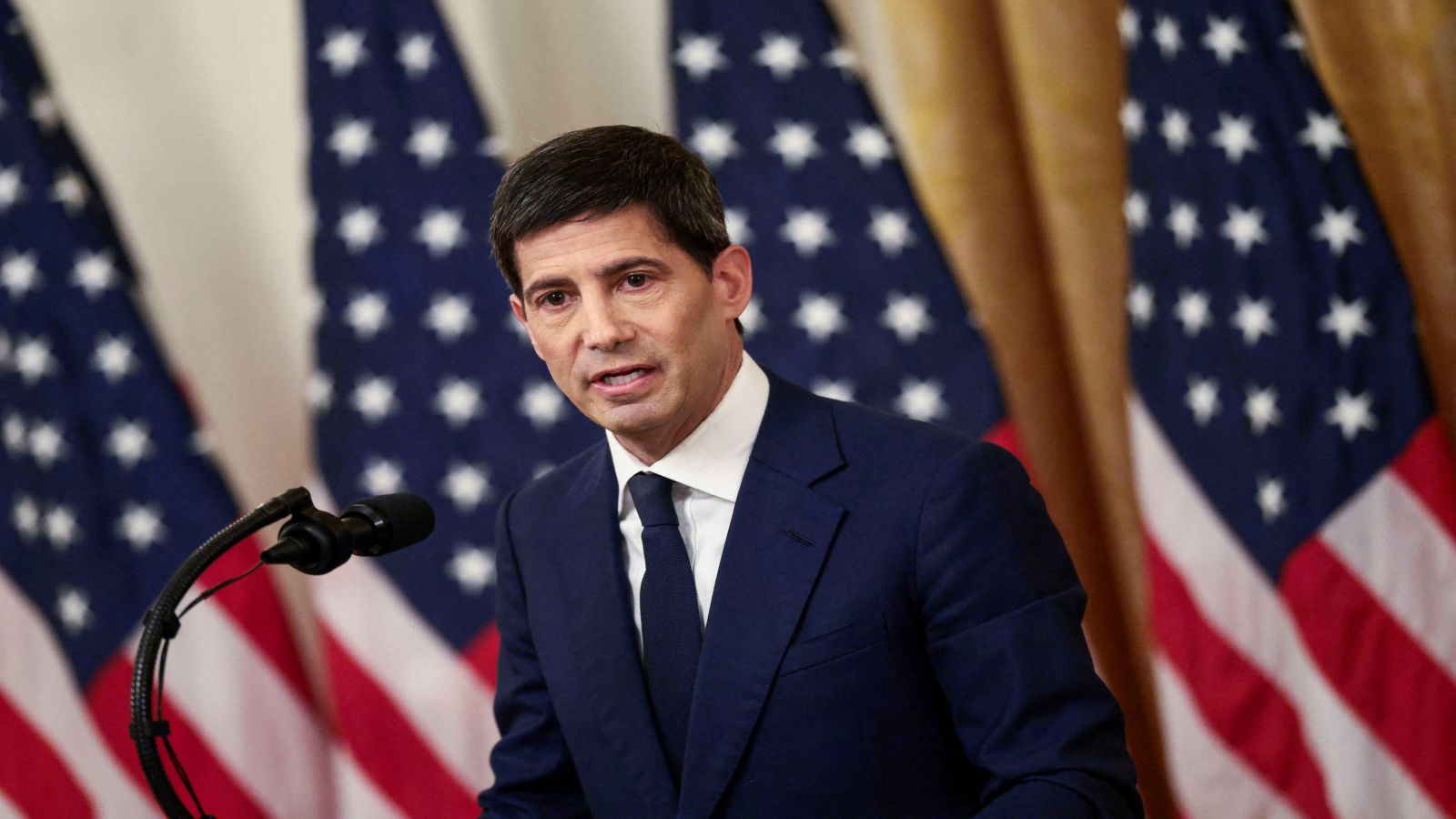
The Federal Reserve will hold its benchmark interest rate steady at 3.5% to 3.75% this week. This is the near-universal consensus as Kevin Warsh takes the gavel for his first Federal Open Market Committee meeting as chair. But the apparent calm of a rate pause hides a fundamental, structural crisis brewing within the central bank. Warsh is trapped between a bond market demanding interest rate hikes to combat a sharp spike in inflation and a White House that demands aggressive rate cuts.
This is not a standard economic cyclical standoff. It is an institutional war for the remaining shreds of the central bank's credibility.
The headline metrics confronting Warsh are brutal. May data showed consumer price inflation surging to a three-year high of 4.2%, while producer prices grew at an alarming 6.5% clip. Much of this spike stems from energy costs connected to recent military conflicts involving Iran. While a fragile weekend peace deal promising to reopen the Strait of Hormuz has temporarily cooled crude markets, the domestic damage is already done. Inflationary expectations are hardening, and structural price pressures have seeped deeply into logistics, services, and corporate supply chains.
The Illusion of the Transitory Pivot
For months, the market harbored a comforting fiction that the supply shocks of early 2026 would dissolve on their own. Central bank veterans recognize this trap. It mirrors the exact policy failure of 2021, when the institution mischaracterized systemic inflation as transitory, waited too long to act, and was left chasing a runaway train.
The current Federal Open Market Committee is already deeply fractured. During the final meeting under former chair Jerome Powell in late April, the committee registered an extraordinary level of dissent. Multiple regional bank presidents openly broke ranks, voting against the retention of an easing bias. That specific phrasing in the monetary policy statement signals to global markets that the central bank remains structurally inclined to cut rates rather than hike them.
FOMC Benchmark Rate Range: 3.50% - 3.75%
May Headline CPI Inflation: 4.2%
May Core CPI Inflation:     2.9%
May Producer Price Index:   6.5%
Warsh has built his professional reputation on advocating for a complete overhaul of central bank communication, frequently calling for a regime change in how monetary policy is signaled. To reassert control over a wild bond market, his primary task this week is not moving the actual federal funds rate. It is executing the technical removal of that easing bias from the official statement.
The Myth of Complete Independence
The traditional view of central banking presumes a clinical, mathematical isolation from the executive branch of government. This view is functionally obsolete. The political reality is that Warsh was handpicked by a president who openly uses public appearances to declare that raising interest rates is a penalty on economic growth.
This presents a profound challenge to the mechanics of monetary policy. If the central bank cuts interest rates to satisfy political demands while headline inflation sits at 4.2%, it risks destroying global confidence in the dollar. If it hikes rates to crush inflation, it risks triggering a major correction in an equity market where valuations are heavily concentrated in a handful of massive technology and semiconductor stocks.
Academic economists are increasingly skeptical that a middle ground exists. A recent poll conducted by the University of Chicago's Clark Center revealed that a majority of surveyed economists expect the central bank will be forced to raise interest rates by at least a quarter point before the end of the year, regardless of political rhetoric. The bond market is moving in tandem with this view, pricing in higher borrowing costs for the long term.
The Broken Transmission Mechanism
Monetary policy operates through a transmission mechanism that relies on predictability. When the central bank adjusts short-term rates, banks adjust commercial lending costs, yields shift, and corporate investment scales up or down accordingly. But this mechanism breaks when the market loses faith in the institution's primary anchor.
Right now, long-term Treasury yields are climbing independently of short-term policy settings. Fixed-income investors are looking through the current rate pause and demanding higher yields to protect against sticky, long-term inflation. This means that even without an official interest rate hike from Warsh, mortgage rates and corporate debt costs are rising across the real economy.
The central bank cannot long endure a reality where its statements say one thing and the bond market enforces another.
Warsh cannot rely on a prolonged honeymoon period to solve this structural imbalance. While institutional courtesy may allow for a unanimous, quiet rate hold this week, the internal split over the path of inflation will manifest in the summary of economic projections. The upcoming dot plot, which charts individual committee members' rate expectations, is highly likely to expose a widening chasm between those who believe the inflation spike is fading and those who see an urgent need to tighten financial conditions.
The policy track of the next six months will not be defined by data alone. It will be defined by whether a newly installed chair can withstand the intense, dual compression of market reality and political necessity without fracturing the very institution he was chosen to lead.