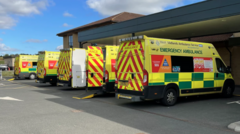
When a thief climbs into the driver’s seat of an idling ambulance and speeds away with a patient still strapped into the gurney in the back, the public reaction is usually one of disbelief. We view these vehicles as mobile sanctuaries, protected by an unwritten social contract that grants them immunity from the chaos of the streets. However, for those of us who have spent decades covering the intersection of public safety and urban decay, these incidents are not isolated freaks of nature. They are the predictable result of a systemic failure to balance emergency response times with basic vehicle security.
The core of the problem lies in the "keep-it-running" protocol. In many jurisdictions, paramedics leave the engine running at a scene to ensure the myriad of life-saving electronics, climate control systems for sensitive medications, and the heavy-duty cooling fans for the engine don't fail. A dead battery in a $200,000 rig isn't just an inconvenience; it is a potential death sentence for the next person waiting for a 911 dispatch. Yet, this necessity creates a low-hanging fruit for the desperate, the mentally ill, or the opportunistic criminal. When an ambulance is stolen with a patient inside, we aren't just looking at a carjacking. We are looking at a kidnapping facilitated by an open door and a running ignition.
The Invisible Threat to Mobile ICUs
Most people assume ambulances are equipped with the same high-tech anti-theft measures found in a modern mid-sized sedan. They aren't. While your personal car might require a proximity key to shift out of park, many older fleets still rely on physical keys or simple ignition setups that are bypassed with ease once the door is unlocked. Even in newer models, the "anti-theft" systems often consist of a manual hidden switch that a distracted medic, rushing to save a cardiac arrest victim, might forget to engage.
The chaos of an active scene is the perfect cover.
Paramedics are trained to focus entirely on the patient. Their backs are turned. Their ears are tuned to the sound of a heart monitor or the instructions of a partner. In that window of intense clinical focus, a vehicle sitting twenty feet away with its lights flashing is a beacon. To a bystander in a state of crisis, that vehicle represents a getaway, a weapon, or simply a warm place to hide. The vulnerability is baked into the job description.
The Logistics of a Moving Target
Why can’t we just lock the doors? The answer is grounded in the brutal reality of emergency medicine. Seconds are the currency of the trade. If a crew needs to retreat to the vehicle to grab a pediatric kit or a spare oxygen tank, fumbling with a key fob or a keypad is an unacceptable delay. This creates a culture of "open access" that seasoned criminals have learned to exploit.
Furthermore, the physical layout of an ambulance makes it a nightmare for situational awareness. The transition from the patient compartment to the cab is often blocked by a bulkhead or a narrow pass-through. If a patient is in the back, the medic is effectively trapped in a soundproof box while the thief takes control of the steering wheel. By the time the crew realizes the motion isn't the result of a partner getting behind the wheel, the vehicle is already merging into traffic.
The Human Cost of Security Failures
When we talk about these thefts, the focus often stays on the vehicle's price tag. This misses the point. The real damage is the psychological trauma inflicted on patients who are already in their most vulnerable state. Imagine being paralyzed by injury or illness, unable to move, and realizing that the person driving you at eighty miles per hour isn't a trained professional, but a panicked carjacker.
This isn't a hypothetical fear. In several recent cases, patients have been dumped on the side of the road or involved in high-speed collisions while still confined to their stretchers. The legal liability for the private EMS companies and municipalities involved is staggering, but the damage to public trust is even worse. If you can’t feel safe in the back of an ambulance, where can you feel safe?
Technological Fixes and the Cost of Implementation
There are solutions available, but they are stuck behind a wall of bureaucratic red tape and budget constraints. "Idle-lock" systems allow the engine to stay running to power medical equipment while the transmission remains locked unless a specific code is entered or a transponder is detected.
- Proximity Sensors: Automatically locking the cab doors when the medic moves more than ten feet away.
- Remote Kill Switches: Allowing dispatchers to safely disable the engine once the vehicle is in an open area.
- Biometric Ignitions: Fingerprint scanners that ensure only authorized personnel can put the vehicle in gear.
The problem? Retrofitting an entire city's fleet costs millions. In an industry where profit margins for private providers are razor-thin and municipal budgets are being slashed, "security upgrades" often lose out to "new heart monitors" or "overtime pay." We are choosing to gamble with the safety of the vehicle to preserve the functionality of the medical gear inside.
A Broken Safety Culture
Beyond the hardware, there is a fundamental need to shift the mindset of first responders. For decades, the "it won't happen here" mentality has governed how rigs are staged at scenes. We have treated the ambulance as a stationary building once it hits the curb.
We need to start treating the ambulance as a mobile asset in a hostile environment. This means training crews in situational awareness that extends beyond the patient. It means mandatory use of ignition-locking technology, regardless of the urgency of the call. It means holding fleet managers accountable when they send crews out in rigs with broken door locks or outdated security protocols.
The narrative that these are "unavoidable tragedies" is a lie. They are the result of a calculated risk that has finally stopped paying off. Every time a patient is kidnapped by an ambulance thief, it is a signal that the systems we built to save lives have become a threat to them.
The Liability Loophole
Insurance companies are beginning to take notice. Historically, a stolen ambulance was handled like any other commercial auto claim. Now, with the rise in "patient-on-board" thefts, underwriters are looking at "failure to secure" clauses. If an EMS agency cannot prove they utilized every available security measure, they may find themselves footed with the bill for the vehicle, the medical equipment, and the multi-million dollar lawsuits that follow a kidnapping.
This financial pressure might be the only thing that actually forces change. When the cost of the lawsuit exceeds the cost of the security upgrade, the technology will suddenly become "essential." It shouldn't take a tragedy to trigger a budget line item, but in the world of public infrastructure, the ledger usually carries more weight than the life in the back of the rig.
Municipalities must mandate that any new ambulance contract includes a requirement for active anti-theft systems that function while the engine is idling.