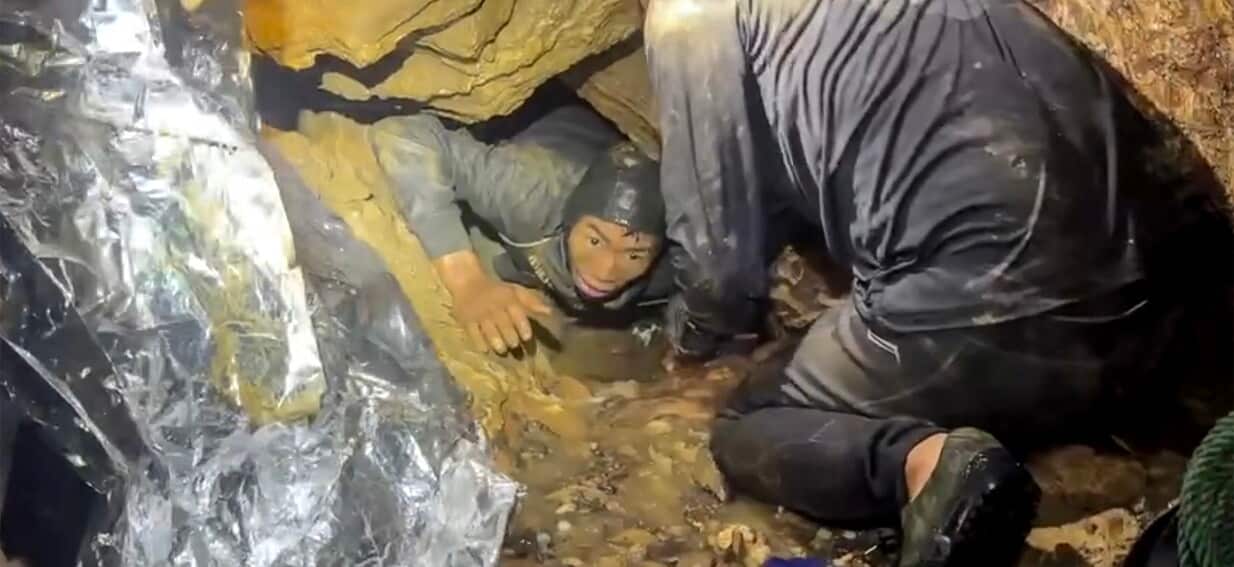
Media outlets are currently salivating over the drama in Laos. Five divers pulled from the mud. Two still missing. The narrative is as predictable as it is dangerous: brave rescuers versus the cruel elements. We see the same grainy footage of oxygen tanks and muddy boots, framed by a frantic countdown against rising water levels.
But the breathless reporting misses the cold, mechanical reality of subterranean extraction. The "rescue" isn't just a race against time; it is often the primary driver of the very risks it seeks to mitigate. Every time a rescue team pushes into a complex system like those found in Southeast Asia’s limestone karst, they aren’t just looking for victims—they are actively destabilizing the environment and exponentially increasing the body count for the sake of optics. In related news, read about: The Silence in the Valley of Dust.
The Logistics of a Slow Motion Disaster
Mainstream coverage treats a cave rescue like a high-speed ambulance run. It isn't. It is an industrial plumbing project performed in the dark while holding your breath.
When five divers are "rescued," the public cheers. What they don't see is the sheer volume of silt and nitrogen introduced into a closed system by twenty "support" divers. In the tight squeezes of a cave, visibility is a finite resource. Once a rescue team kicks up the floor, they effectively blind the missing persons they are trying to save. If those two missing divers in Laos are still alive, their best chance is sitting still and waiting for the water to clear. The arrival of a massive rescue flotilla ensures the water never clears. BBC News has provided coverage on this critical subject in great detail.
We have seen this play out in high-profile incidents from Thailand to the Pyrenees. The urge to "do something" frequently overrides the necessity of doing nothing.
The Problem with Humanitarian Hydrology
The common consensus is that you pump water out to save lives. It sounds logical to a layman. It is often a death sentence.
- Hydrostatic Pressure: Water inside a cave provides structural support to the walls. Rapidly pumping millions of gallons out can trigger "roof falls" or sediment collapses.
- The Vacuum Effect: If you clear one chamber, you might inadvertently pull water from a deeper, unseen reservoir, flooding the very "dry" pocket where survivors are huddling.
- The Sump Trap: Pumping rarely clears a cave; it just moves the sumps—sections of the cave entirely underwater. This creates a moving target for the divers and the trapped party, making navigation impossible even for those who know the cave well.
Stop Calling Them Tourists
The headlines label these people "missing divers." This is a linguistic shield for incompetence. In the world of technical diving, there is a clear line between an explorer and a trespasser.
Most of these incidents occur because individuals with Open Water certifications—meant for the sunny reefs of the Caribbean—decide to swim into overhead environments without a guideline, a redundant gas supply, or the psychological training to handle a "silt-out."
When we frame these events as "tragedies" or "accidents," we ignore the causality. A cave is not a malevolent entity. It is a geological formation with fixed rules. If you break the rules of gas management ($Rule of Thirds$: one third in, one third out, one third for emergencies), you aren't a victim of the cave. You are a victim of your own ego.
I have seen operations where millions of dollars in equipment are deployed to save people who ignored a "Danger: Do Not Enter" sign. We are subsidizing recklessness under the guise of heroism.
The Brutal Math of Body Recovery
There is a point in every search where the "Rescue" becomes a "Recovery." The media hates this transition because it kills the "race against the clock" hook. However, the most professional thing a dive lead can do is call off the search.
Risking five elite lives to find two corpses is bad math. In the 1994 Boesmansgat recovery in South Africa, Dave Shaw died trying to retrieve the body of Deon Dreyer, who had been dead for ten years. It was a masterclass in technical skill, but a failure in risk management.
In Laos, the pressure to "bring them home" forces divers into 0% visibility conditions where they are one equipment failure away from becoming a third or fourth missing person. We need to stop demanding that rescuers take suicidal risks for what is essentially a delivery service for the deceased.
The Myth of the Air Pocket
People love to ask, "Could they still be in an air pocket?"
In a limestone cave during monsoon season, an "air pocket" is a CO2 trap. Unless there is active ventilation from a surface crack, a human being will consume the oxygen in a small chamber within hours. Long before they starve or drown, they will succumb to hypercapnia.
The search for the "missing pair" in Laos is likely already a search for remains. Pretending otherwise to keep the 24-hour news cycle spinning is a disservice to the families and a psychological burden on the divers in the water.
Why We Should Stop Rescuing
This is the hard truth that nobody wants to hear: The more efficient we get at cave rescues, the more people will take lethal risks.
It’s the "moral hazard" of the wilderness. If you know a helicopter or a team of British cave-diving legends will come for you, you’ll push that extra 200 meters into the dark without a reel.
- Financial Cost: A single week of a multi-national rescue effort can cost upwards of $5 million.
- Environmental Impact: The installation of fixed lines, lighting, and pump systems permanently scars fragile ecosystems.
- The Hero Complex: It creates an incentive for local politicians to prioritize the "save" over long-term safety regulations and enforcement.
We don't need more "hero" divers. We need fewer people in the water who don't belong there.
The Equipment Fallacy
Modern tech has given us a false sense of security. Side-mount rigs, closed-circuit rebreathers (CCRs), and high-lumen LED lights make the cave look manageable.
But technology is a multiplier, not a savior. A rebreather allows you to stay underwater for six hours, which means you can get six hours deep into a hole where no one can reach you. When a rebreather fails, it fails silently (the "O2 hit").
The divers in Laos are likely using standard configurations, but no amount of gear can overcome the fundamental problem of $P_1V_1 = P_2V_2$. As they go deeper, their gas consumption increases, their decompression obligation sky-rockets, and their margin for error vanishes.
If the missing pair didn't have the discipline to turn back when their gauges hit the halfway mark, no amount of high-tech sonar or ROVs will find them alive.
The Real Search Intent
People search for "Laos cave rescue updates" because they want a miracle. They want to feel that human ingenuity can beat the indifferent physics of the planet.
The real update is this: The search is a performance. The rescuers are working in a washing machine of brown water. The geology is shifting. The oxygen is gone.
Instead of asking "When will they be found?", we should be asking why we allow untrained individuals to turn pristine natural wonders into high-stakes morgues. We should be asking why the international community treats these incidents like sporting events instead of the preventable failures of judgment they actually are.
The five divers who were "rescued" didn't win. They survived a series of errors that they should never have made. The missing two are paying the price for the group’s collective arrogance.
Stop looking for a happy ending in the mud.