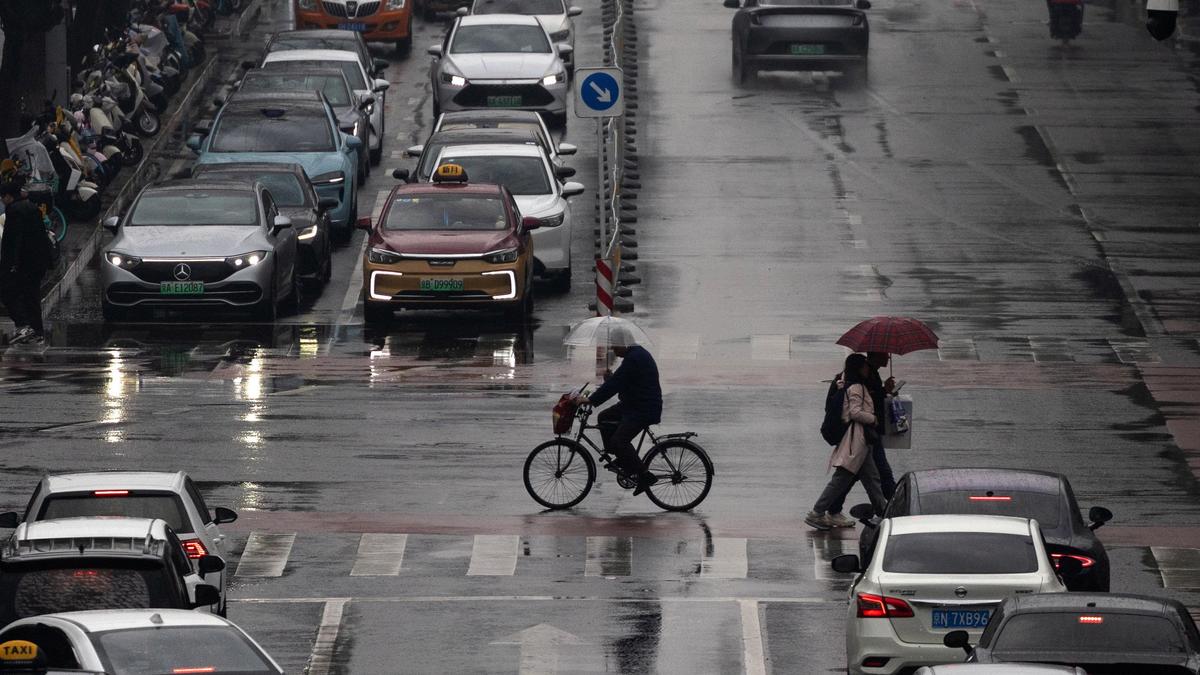
Mainstream news rooms handle extreme weather events with a predictable, lazy template. A cloudburst hits southern China, a river breaches its banks, and the headlines immediately race to tally the immediate casualties and calculate direct economic losses. They point at the sky, blame climate volatility, and call it a day.
This surface-level reporting misses the entire point.
The real story of modern urban flooding is not about the rain. It is about engineering path-dependency, the hidden vulnerabilities of rapid concrete urbanization, and the failure of static defense systems. When we treat torrential downpours as unpredictable black swan events, we absolve the systemic design choices that turn manageable natural phenomena into human catastrophes.
The Myth of the Unprecedented Downpour
Every time a major metro area floods, officials and media outlets rush to use words like "historic," "once-in-a-century," or "unprecedented." This language creates a false narrative that no amount of preparation could have averted the outcome.
It is a comfortable lie.
Hydrologists use the concept of a return period to estimate the probability of extreme events. A 100-year flood has a 1% chance of occurring in any given year. But our baseline data is skewed. Urbanization fundamentally alters the local water cycle. When you replace thousands of square kilometers of absorbent soil and wetlands with impermeable asphalt and concrete, surface runoff increases exponentially.
A rainfall volume that a rural valley could absorb with ease becomes a devastating torrent in a concrete basin. The disaster is baked into the civil engineering before the first cloud even forms. The conventional media views floods as external attacks on cities. In reality, modern cities are designed to flood themselves the moment drainage capacity is breached by even a fraction of a percentage point.
Why Engineering for Maximum Capacity Always Fails
Traditional flood mitigation relies on brute-force civil engineering. We build higher levees, deeper concrete channels, and massive underground retention basins. The underlying philosophy is simple: contain the water and force it out of the city as fast as possible.
This approach suffers from a catastrophic flaw known in infrastructure circles as the "levee effect."
The Levee Effect: Building structural defenses reduces the frequency of minor floods, which inadvertently encourages rapid economic development and population growth in high-risk floodplains. When a storm inevitably exceeds the design capacity of those defenses, the resulting catastrophe is orders of magnitude worse than if the minor floods had been allowed to happen naturally.
By treating water as an enemy to be exiled, cities create brittle systems. A concrete drainage channel works perfectly up to 100% capacity. At 101%, it fails catastrophically, channeling high-velocity water directly into dense residential zones.
I have analyzed municipal infrastructure budgets where billions are funneled into expanding pipeline diameters, while pennies are allocated toward watershed restoration. It is a losing arms race against gravity and physics. You cannot downsize a river.
The Reality of Runoff Coefficients
To understand why the current infrastructure paradigm is broken, look at the runoff coefficient—the ratio of the volume of water that runs off a surface to the total volume of precipitation.
| Surface Type | Average Runoff Coefficient | What It Means |
|---|---|---|
| Natural Forest / Wetlands | 0.05 – 0.20 | 80% to 95% of rain is absorbed by the earth. |
| Suburban Residential | 0.35 – 0.55 | Roughly half the water runs off immediately. |
| Downtown Urban Core | 0.70 – 0.95 | Virtually all water becomes instantaneous surface runoff. |
When a city layout converts land from a coefficient of 0.10 to 0.90, the volume of water entering the drainage network spikes by 800%. No municipal drainage system on earth can scale its capacity by eight times without consuming half the city's physical footprint.
Dismantling the Sponge City Illusions
In response to these systemic failures, alternative frameworks like the "Sponge City" concept have gained traction across East Asia and Europe. The idea sounds brilliant on paper: use permeable pavements, green roofs, and urban wetlands to absorb, store, and purify rainwater naturally.
But the current enthusiasm ignores a harsh, physical reality. Green infrastructure has a strict saturation point.
During a prolonged, multi-day torrential rain event—the kind that routinely batters central and southern China during the monsoon season—the soil and vegetation of a sponge city become fully saturated within the first few hours. Once the sponge is full, every drop of subsequent rainfall becomes 100% surface runoff.
Sponge cities are highly effective at managing routine summer thunderstorms and reducing the urban heat island effect. Marketing them as a primary defense against severe regional monsoons is irresponsible. It misleads the public and gives urban planners a greenwashed excuse to keep building in low-lying, high-risk zones.
The Misguided Questions We Ask During Disasters
When the public demands answers after a catastrophic flood, the discourse usually focuses on flawed premises. Look at the typical queries that dominate search engines and town halls during a crisis, and notice how they miss the mark.
"Why didn't the early warning systems prevent casualties?"
This question assumes that information equals mobility. Accurate meteorological tracking can predict exactly where the rain will fall, but it cannot fix a choked evacuation route or alter the topology of a neighborhood trapped between two concrete embankments. Warning a population that they are in a high-risk zone does nothing if the built environment offers no safe high ground within walking distance.
"Should we build larger dams upstream to regulate these rivers?"
The instinct is always to build bigger walls. But large-scale damming alters regional sedimentation patterns. Over decades, rivers deposit silt behind the dams, raising the riverbed upstream and lowering it downstream, which destabilizes bank infrastructure. Dams also give a false sense of security that encourages further dangerous development downstream. When an extreme event forces a dam operator to open the spillways to prevent a structural breach, the resulting artificial flood wave is far more destructive than a natural rise in water levels.
Moving Beyond Static Defenses
If brute-force engineering fails at the margins and green infrastructure saturates, what is the alternative? We must shift from a philosophy of flood resistance to one of flood resilience.
This means accepting that water will enter the urban environment and designing spaces that can submerge without failing.
- Sacrificial Urban Zones: Public parks, sports fields, and underground parking structures must be designed as intentional, temporary retention basins. They should be built with waterproof materials, clear drainage channels, and automated lockdown systems that trigger when water levels rise.
- Decentralized Power and Utility Grids: The traditional practice of placing backup generators and electrical substations in basement levels is an engineering sin that still occurs in major developments. Utilities must be elevated or completely modularized so that a flooded basement does not knock out power to an entire district.
- Automated Hydro-Barriers: Relying on sandbags and manual labor during a sudden flash flood is an archaic strategy. Modern urban perimeters require passive, buoyancy-driven flood barriers that rise automatically using the power of the incoming water itself.
This approach requires significant upfront capital and forces uncomfortable conversations about land use. It means admitting that certain low-lying areas should never have been developed in the first place, and that some real estate assets must be abandoned to the river.
The Cost of Inaction
The economic math used by municipal governments is fundamentally broken. They weigh the multi-billion-dollar cost of retrofitting a city for resilience against the immediate cost of rebuilding after a disaster. Because insurance payouts, national relief funds, and emergency emergency budgets cushion the immediate blow, local administrators choose to rebuild the exact same vulnerable structures in the exact same floodplains.
This cycle of building, flooding, mourning, and rebuilding the same flaws is the true tragedy of extreme weather. The rain is an act of nature. The disaster is an act of design.
Stop looking at the sky to find the culprit for urban devastation. Look at the blueprint.