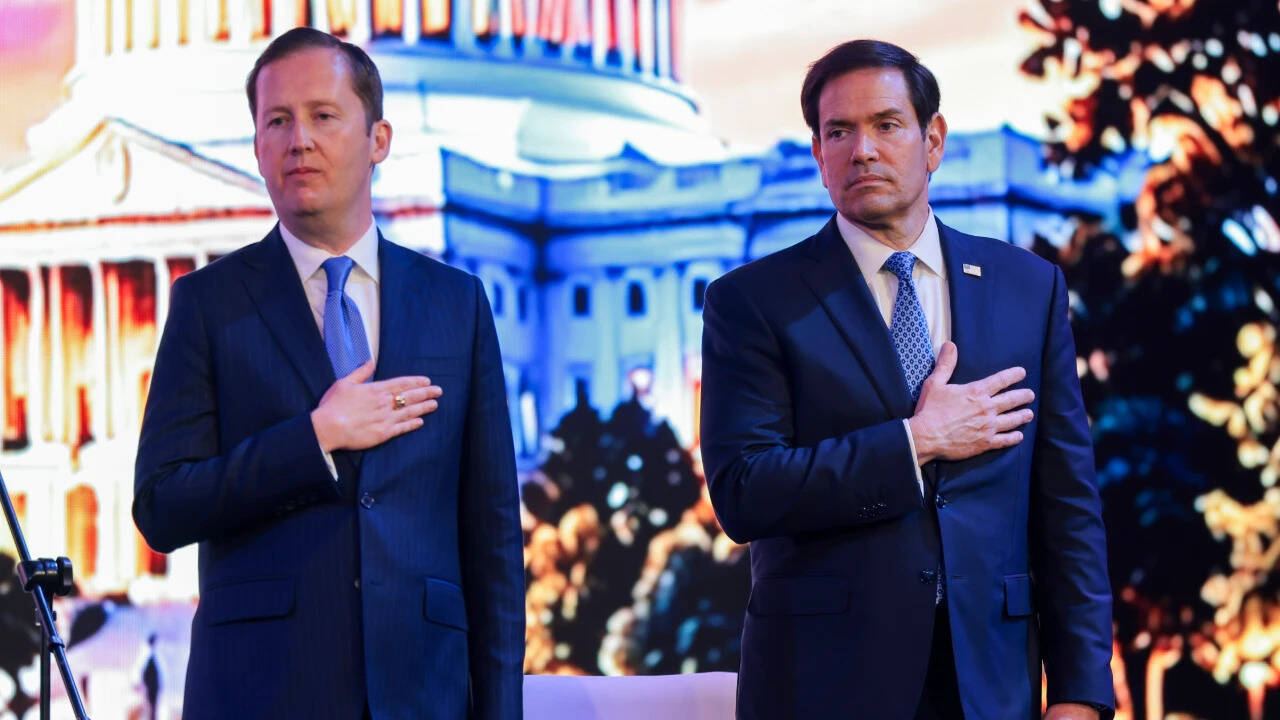
Post-midterm cabinet reshuffles operate on a predictable political calculus where electoral friction forces executive branches to reallocate institutional authority from policy specialists to loyalty enforcers. Reports indicating that Sergio Gor, the United States Ambassador to India and former Director of the White House Presidential Personnel Office, could replace Marco Rubio as Secretary of State illustrate a classic principal-agent realignment within the second Trump administration. Rather than representing isolated personnel drama, this potential transition reflects a structural shift in how the executive branch manages foreign policy risk, Senate confirmation bottlenecks, and bilateral trade leverage following the November 2026 midterm elections.
The Structural Logic of Post-Midterm Cabinet Attrition
Historically, the two-year mark of a presidential term triggers a systematic purge or reassignment of initial cabinet appointees. During the first twenty-four months of an administration, principals select cabinet heads to satisfy two competing constraints: passing Senate confirmation and placating ideological factions within the governing coalition. Marco Rubio’s appointment as Secretary of State in early 2025 satisfied both criteria. As a former senior member of the Senate Foreign Relations Committee, Rubio possessed the institutional credibility to secure rapid confirmation while signaling continuity to traditional defense hawks.
Midterm elections alter this optimization equation. Once the legislative calendar shifts toward the final two years of a term, the White House prioritizes ideological cohesion and rapid execution over legislative coalition-building. Traditional foreign policy institutionalists often generate friction with transactional executive directives, particularly regarding tariff regimes, alliance burden-sharing, and unilateral sanctions. When electoral outcomes tighten congressional margins or expose domestic political vulnerabilities, the executive branch typically absorbs policy dissent by replacing outward-facing diplomats with internal operatives whose primary competency is administrative obedience.
The Principal-Agent Friction at the State Department
In organizational economics, the principal-agent problem occurs when an executive (the principal) delegates authority to a department head (the agent) whose professional incentives diverge from the principal's immediate political objectives. At the Department of State, this divergence is acute. A sitting Secretary of State must manage a career bureaucracy steeped in multilateral doctrine while simultaneously maintaining personal political viability for future electoral cycles.
- Institutional Inertia: Career Foreign Service Officers operate under established diplomatic protocols that resist abrupt shifts in bilateral posture, forcing the Secretary to mediate between bureaucratic process and White House demands.
- Electoral Optionality: High-profile politicians holding cabinet posts retain independent political brands, creating subtle incentives to distance themselves from unpopular executive actions ahead of subsequent presidential primary cycles.
- Operational Latency: Traditional diplomatic clearance processes introduce delays that clash with an executive style predicated on immediate leverage and public concessions.
Replacing a career politician like Rubio with an internal loyalist like Gor eliminates the second variable entirely and aggressively compresses the third. An operative without an independent electoral base derives 100 percent of their institutional power from proximity to the president, aligning the agent's survival directly with the principal's immediate preferences.
Evaluating the Sergio Gor Operational Profile
Understanding why Sergio Gor emerges as a viable successor requires examining his functional trajectory rather than his traditional diplomatic credentials. Prior to his deployment to New Delhi as Ambassador to India, Gor served as the architect of the administration's vetting and personnel apparatus at the Presidential Personnel Office (PPO). In modern executive governance, control over personnel vetting is the primary mechanism for enforcing ideological compliance across federal agencies.
Gor’s transfer from the PPO to the ambassadorship in India followed a distinct operational logic. Washington’s bilateral relationship with New Delhi represents one of the most complex intersections of trade friction, supply chain decoupling from China, and defense technology transfer. Placing a trusted political enforcer in New Delhi bypassed traditional diplomatic intermediaries, allowing the White House to conduct high-stakes negotiations through a direct backchannel.
- Vetting as Governance: Managing the PPO required evaluating thousands of appointees based on strict loyalty metrics, demonstrating an intimate familiarity with the administration's internal power map.
- Direct Principal Access: Years of close operational proximity to the president eliminate the translation errors that frequently occur when career diplomats interpret executive intent.
- Bilateral Stress-Testing: Serving as envoy to a major strategic partner provided Gor with frontline exposure to tariff negotiations, visa disputes, and regional security frameworks without requiring decades of prior Foggy Bottom tenure.
Elevated to Secretary of State, Gor would function less as a conventional chief diplomat and more as an executive chief of staff overseeing foreign ministries. Under this model, the State Department shifts from a policy-formulation engine to an implementation arm of the National Security Council and the Oval Office.
The India-US Bilateral Nexus as a Proving Ground
The geopolitical weight of the New Delhi posting cannot be separated from the succession rumor. Between 2025 and late 2026, US-India relations entered a phase of acute transactional stress. While both nations share strategic alignment regarding maritime security in the Indo-Pacific, bilateral friction escalated over reciprocal tariffs, market access for American agricultural and technology sectors, and India’s continued procurement of discounted Russian energy and defense hardware.
Managing this portfolio required an envoy willing to apply direct economic pressure without destabilizing the broader Quad security architecture. If the White House views Gor’s handling of New Delhi as a successful template for extracting bilateral concessions while maintaining strategic alignment, replicating that model across the entire State Department becomes a logical administrative step.
Trade Leverage Over Multilateral Consensus
A Gor-led State Department would formalize the subordination of traditional diplomacy to trade and industrial policy. Under Rubio, the department maintained a dual track: supporting the White House’s tariff threats while reassuring European and Asian allies of enduring security commitments. An internal loyalist at the helm removes that dual track. Foreign ministries in Brussels, Tokyo, and Seoul would face a unified front where security guarantees, foreign aid, and diplomatic recognition are explicitly tied to trade balance adjustments and domestic investment commitments in the United States.
Confirmation Mechanics and Institutional Constraints
Any hypothetical transition from Rubio to Gor confronts hard procedural barriers governed by the Appointments Clause of the US Constitution and the Senate rules following the November 2026 elections. Analyzing this scenario requires separating executive desire from legislative feasibility.
The Senate Math Bottleneck
Assuming Rubio departs—either voluntarily to prepare for future political positioning or via executive reassignment—Gor would require confirmation by a simple majority in the newly constituted Senate. The composition of the 120th Congress, taking office in January 2027, dictates the viability of this nomination.
- Narrow Majority Vulnerability: If the ruling party holds a slim margin in the Senate, even two or three institutionalist holdouts on the Foreign Relations Committee can stall a nomination, forcing an arduous floor vote.
- Credential Scrutiny: Unlike Rubio, who sailed through confirmation due to senatorial courtesy and committee seniority, Gor would face intense scrutiny regarding his lack of broad regional expertise beyond South Asia and his prior role in purging career civil servants.
- The Acting Capacity Workaround: Under the Federal Vacancies Reform Act of 1998, the president can designate an existing Senate-confirmed official—which includes a confirmed ambassador like Gor—to serve as Acting Secretary of State for a temporary statutory window (typically 210 days, extended if a nomination is pending).
This statutory mechanism provides the White House with an immediate operational bypass. Even if full Senate confirmation appears fraught, installing Gor in an acting capacity allows the executive branch to execute a rapid leadership transition at Foggy Bottom during the critical post-midterm window.
Geopolitical Repercussions of a Loyalist Transition
Allied and adversarial capitals continuously model the internal power dynamics of Washington to calibrate their own diplomatic risk. A transition from Marco Rubio to Sergio Gor sends distinct signals to different geopolitical actors, altering negotiation baselines immediately upon confirmation or acting appointment.
Impact on Adversarial Deterrence
Rubio’s tenure projected a specific deterrence profile toward Beijing, Tehran, and Moscow, rooted in traditional hawkishness and alliance solidarity. Adversaries understood that Rubio favored robust forward military postures and strict sanctions enforcement. Replacing him with an operative whose primary mandate is executing transactional executive deals introduces ambiguity into deterrence calculations.
Beijing, in particular, would interpret the move as an opening to compartmentalize security disputes—such as Taiwan Strait tensions or South China Sea freedom of navigation operations—within broader bilateral trade negotiations. Adversaries generally prefer dealing with transactional enforcers over ideological hawks because transactional frameworks assume every geopolitical position carries a negotiable price.
Allied Hedging Behaviors
Conversely, treaty allies in Europe and the Indo-Pacific react to the removal of institutionalist cabinet members by accelerating hedging strategies. When Washington replaces a known quantity like Rubio with an internal political operative, foreign ministries recognize that informal backchannels to the White House now supersede formal diplomatic protocols.
- Bypassing Embassies: Foreign ambassadors in Washington will shift lobbying budgets away from State Department regional bureaus and directly toward White House political advisors and economic counselors.
- Strategic Autonomy Acceleration: European capitals will face renewed domestic pressure to formalize independent defense procurement mechanisms, anticipating sharper demands regarding NATO defense spending thresholds.
- Bilateral Deal-Making: Asian allies will seek direct bilateral trade and security compacts with the Oval Office rather than relying on multilateral frameworks negotiated through State Department intermediaries.
Analytical Limitations and Information Asymmetries
Evaluating post-midterm cabinet rumors requires strict epistemic discipline. Media reports citing unnamed administration sources regarding personnel changes serve multiple strategic functions in Washington, and treating them as inevitable outcomes introduces severe analytical error.
First, succession leaks frequently operate as trial balloons floated by competing factions within the West Wing to gauge Senate resistance or test public market reactions. Second, rumors of replacement are routinely deployed as internal disciplinary tools to signal dissatisfaction with a cabinet secretary's current alignment without incurring the immediate political cost of a firing. Third, cabinet members themselves occasionally allow departure narratives to circulate to facilitate a graceful exit toward private-sector compensation or preparations for the 2028 presidential cycle.
Without formal resignation filings or official White House nomination transmissions to the Senate, any projection of a Rubio-to-Gor transition remains probabilistic rather than deterministic. The underlying structural pressures—post-midterm executive consolidation, friction between traditional diplomacy and transactional trade policy, and the premium placed on personal loyalty—are concrete realities, regardless of whether Gor specifically occupies the seventh-floor office at the Harry S. Truman Building.
Strategic Positioning for Diplomatic and Corporate Stakeholders
Organizations, foreign missions, and multinational enterprises exposed to US foreign policy shifts must adjust their operational posture immediately to account for this structural trajectory, independent of the specific individual holding the title of Secretary of State.
- Audit Institutional Dependencies: Map all current regulatory approvals, export licenses, and bilateral trade contingencies that rely solely on State Department bureau clearances, identifying single points of failure if leadership shifts toward transactional enforcement.
- Reallocate Government Relations Capital: Shift engagement resources from traditional diplomatic regional desks toward the White House National Economic Council, the Office of the United States Trade Representative, and senior presidential personnel advisors.
- Model Tariff-Security Linkages: Stress-test international supply chains against scenarios where US diplomatic support or sanctions waivers are explicitly conditioned on immediate domestic manufacturing investments or bilateral trade deficit reductions.
- Monitor Vacancies Act Timelines: Track Senate Foreign Relations Committee schedules in early 2027 to anticipate whether the administration will utilize temporary acting appointments to bypass prolonged confirmation battles.