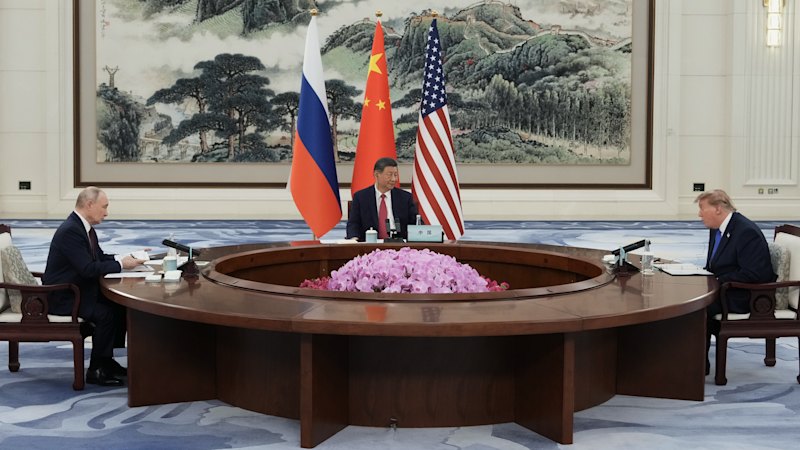
One photograph did more heavy lifting in Shenzhen than a decade of Chinese white papers.
On November 19, 2026, Chinese President Xi Jinping sat squarely in the center of a massive wooden table at Kylin Villa. Flanking him on either side were U.S. President Donald Trump and Russian President Vladimir Putin. If you look at the diplomatic choreography alone, you already know who won the room. Xi wasn't just hosting a sideline meeting at the Asia-Pacific Economic Cooperation (APEC) summit. He was visually casting Beijing as the indispensable center of gravity in global politics, with Washington and Moscow reduced to regional peers sitting at his elbows.
Most Western coverage immediately split into two predictable camps. One side panicked about a "Yalta 2.0" carving up the globe into authoritarian spheres of influence. The other brushed the whole afternoon off as empty theater because the leaders walked away without signing a peace deal on Ukraine or Iran.
Both takes miss the point. In modern statecraft, the spectacle is the substance.
Why the Shenzhen Seating Chart Mattered More Than the Paperwork
Diplomacy runs on symbols before it ever runs on treaties. When the White House and Beijing released their matching texts—titled the U.S.-Russia-China Heads of State Declaration toward Peace in Washington and the China-Russia-U.S. Heads of State Declaration Toward Peace in Beijing—the actual policy commitments were intentionally vague.
There was no enforcement mechanism. There was no timetable. There wasn't even a passing mention of Russia's ongoing war in Ukraine, even as European leaders gathered separately in Berlin to discuss air defenses and security guarantees for Kyiv.
Yet handing Xi Jinping that visual frame—sitting between the leaders of the United States and Russia on Chinese soil—gave Beijing an instant propaganda asset across the Global South. For years, Xi has pitched a multipolar order where American dominance fades and nations operate under Beijing's framework of "mutual respect" and "non-interference". Until November 2026, that pitch sounded like aspirational branding from Beijing. By showing up in Shenzhen and posing for the cameras, Trump turned Xi's talking point into a visual reality.
I've watched international summits get dissected for years, and pundits almost always over-index on binding legal text while ignoring psychological momentum. A non-binding political declaration doesn't change international law overnight, as legal scholars have pointed out regarding the Shenzhen text. What it does change is how middle powers in Southeast Asia, Latin America, and the Middle East hedge their bets. When smaller nations see Washington validating a three-power directorate in Shenzhen, they stop assuming the old rules-based order will protect them.
Inside the Four-Point Declaration Toward Peace
If you actually read the four bullet points agreed upon at Kylin Villa, a clear pattern emerges. Every single clause serves a specific domestic or geopolitical irritant shared by Beijing and Moscow, with Washington signing off to project deal-making momentum.
Reforming the United Nations on Great-Power Terms
The three leaders pledged to reform the UN so it conforms to its original mission of international peace and security. Notice the framing. Rather than expanding decision-making to give smaller democracies a louder voice, the declaration centers authority squarely on the permanent members of the UN Security Council. Putin even emphasized in his opening remarks that the three countries share a "special responsibility" as founding members. That phrasing quietly sidelines Europe and middle powers from shaping institutional updates.
Boosting Refined Petroleum Supplies
The second point commits the trio to increasing the production and supply of refined petroleum products "for the benefit of all nations". On paper, it sounds like routine energy stabilization. In practice, it normalizes Russia's reintegration into global energy discussions despite ongoing Western sanctions, while aligning with Trump's domestic focus on keeping fuel prices low.
Kneecapping International Courts
This is the clause that should alarm legal observers most. All three heads of state declared that "state consent and respect for immunities of State officials are of paramount importance," warning that the International Criminal Court (ICC) and similar bodies must not "abuse their jurisdiction".
Think about what just happened there. The ICC has an active arrest warrant for Vladimir Putin. By signing onto language attacking international judicial reach, the United States publicly aligned itself with Moscow and Beijing against multilateral accountability mechanisms. You don't need a formal alliance to dismantle global norms; you just need the world's top powers to agree that nobody gets to judge them.
Nuclear Risk Dialogue Without Arms Control
Finally, the leaders reaffirmed the classic Reagan-Gorbachev line that "a nuclear war cannot be won and must never be fought," promising dialogue on reducing nuclear risks. Arms control experts at the Council on Foreign Relations quickly noted the catch. "Reducing nuclear risks" is miles away from verifiable arms control. China has rapidly expanded its nuclear arsenal while refusing binding caps, and nothing in Shenzhen forces Beijing to freeze warhead production.
What Each Leader Actually Walked Away With
To understand why this summit happened now—just weeks after U.S. midterm elections and two months after Xi's September state visit to Washington—you have to look at the asymmetric payoffs.
- Xi Jinping got strategic validation. Beijing has spent a decade trying to get Washington to accept its formula of "major-country relations" built on coexistence rather than systemic rivalry. By hosting both Trump and Putin, Xi demonstrated that global governance now runs through China. Better yet, he bought breathing room ahead of the January 10, 2027 expiration of the U.S.-China trade truce.
- Vladimir Putin got instant rehabilitation. Partially isolated since the 2022 invasion of Ukraine, Putin sat as an equal next to the American and Chinese presidents. He didn't have to concede a single square kilometer of Ukrainian territory to earn that seat. Simply being in the room shattered the Western narrative that Russia is a diplomatic pariah.
- Donald Trump got headlines and personal rapport. Trump thrives on high-stakes, leader-to-leader theater, calling the engagement a departure from "the old school refusing to talk". With the G20 summit scheduled for December 14–15 at his Doral resort in Miami, Trump wants both Xi and Putin to show up on his turf next. Shenzhen was the down payment for Miami.
Europe and Middle Powers Are the Real Casualties
While Washington, Beijing, and Moscow traded pleasantries in southern China, America's traditional allies were left staring at a cold reality.
Europe wasn't invited to Kylin Villa. Neither was Japan, South Korea, or Australia. For decades, U.S. foreign policy rested on working through democratic alliances to balance authoritarian rivals. Shenzhen flipped that model on its head. It signaled that when the big three want to discuss energy, nuclear stability, or UN reform, middle powers are spectators rather than stakeholders.
That shift carries immediate consequences for defense planning and trade. If allies in Berlin, Tokyo, or Seoul suspect Washington is more interested in cutting bilateral deals with Beijing and Moscow than underwriting collective security, they face tough choices. Some will accelerate regional defense pacts independent of Washington—much like how the EU had to activate crisis-monitoring under its Chips Act in September 2026 after Chinese export controls on gallium and germanium sent European spot prices tripling. Others may quietly rethink non-proliferation assumptions if the American nuclear umbrella looks transactional.
How to Read Geopolitical Summits Without Getting Played
When major powers stage high-profile summits, the official press releases are designed to distract you from the underlying power shifts. Next time world leaders gather for a "historic" photo op, use a sharper filter to separate theater from reality:
- Check who isn't in the room. The guest list tells you more than the agenda. When affected nations—like Ukraine during talks about global peace—are excluded, the summit isn't about solving conflicts; it's about establishing hierarchy.
- Watch the clock on trade deadlines. Diplomatic smiles rarely survive tariff cliffs. Keep your eye on January 10, 2027, when the current U.S.-China trade truce expires, and watch whether December's G20 meeting in Miami produces actual tariff relief or just another round of flattery.
- Track supply chains, not speeches. Ignore vows of "mutually beneficial cooperation" and watch export licenses on critical minerals like gallium, germanium, and rare earths alongside U.S. enforcement of AI semiconductor controls. That is where the real leverage lives.
- Distinguish political declarations from treaties. Unless a document includes ratification steps, verification protocols, or dispute-resolution rules, treat it as a temporary mood ring rather than a binding shift in policy.
Watch what happens in Miami next month, and keep a close eye on how China's vision for a new world order continues to shape its long-term diplomacy. This video provides helpful background on Xi Jinping's broader strategic ambitions and how Beijing frames its push to reshape international norms alongside Washington.