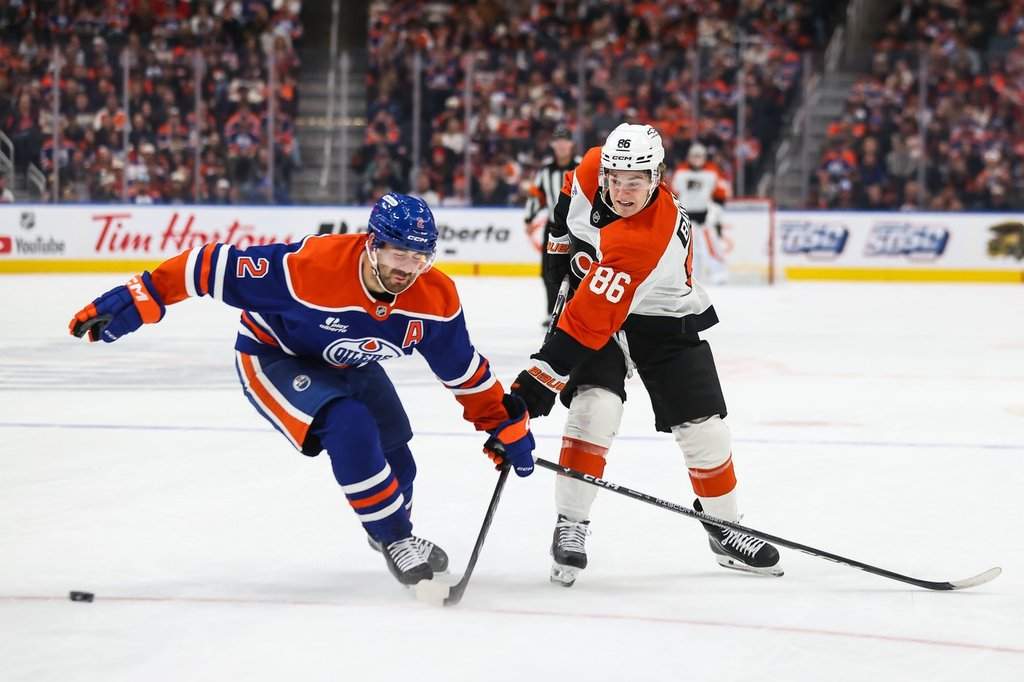
Evan Bouchard scored the overtime winner to lift the Edmonton Oilers to a 3-2 victory over the Philadelphia Flyers, capping a tight contest defined by structural discipline and sudden-death execution. While the box score records a single-goal margin, the underlying mechanics of the game tell a much deeper story about how elite offensive defensemen manipulate three-on-three space and how a rebuilding Philadelphia squad nearly suffocated one of the NHL's most explosive offenses.
Most post-game recaps treat a 3-2 overtime finish as a coin flip. They point to the final shot, praise the goaltenders, and move on to the next stop on the road trip. That surface-level reading misses the tactical chess match that unfolded across sixty-plus minutes of hockey. Edmonton did not simply out-talent Philadelphia. They survived a deliberate, low-event trap before exploiting the exact structural vulnerability that three-on-three overtime creates for aggressive, man-to-man defensive systems.
The Anatomy of a Three-on-Three Breakdown
Three-on-three overtime is not hockey. It is a possession-based spatial exercise disguised as an extra period. When Evan Bouchard stepped onto the ice in the extra frame, the fundamental rules of defensive zone coverage had already shifted from protecting the house to surviving isolated one-on-one matchups across two hundred feet of open ice.
Philadelphia spent three full periods denying Edmonton speed through the neutral zone. The Flyers clogged the middle, forced dump-ins, and leaned heavily on stick checks to disrupt the Oilers' transition game. At five-on-five, that blueprint works. Five skaters can layer their coverage, allowing a weak-side winger to collapse into the slot whenever a defenseman pinches down the wall.
Overtime removes that safety net entirely. With only three skaters per side, every defensive rotation requires an immediate, flawless handoff. If a forward chases a puck carrier above the faceoff circles, nobody is left to protect the back door.
Bouchard understands this geometry better than almost any blueliner in the league. Rather than rushing the puck into traffic, he uses patience at the offensive blue line to force defenders into premature commitments. Against Philadelphia, the sequence leading to the winning goal relied on classic three-on-three deception. By holding the puck just long enough to draw a Flyer defender out of his shooting lane, Bouchard created a passing angle that did not exist two seconds earlier, then stepped into open ice to finish the play himself.
Why Defensemen Dictate Sudden Death
For decades, coaches deployed three forwards in overtime to maximize scoring punch. That trend died quickly once analytics departments tracked possession rates off the opening faceoff. Losing a draw without a natural defender on the ice almost always results in a sixty-second defensive scramble that leaves elite scorers too exhausted to counterattack.
Modern overtime systems run through mobile defensemen who possess three specific traits:
- Deceptive edge work that allows them to escape forecheck pressure without surrendering the red line.
- Heavy, accurate release mechanics capable of beating a screened goaltender from the top of the circle without needing a windup.
- Spatial discipline to know when to retreat into their own zone to reset a line change rather than forcing a low-percentage shot into shin pads.
Bouchard checks every box. His shot velocity forces penalty killers and overtime defenders alike to respect the point, which naturally widens the passing lanes for Edmonton's forwards. When opponents overplay his shot, he slips pucks down low. When they sag back to protect the crease, he walks into the high slot and fires. Philadelphia gave him half a step of daylight, and the game ended instantly.
How Philadelphia Nearly Solved Edmonton at Five-on-Five
To appreciate why Bouchard's overtime heroics mattered so much, you have to examine why Edmonton struggled to generate clean looks during regulation. The Flyers entered the matchup with a clear mandate to turn the game into a grind, and for sixty minutes, they largely succeeded.
Philadelphia's coaching staff recognized a basic truth about playing the Oilers. If you trade rush chances with Edmonton, you lose by four goals. Their top-end speed through the middle of the ice punishes any team that turns the puck over between the blue lines. To neutralize that threat, the Flyers implemented a structured 1-2-2 forecheck that prioritized positional integrity over heavy hits.
Instead of sending two forecheckers deep below the goal line—a move that invites Edmonton's defensemen to fire stretch passes to streaking wingers—Philadelphia kept its third forward high in the neutral zone. That F3 acted as a permanent safety valve. Whenever Edmonton broke the initial pressure, they ran directly into a wall of sticks at their own blue line.
The Hidden Cost of Neutral Zone Traps
Playing a disciplined, low-event road game requires immense mental stamina, and it carries a built-in offensive penalty. By keeping their third forward high to prevent Edmonton's counterattacks, the Flyers sacrificed sustained cycle time in the offensive zone. Their two goals came from capitalizing on rare defensive lapses and winning dirty battles near the crease rather than sustained territorial dominance.
This creates a razor-thin margin for error. When you commit to winning a 2-1 or 3-2 game against a high-powered offense, a single neutral-zone turnover or a blown coverage assignment erases forty minutes of hard work. Philadelphia executed their system nearly to perfection, frustrating Edmonton's top forwards and forcing them to play along the perimeter where dangerous shots rarely materialize.
Yet the Flyers could not close the door in regulation. Part of that comes down to Edmonton's sheer persistence, while the rest reflects the physical toll of chasing stars around the rink for three periods. Defending takes more energy than attacking, and by the time the buzzer sounded to end the third period, Philadelphia's legs were noticeably heavier than they were in the first.
The Evolution of Evan Bouchard's Two-Way Game
Early in his NHL career, Evan Bouchard carried a reputation familiar to countless offensive defensemen. Critics praised his cannon of a slap shot and his ability to quarterback a power play, while questioning his urgency in his own end of the rink. Scouts wondered if he could survive heavy playoff forechecks without needing sheltered minutes.
Those doubts look increasingly outdated. Bouchard's progression into a genuine number-one defenseman did not happen because he suddenly changed his identity. He still thrives on moving the puck north and joining the rush. What changed is his efficiency without the puck.
Subtle Adjustments in Defensive Positioning
Watch Bouchard closely during a defensive zone shift now compared to three seasons ago, and the differences jump off the screen:
- Stick placement on entry. He uses an active stick to steer opposing wingers toward the boards early, cutting off cutback lanes before the attacker reaches the faceoff dot.
- Box-out timing. Instead of wrestling bigger forwards after a shot is taken, he establishes inside body position early, clearing sightlines for his goaltender.
- First-touch exits. Rather than absorbing a hit to make a risky pass up the middle, he uses the glass or soft chip plays to clear the zone when outnumbered.
None of these habits show up on a highlight reel. You will not see a clip of a clean defensive-zone box-out trending on social media after a 3-2 win. Yet those routine plays are the exact reason Edmonton's coaching staff trusts Bouchard on the ice in the final minute of a tied game and at the start of overtime. You cannot score the sudden-death winner if you are sitting on the bench because the coach worries about your defensive reliability.
Goaltending Under Low-Volume Pressure
A 3-2 final score naturally draws attention to the crease, though the challenges facing both goaltenders in this specific matchup differed wildly from a typical track-meet hockey game. Neither netminder faced a barrage of forty-plus shots. Instead, both dealt with long stretches of inactivity punctuated by sudden, high-danger breakdowns.
Goaltenders universally hate low-shot games. When you face fifteen shots in a period, you stay locked into the rhythm of the puck, tracking deflections and controlling rebounds naturally. When you go seven minutes without touching the rubber, your focus drifts, your muscles cool down, and the first shot you finally see is usually a backdoor tap-in or a clean breakaway off a turnover.
Both goaltenders delivered sharp performances under difficult psychological conditions. Edmonton's starter had to stay sharp while his team controlled large stretches of territorial possession without breaking through on the scoreboard. Philadelphia's netminder faced the opposite problem, absorbing waves of perimeter pressure while bracing for the inevitable cross-seam pass that Edmonton's forwards hunt on every shift.
In overtime, goaltending mechanics change completely. With shooters walking into the slot uncontested, pure reaction speed gives way to depth management and aggressive crease positioning. When Bouchard wound up for the winner, the Flyer goaltender had to respect the passing option to his backdoor before sliding across to square up to the shot. That split-second hesitation is all an NHL shooter needs to find open twine.
What This Result Means for Both Franchises
A single regular-season game in November or March rarely alters the trajectory of a franchise, yet the contrasting styles on display in Edmonton's 3-2 victory highlight where both organizations stand in their competitive cycles.
For the Flyers, taking a point on the road against a perennial Stanley Cup contender validates their structural rebuild. Under demanding coaching, Philadelphia has stripped away the loose, pond-hockey habits that plagued the franchise for years. They compete hard, adhere to strict positional rules, and refuse to beat themselves. However, the overtime loss also exposes their glaring roster limitation. You can coach structure, effort, and defensive buy-in, but you cannot coach elite finishing talent. Until Philadelphia adds game-breaking skill to complement their blue-collar work ethic, they will continue to lose tight games against rosters with superior top-end firepower.
For the Oilers, banking two points in a game where their offensive engine sputtered for long stretches represents a critical sign of maturity. Championship teams do not win eighty-two games by blowing opponents out 6-2 every night. They win by staying patient when a trapping opponent clogs the neutral zone, trusting their defensive structure to keep the game within reach, and relying on their stars to capitalize when the ice finally opens up.
Edmonton did not play its cleanest game against Philadelphia, and their power play failed to break the contest open during regulation. None of that mattered once the extra frame began. When the game stripped away the traffic and left three skaters per side, Evan Bouchard stepped into the open space and ended the night with one swing of his stick.


